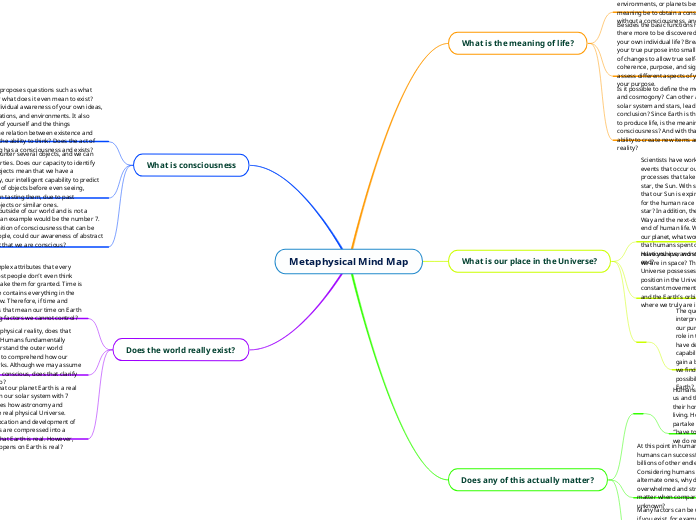
If the meaning, purpose, or reasoning for human life has not been clarified after approximately 6 million years, could the only intent be to exist and have a consciousness? Consciousness means to be aware of one’s surroundings will existence means the state of living or possessing objective reality. Have you ever thought of what we do for other species, environments, or planets besides our very own? Could our meaning be to obtain a consciousness as there is no life without a consciousness, and no consciousness without life?
Besides the basic functions humans undergo for survival, is there more to be discovered in order to find the meaning of your own individual life? Breaking down the steps to discover your true purpose into smaller pieces, may require a multitude of changes to allow true self-identity to be explored. Analyzing coherence, purpose, and significance are helpful ways to assess different aspects of your life and lead you to finding your purpose.
Is it possible to define the meaning of life will using cosmology and cosmogony? Can other aspects of our lives, such as the solar system and stars, lead us to a complementary conclusion? Since Earth is the only planet out of billions known to produce life, is the meaning of life as simple as having a consciousness? And with that consciousness, employing our ability to create new items and generate new ideas into reality?
Scientists have worked for years to detect the time and date of events that occur outside of planet Earth. As we know, the daily processes that take place and human life rely on one single star, the Sun. With scientific evidence leading to the concept that our Sun is expiring in 5 billion years, what does that mean for the human race that depends on this bright incandescent star? In addition, the theory of the collision between the Milky Way and the next-door Andromeda galaxy would result in an end of human life. With possible and uncontrollable endings to our planet, what would our purpose have been for the time that humans spent on Earth? Did we learn to survive, build relationships, and stabilize an entire nation, just for it to all end?
Have you ever wondered just how big the Universe is, or where we are in space? The lack of discovery about the unknown Universe possesses a grand scale of questions about our position in the Universes ultimate order and structure. With the constant movement of tectonic plates, the rotation of the Earth and the Earth’s orbit around the sun, how do we determine where we truly are in the endless Universe?
The quest to understand our place in the Universe can be interpreted both as a species or as individuals. The pursuit of our purpose has caused many adjustments in our view of our role in the galaxy as a multitude of astronomical discoveries have developed. With new technology arising, we have the capability to observe deeper and further into the Universe to gain a better understanding. With the ability to do so, what will we find? Will we comprehend our purpose, or is there a possibility we already know our reasoning for being on planet Earth?
Humans devote plenty of time to things that are important to us and that we care about. For example, teenagers stress over their homework and adults put effort into their jobs to make a living. However, how do we understand if the actions we partake in actually matter? Although we might feel like we “have to” do something, why would we worry about it if nothing we do really matters?
At this point in humanity, Earth is the only place known where humans can successfully survive. With that, there are also billions of other endless stars and galaxies without human life. Considering humans live on one tiny planet out of the endless alternate ones, why do we let little problems cause us to feel overwhelmed and stressed? Do these small issues actually matter when comparing our position on Earth to the rest of the unknown?
Many factors can be used to determine if you are conscious or if you exist, for example, how do you know you’re not dreaming when you believe an event is truly happening? However, even if we are conscious and we do exist, do these concepts even matter? What can these circumstances do to allow our daily processes to actually be important? To analyze, existing and having a consciousness allows us to think, however, why do we need to think? Is the act of thinking, or the other attributes to our lives that existence and consciousness give us, seriously meaningful?
The concept of existence proposes questions such as what does one know as true, or what does it even mean to exist? Consciousness is your individual awareness of your own ideas, memories, feelings, sensations, and environments. It also includes your awareness of yourself and the things surrounding you. Could the relation between existence and consciousness simply be the ability to think? Does the act of thinking imply that a being has a consciousness and exists?
In our daily lives, we encounter several objects, and we can observe their basic properties. Does our capacity to identify and interact with these objects mean that we have a consciousness? Especially, our intelligent capability to predict or understand properties of objects before even seeing, touching, smelling, or even tasting them, due to past interactions with those objects or similar ones.
An abstract object exists outside of our world and is not a physical or mental entity, an example would be the number 7. Although there is no definition of consciousness that can be agreed upon by many people, could our awareness of abstract objects represent the fact that we are conscious?
Space and time are two very complex attributes that every human being gains, however, most people don’t even think about what they truly mean and take them for granted. Time is theoretically limitless while space contains everything in the universe and more for all we know. Therefore, if time and space are basically endless, does that mean our time on Earth will never end without considering factors we cannot control?
If existing means to interact with physical reality, does that mean our world has to exist too? Humans fundamentally depend on scientific data to understand the outer world around us, therefore, allowing us to comprehend how our existence and consciousness works. Although we may assume and identify that we exist and are conscious, does that clarify that the world we live in is real too?
Multiple scientists have proven that our planet Earth is a real physical object that participates in our solar system with 7 other planets. Cosmology identifies how astronomy and physics relate to comprehend the real physical Universe. Cosmogony is the theory of the location and development of our Universe. When both subjects are compressed into a whole, it leads to the conclusion that Earth is real. However, does this mean what exists or happens on Earth is real?