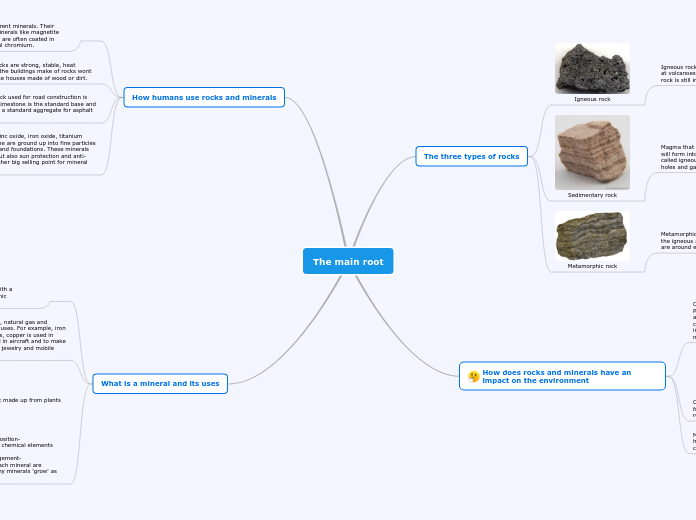
The main root
The three types of rocks
Igneous rock
Igneous rocks form when magma cools and crystallizes, either at volcanoes on the surface of the Earth or while the melted rock is still inside the crust.
Sedimentary rock
Magma that cools very slowly
will form into a volcanic rock,
called igneous rock, with tiny
holes and gas bubbles.
Metamorphic rock
Metamorphic rock is formed when
the igneous and sedimentary rock
are around extreme heat or pressure.
How does rocks and minerals have an impact on the environment
Canada's mining industry is one of the largest in the world. Producing more than 60 metals and minerals, Canada is among the top five worldwide producers of 14 different commodity metals and minerals. In 2018, Canada’s mining industry contributed $97 billion, or 5%, to Canada’s total nominal GDP.
Certain minerals directly cause environmental hazards ranging from air and water pollution to contamination within residential communities.
Mineral contamination effects include causing disease in humans and wildlife, befouling wilderness and streams, and contributing to global warming.
How humans use rocks and minerals
[Cars] - Cars are made from many different minerals. Their steel body is made from the iron-rich minerals like magnetite and hematite. Door handles and badges are often coated in chromium which comes from the mineral chromium.
[building materials] - the rocks are strong, stable, heat resistance, waterproof, and the buildings make of rocks wont fall down by the wind - unlike houses made of wood or dirt.
[Roads] - The majority of rock used for road construction is either limestone or gravel. Limestone is the standard base and sub grade stone, and is also a standard aggregate for asphalt batching.
[cosmetics] - Minerals like zinc oxide, iron oxide, titanium dioxide, mica and ultramarine are ground up into fine particles and used to make powders and foundations. These minerals provide not only pigment, but also sun protection and anti-inflammatory effects. The other big selling point for mineral makeup is purity.
What is a mineral and its uses
A mineral is a naturally occurring inorganic solid, with a definite chemical composition, and an ordered atomic arrangement.
Energy minerals include metal, coal, oil, natural gas and uranium. Metals have a wide variety of uses. For example, iron is used in cars or for frames of buildings, copper is used in electrical wiring, and aluminium is used in aircraft and to make drink cans. Precious metals are used in jewelry and mobile phones.
Minerals are naturally occurring-
They are not made by humans
Minerals are inorganic-
They have never been alive and are not made up from plants or animals
Minerals are solids-
They are not liquids, or gases.
Minerals have a definite chemical composition-
Each one is made of a particular mix of chemical elements
Minerals have an ordered atomic arrangement-
The chemical elements that make up each mineral are arranged in a particular way - this is why minerals 'grow' as crystals