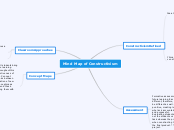
Mind Map of Constructivism
Constructivism Defined
Idea that you can not learn from scratch
constructivism is a theory of learning based upon the idea that individuals construct their own knowledge and understanding of the world through the interaction between experiences and the reflection upon those experiences
“Knowledge is not a commodity which is transported from one mind to another.” (Von Glasersfeld, 2010)
Yilmaz (2008) summarized the key ideas of constructivism which include the following:
Learning is an active process.
Learning is an adaptive activity.
Learning is situated in the context in which it occurs.
Knowledge is not innate, passively absorbed, or invented,but constructed by the learner.
All knowledge is personal and idiosyncratic.
All knowledge is socially constructed.
Learning is essentially a process of making sense of the world.
Experience and prior understanding play a role in learning.
Social interaction plays a role in learning.
Assessment
Formative assessment is key as it drives students` future learning. Each child`s experiences are different, therefore, their construction of knowledge will be different as well. Assessment should not be punitive, creating low self-esteem for those students who lack accountability, rather it needs to be effective and purposeful.
Evaluating students on content determines whether or not the student successfully completed an authentic task whereas the process a student goes through when constructing their knowledge is as important as the final product. ***** Focus for the research project.
Therefore evaluation should be an integrative piece which provides key opportunities for assessment
Classroom Approaches
However, successful use of constructivism relies heavily on careful, thoughtful planning that requires a great deal of teacher direction in the form a scaffolding in order to ensure student success (Hmelo-Sivler, Duncan & Chinn, 2007).
The key difference between traditional teaching approaches and constructivist approaches is that the former is teacher led, where the latter is student led.
Students are encouraged to develop and explore alternative explanations rather than just passively accept the teacher’s objective reality as fact (Kumar, 2011).
Concept Maps
Concept maps build on the idea that all students bring their own experiences and memories to learning. Hopefully you have been using one throughout this presentation and can attest to the effectiveness of using concept maps in the classroom. Concept mapping allows the learner to make links between concepts, while assisting in the integration of new knowledge with old. When creating concept maps students begin with a big idea and extend those thoughts into meaningful pieces, linking them with other concepts or classifications.