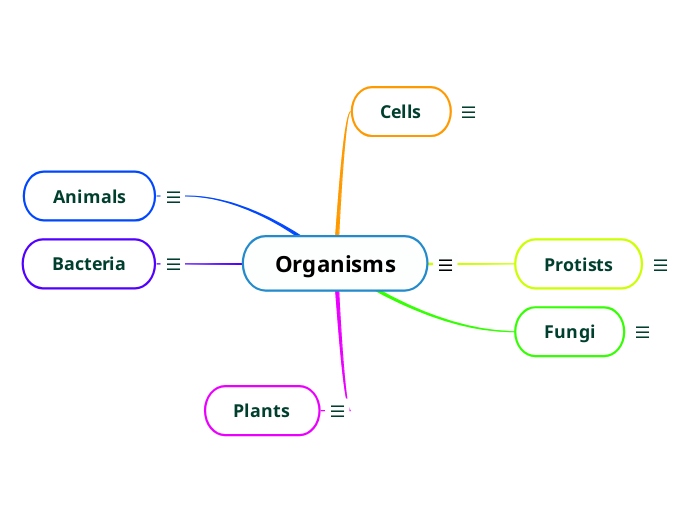
Organisms
A organism is a living thing made up of cells. They can be fungi, plants, animals and more.
Cells
Cells are the main unit of life. They make up every single living organism such as plants, animals, fungi, you get it. They are divided into two groups. Unicellular means a organism with only one type of cell. And multicellular is a organism with multiple cells. Some cells are bone cells, blood cells, white blood cells, and T-killer cells.
Protists
Protists are a type of organism that commonly live in moist surfaces such as inside water. They can be unicellular and multicellular. A famous type of protists are algae. And they cannot perform photosynthesis, thus they have to rely on their environment to survive.
Fungi
Fungi are a type of organism that uses decaying waste into energy to expand and clean more waste. Some can kill you while digested, and some can be used to cook and eat. Some of them are unicellular and some of them are multicellular. Some examples of fungi are fly agaric, cordyceps, and penny bun.
Animals
Animals are a type of organisms. They have characteristics such as being multicellular, having a classification system by having vertebrates and invertebrates. These give differences to each animal. Some animals are birds, dogs, cats, and fish.
Bacteria
Bacteria are unicellular, they are mostly the reason why you normally don't feel well. They usually stick in colonies and duplicate to invade a host. Normally defeated because of white blood cells protecting you. Bacteria also don't have a nucleus. Some examples of bacteria are salmonella, E. coli, and helicobacter.
Plants
Plants are multicellular organism. They can live on land and on water. Some examples of these plants are trees, bushes, grass. They create their own food from using the sun.