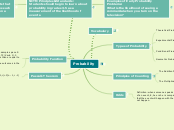
Probability

r

Definition of Probability: the mathematics of uncertainty, in which the likelihood that a chacne event occurs is measured by a number between 0 and 1 where 0 indicates that there is no chance of the event occurring and 1 indicates that the event must certainly occur.

Types of Probability

Theoretical Probability

Definition: Probability based on considerations

r

Theoretical Probability: a theoretical probability function, unlike an experimental probability function, does not depend on past experiments or statistical data, instead, the function is based on other assumptions.Most often, theoretical probability depends on assuming that each outcome of the sample space is equally likely in this case, we say have a uniform sample space.

Formula: (given equally likely outcomes in the SS)
P(E) = n (E) divided by n (S)

Experimental Probability

Definition: Probability that is estimated by the number of times an outcome has occurred in past trials, and is used to predict the likelihood that the outcome will occur in the future.

Formula
P(x) = number of times outcome x occurs divided by the number of trials of the experiment.

Conditional Proability

Definition: when the probability of one event depends on the outcome of another event.

Formula
P (E|F) = n (E or F) divided by n (F)

Geometric Probability

Definition: when it is assumed that each point in a region S is equally likely to be chosen.

Formula
P(E) = area (E) divided by area (S)

Principles of Counting

r

The Addition Principle of Counting: if E and F are mutually exclusive events in a sample space, then the number of outcomes favorable to either E or F is found by adding the number of outcomes in the events.The Multiplication Principle of Counting: A helpful way to view the outcome of an experiment or procedure as a result of a sequence of steps. We call this a multistage experiment or a multistep process. Since several events are considered along the way, this situation is called a compound event.

The Addition Principle of Counting

Formula
n (E or F) = n (E) + n (F)

The Multiplication Principle of Coutning

Formula
n sub 1 x n sub 2 ...

Odds

Definition: when someone speaks of the odds in favor of an event, E, he or she is comparing the likelihood that the event will happen with the likelihood that it will not happen.

Odds in Favor

Odds Against

Probability Function

Definition: a function defined on the sample space S so that each outcome has a value of P (X sub 1), 0 less than or equal to P (x sub 1) less than or equal to 1.

the sum of the probabilities of all the outcomes in the sample space is 1.

Pascal's Theorem

C (n, r) = C(n - 1,r) + C(n - 1, r - 1)

NCTM Principles & Standards: Students should begin to learn about probability in grades 3-5 as a measurement of the likelihood of events.

a

Examples of Early Probability Problems:
What is the likelihood of seeing a commercial when you turn on the television?

Students should learn about probability through experiments that only have a handful of outcomes such as using game spinners to land on a color, rolling a di, etc.

a

Vocabulary

r

Outcomes: a possible result of one trial of an experiment.Sample Space: the set of all outcomes of an experimentEvent: a subset of outcomes.Probability Function: an outcome, x, in event, E.Mutually Exclusive Events: events that have no outcomes in common.Complementary Events: The set of events not favorable to E is the complementary to E prime.Permutations: arrangements in ordered lists.Factorial: ordered arrangements such as 4 x 3 x 2 x 1 = 24 or 4!Permutation: an arrangement of a given number of objects from a specified set into an ordered list.Combination: a selection of a given number of objects from a set to form an unordered subset of the objects.Simulation: a method for determining answers to real problems by conducting experiments whose outcomes are analogous to the outcomes of the real problems.