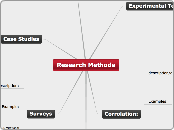
Research Methods
Experimental Techniques:
Definition/description:
1) study where investigator manipulates (at least) one variable + measuring (at least) one other variable.
2) method used in psychological research + can lead to answering cause-effect questions. + group that recieves tthe independent variable = experimental group.
Example:
(a) Testing effects of ritalin medication onattention spans of children with ADHD
(b) Examining reliability of eyewitness testimony in young children
Limitiations:
those involved in research can be biased + influenced by surroundings. + mistakes can be made + different persecptions of true ansers from experiment.
Strengths:
experimental method very valuable because researcher able to constrain/control situation+various variables. + actually get to test + trial before proving.
Corrolation:
description/definition:
measuring the relation between two variables.
Sometimes correlation studies seen as separate research method + other times it is subsumed under another category.
Examples:
2 types of corrolation: 1) positive corrolation where as one increases the other variable increase (vice versa) e.g. relationship betwee nprice of a good and the supply. 2) negative correclation: on variable increases, the pther decreases. e.g. price of the good and the demand for it.
Limitations:
can be decieving + finding the corrolation isnt the issue its finding all possible corroclations. + intervening variable may be present & affects results - unexpected. + constant confusion with cause.
Strengths:
helps identify relationships + can see links between two variables + can help make predictions
Natural observation
description/defoinition:
participants carefully observed in natural setting without researchers interference.
Example:
(a) an anthropologist unobtrusively observing wild
gorillas
(b) a researcher sitting in a fast food restaurant and
observing the eating habits of men vs. women
Limitations:
time consuming + sought-after behavior may never occur + no control over environment
strengths:
very clear + good if researcher wants participants to be reacting normally + reliable as in its natural setting +
Case Studies
Definitions/ descriptions:
obtaining detailed information about individual to develop general principles about behavior.
+ sometimes helpful to study one person in great depth to learn much information. method is particularly useful in studying rare disorders or circumstances.
Example:
a) studying the life history of a man who acquired
schizophrenia at the age of 20
b) following one child from conception to adulthood to
examine this specific lifespan development
Limitations:
require a lot of time,+ effot, +attention to detai + hard to generalize from single case + possible biase
Strengths:
reveal more about particular subject than other research method.+goes into depth in info + good method to challenge theorie + usually fully rounded.
Surveys
Definition/ description:
questioning large groups about beliefs + ideas. Based on questions +answers. requires representative sample + sample that reflects all major characteristics of population represented.
Example:
(a) survey of recent retired citizens on their major concerns
about life without work
(b) survey of first-time pregnant women on their beliefs about
their efficacy on being a mother
Limitations:
can take ages + wastes alot of time + need to target right sample (v. hard) + choices can be confusing + options can be limited + difficulty gaining in depth answers + no garuntee person being honest.
Strengths:
qucik + efficient + wide variety covered + diversity + not bias + shows different preferences + provokes ideas and thinking