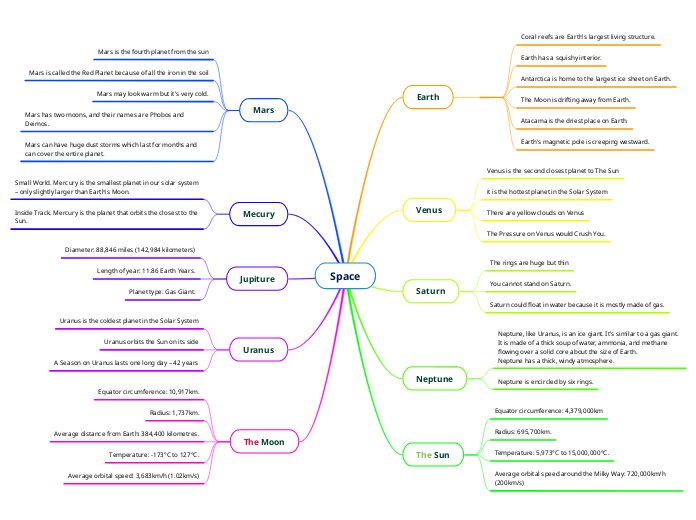
Coral reefs are Earth's largest living structure.
Earth has a squishy interior.
Antarctica is home to the largest ice sheet on Earth.
The Moon is drifting away from Earth.
Atacama is the driest place on Earth.
Earth's magnetic pole is creeping westward.
Venus is the second closest planet to The Sun
it is the hottest planet in the Solar System
There are yellow clouds on Venus
The Pressure on Venus would Crush You.
The rings are huge but thin
You cannot stand on Saturn.
Saturn could float in water because it is mostly made of gas.
Neptune, like Uranus, is an ice giant. It's similar to a gas giant. It is made of a thick soup of water, ammonia, and methane flowing over a solid core about the size of Earth.
Neptune has a thick, windy atmosphere.
Neptune is encircled by six rings.
Equator circumference: 4,379,000km
Radius: 695,700km.
Temperature: 5,973°C to 15,000,000°C.
Average orbital speed around the Milky Way: 720,000km/h (200km/s)
Mars is the fourth planet from the sun
Mars is called the Red Planet because of all the iron in the soil
Mars may look warm but it's very cold.
Mars has two moons, and their names are Phobos and Deimos.
Mars can have huge dust storms which last for months and can cover the entire planet.
Small World. Mercury is the smallest planet in our solar system – only slightly larger than Earth's Moon.
Inside Track. Mercury is the planet that orbits the closest to the Sun.
Diameter: 88,846 miles (142,984 kilometers)
Length of year: 11.86 Earth Years.
Planet type: Gas Giant.
Uranus is the coldest planet in the Solar System
Uranus orbits the Sun on its side
A Season on Uranus lasts one long day – 42 years
Equator circumference: 10,917km.
Radius: 1,737km.
Average distance from Earth: 384,400 kilometres.
Temperature: -173°C to 127°C.
Average orbital speed: 3,683km/h (1.02km/s)