Earth It is the planet we live on. It is known as the Ocean planet. The Earth is mostly iron and oxygen. 7.4 billion people live on Earth. In the past, sea levels were very different.
Neptune In the past, sea levels were very different. Neptune is dark, cold, and very windy. It's the last of the planets in our solar system. Neptune is very similar to Uranus. Neptune is encircled by six rings.
Mars Mars is also known as the Red Planet. Mars is named after the Roman god of war. Mars is the 4th planet from the sun. Mars has 2 moons called Deimos and Phobos. Mars is smaller than Earth with a diameter of 4217 miles
Mercury Fastest Planet. Rough Surface. Can't Breathe There. Moonless. Ringless. Tough Place for Life.
Venus It is the hottest planet in the Solar System. There are yellow clouds on Venus. The Pressure on Venus would Crush You. Venus is the only planet in our Solar System that rotates clockwise. A day on Venus lasts 243 Earth Days.
Uranus Uranus is about four times wider than Earth. Short-ish Day, Longish Years. The Other Ringed World. A Bit Lonely. Ice Giant.
Jupiter It is the biggest planet in our Solar System. Jupiter has rings, but they're too faint to see very well. Jupiter has 80 moons. Jupiter is a Gas Giant. A day on Jupiter is super fast.
Saturn Saturn is huge. You cannot stand on Saturn. The rings are huge but thin. rings are not solid. Some of these bits are as small as grains of sand.
Pluto Pluto is a Dwarf Planet. Pluto was considered a planet until 2006. Sometimes Pluto is closer to The Sun than Neptune. Pluto is smaller than the Moon. There are white mountains on Pluto.
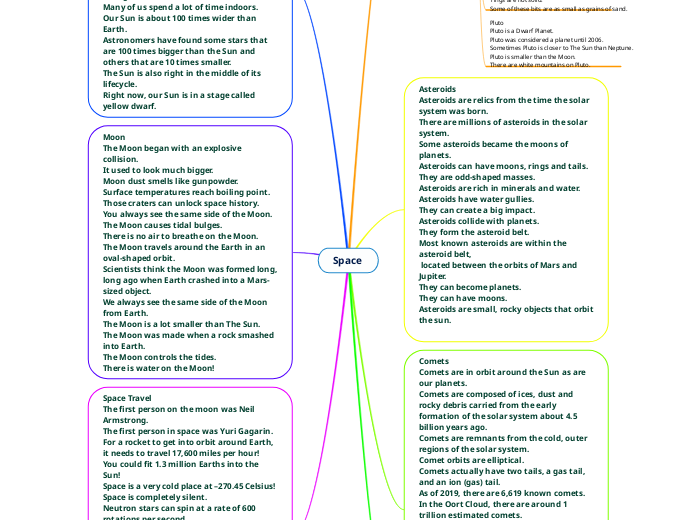
Asteroids Asteroids are relics from the time the solar system was born. There are millions of asteroids in the solar system. Some asteroids became the moons of planets. Asteroids can have moons, rings and tails. They are odd-shaped masses. Asteroids are rich in minerals and water. Asteroids have water gullies. They can create a big impact. Asteroids collide with planets. They form the asteroid belt. Most known asteroids are within the asteroid belt, located between the orbits of Mars and Jupiter. They can become planets. They can have moons. Asteroids are small, rocky objects that orbit the sun.
Comets Comets are in orbit around the Sun as are our planets. Comets are composed of ices, dust and rocky debris carried from the early formation of the solar system about 4.5 billion years ago. Comets are remnants from the cold, outer regions of the solar system. Comet orbits are elliptical. Comets actually have two tails, a gas tail, and an ion (gas) tail. As of 2019, there are 6,619 known comets. In the Oort Cloud, there are around 1 trillion estimated comets. The famous Halley comet is visible once every 75 or 76 years. Comets travels at about 2,000 miles per hour. Comets are cosmic snowballs of frozen gases, rock, and dust that orbit the Sun. When frozen, they are the size of a small town. Halley's Comet. Halley's Comet is the most famous of all comets. Comets are remnants from the cold, outer regions of the solar system.
Main topic
Sun The Sun is over 4.5 billion years old. The surface of The Sun is 5,505 °C. The Sun's light reaches the Earth in eight minutes. Sunlight kills bacteria. Many of us spend a lot of time indoors. Sunlight may reduce high blood pressure. Sunlight can regulate the immune system. Sunlight strengthens bones. Sunlight can improve sleep quality. Sunlight boosts mood. Sunlight kills bacteria. Many of us spend a lot of time indoors. Our Sun is about 100 times wider than Earth. Astronomers have found some stars that are 100 times bigger than the Sun and others that are 10 times smaller. The Sun is also right in the middle of its lifecycle. Right now, our Sun is in a stage called yellow dwarf.
1
Moon The Moon began with an explosive collision. It used to look much bigger. Moon dust smells like gunpowder. Surface temperatures reach boiling point. Those craters can unlock space history. You always see the same side of the Moon. The Moon causes tidal bulges. There is no air to breathe on the Moon. The Moon travels around the Earth in an oval-shaped orbit. Scientists think the Moon was formed long, long ago when Earth crashed into a Mars-sized object. We always see the same side of the Moon from Earth. The Moon is a lot smaller than The Sun. The Moon was made when a rock smashed into Earth. The Moon controls the tides. There is water on the Moon!
Space Travel The first person on the moon was Neil Armstrong. The first person in space was Yuri Gagarin. For a rocket to get into orbit around Earth, it needs to travel 17,600 miles per hour! You could fit 1.3 million Earths into the Sun! Space is a very cold place at –270.45 Celsius! Space is completely silent. Neutron stars can spin at a rate of 600 rotations per second. There is an uncountable number of stars in the known universe. 99 percent of our solar system's mass is the sun. The Apollo astronauts' footprints on the moon will probably stay there for at least 100 million years. The first artificial satellite — Sputnik, launched Oct. 4, 1957. The hottest planet in our solar system is 450° C. There may be life on Mars. Nobody knows how many stars are in space.