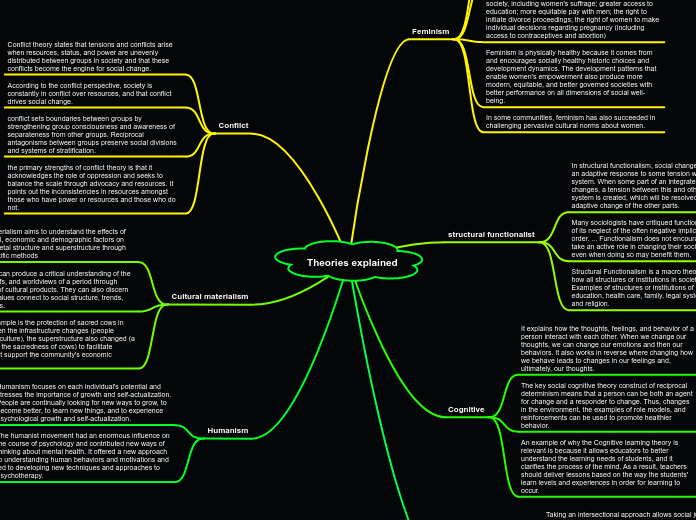
feminist analysis has made a major contribution to and has changed social theory, making sociologists aware of issues that were previously ignored
gender is a social construct as social actors actively create it during everyday interactions.
The feminist movement has effected change in Western society, including women's suffrage; greater access to education; more equitable pay with men; the right to initiate divorce proceedings; the right of women to make individual decisions regarding pregnancy (including access to contraceptives and abortion)
Feminism is physically healthy because it comes from and encourages socially healthy historic choices and development dynamics. The development patterns that enable women's empowerment also produce more modern, equitable, and better governed societies with better performance on all dimensions of social well-being.
In some communities, feminism has also succeeded in challenging pervasive cultural norms about women.
In structural functionalism, social change is regarded as an adaptive response to some tension within the social system. When some part of an integrated social system changes, a tension between this and other parts of the system is created, which will be resolved by the adaptive change of the other parts.
Many sociologists have critiqued functionalism because of its neglect of the often negative implications of social order. ... Functionalism does not encourage people to take an active role in changing their social environment, even when doing so may benefit them.
Structural Functionalism is a macro theory that looks at how all structures or institutions in society work together. Examples of structures or institutions of society include: education, health care, family, legal system, economy, and religion.
It explains how the thoughts, feelings, and behavior of a person interact with each other. When we change our thoughts, we can change our emotions and then our behaviors. It also works in reverse where changing how we behave leads to changes in our feelings and, ultimately, our thoughts.
The key social cognitive theory construct of reciprocal determinism means that a person can be both an agent for change and a responder to change. Thus, changes in the environment, the examples of role models, and reinforcements can be used to promote healthier behavior.
An example of why the Cognitive learning theory is relevant is because it allows educators to better understand the learning needs of students, and it clarifies the process of the mind. As a result, teachers should deliver lessons based on the way the students' learn levels and experiences in order for learning to occur.
Taking an intersectional approach allows social justice leaders to focus on solutions informed by the experiences and voices of these women; engages and activates new audiences in ways that resonate with their experiences and values; and supports and uplifts the voices of these women within alliances, at town halls, ...
As a structural and relational theory and a method or analytic tool, intersectionality is poised to reveal both the intersections of institutions, systems, and categorizations that produce oppression and the intersections of identity categorizations within individuals and groups.
Conflict theory states that tensions and conflicts arise when resources, status, and power are unevenly distributed between groups in society and that these conflicts become the engine for social change.
According to the conflict perspective, society is constantly in conflict over resources, and that conflict drives social change.
conflict sets boundaries between groups by strengthening group consciousness and awareness of separateness from other groups. Reciprocal antagonisms between groups preserve social divisions and systems of stratification.
the primary strengths of conflict theory is that it acknowledges the role of oppression and seeks to balance the scale through advocacy and resources. It points out the inconsistencies in resources amongst those who have power or resources and those who do not.
Cultural materialism aims to understand the effects of technological, economic and demographic factors on molding societal structure and superstructure through strictly scientific methods
sociologists can produce a critical understanding of the values, beliefs, and worldviews of a period through close study of cultural products. They can also discern how these values connect to social structure, trends, and problems.
A classic example is the protection of sacred cows in India. ... When the infrastructure changes (people adopted agriculture), the superstructure also changed (a new belief in the sacredness of cows) to facilitate practices that support the community's economic viability.
Humanism focuses on each individual's potential and stresses the importance of growth and self-actualization. People are continually looking for new ways to grow, to become better, to learn new things, and to experience psychological growth and self-actualization.
The humanist movement had an enormous influence on the course of psychology and contributed new ways of thinking about mental health. It offered a new approach to understanding human behaviors and motivations and led to developing new techniques and approaches to psychotherapy.