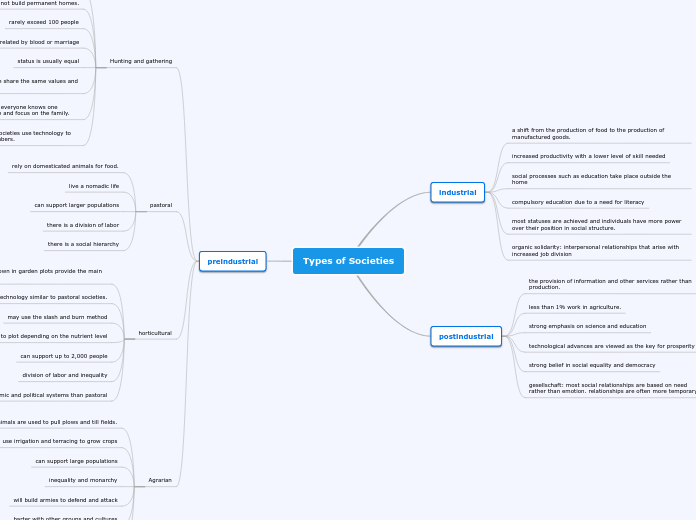
a shift from the production of food to the production of manufactured goods.
increased productivity with a lower level of skill needed
social processes such as education take place outside the home
compulsory education due to a need for literacy
most statuses are achieved and individuals have more power over their position in social structure.
organic solidarity: interpersonal relationships that arise with increased job division
the provision of information and other services rather than production.
less than 1% work in agriculture.
strong emphasis on science and education
technological advances are viewed as the key for prosperity
strong belief in social equality and democracy
gesellschaft: most social relationships are based on need rather than emotion. relationships are often more temporary
Hunting and gathering
the daily collection of plants and hunting of animals.
move around constantly and do not build permanent homes.
rarely exceed 100 people
most members are related by blood or marriage
status is usually equal
mechanical solidarity: when people share the same values and goals.
gemeinschaft: preindustrial where everyone knows one another and relationships are close and focus on the family.
subsistence strategies: the ways societies use technology to provide for the needs of their members.
pastoral
rely on domesticated animals for food.
live a nomadic life
can support larger populations
there is a division of labor
there is a social hierarchy
horticultural
fruits and vegetables grown in garden plots provide the main source of food.
have a level of technology similar to pastoral societies.
may use the slash and burn method
will rotate from plot to plot depending on the nutrient level
can support up to 2,000 people
division of labor and inequality
better economic and political systems than pastoral
Agrarian
animals are used to pull plows and till fields.
will use irrigation and terracing to grow crops
can support large populations
inequality and monarchy
will build armies to defend and attack
barter with other groups and cultures
2 groups. landowners and peasants