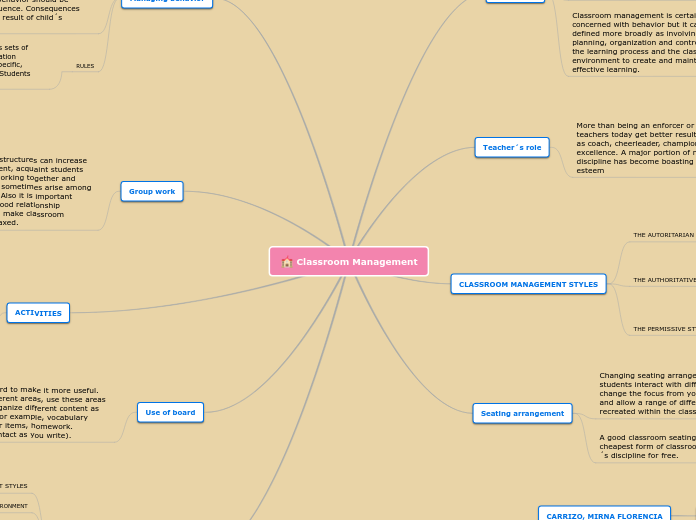
Classroom management is the term we will use to highlight all of those positive behaviors and decisions teachers make to facilitate the learning process of their students. It refers to all those activities necessary to create and maintain an olderly learning environment.
Classroom management is closely linked to issues of motivation, discipline and respect.
Classroom management is certainly concerned with behavior but it can also be defined more broadly as involving the planning, organization and control of learners, the learning process and the classroom environment to create and maintain an effective learning.
More than being an enforcer or a punisher, teachers today get better results by serving as coach, cheerleader, champion of excellence. A major portion of maintaining discipline has become boasting students self-esteem
Teachers are now, sometimes, first/only authoritary figure in child´s life who espouses values of civility, mutual respect and cooperation.
Teachers must be part of school wide discipline team and help out with discipline outside their own classrooms.
Good teachers must be willing to bend rules when it is necessary.
THE AUTORITARIAN STYLE
This type of style encourages students to be independent thinkers and doers but it still involves effective monitoring.
THE AUTHORITATIVE STYLE
A management style that is restrictive and punitive. The focus is mainly on keeping order in the classroom rather than on instructions and learning.
THE PERMISSIVE STYLE
This type of style offers students with considerable autonomy but provide them with little support for developing learning skills or managing their behavior.
Changing seating arrangements can help students interact with different people, change the focus from you when appropriate and allow a range of different situations to be recreated within the classroom.
CIRCLE
SQUARE
HORSESHOE
A good classroom seating arrangement is the cheapest form of classroom management. it´s discipline for free.
The purpose of classroom management is socializating students with the dos and don´ts behavioral in the school´s environment. Meaning that, it teaches children how to behave in ways that facilitate learning.
Disruptive behavior: is the bahavior that is problematic or inappropriate. It interferes with students´ own learning or disrupts the class. Inappropriate behavior should be followed by a consequence. Consequences are viewed as an end result of child´s inappropriate acts.
RULES
Students can readily adapt to various sets of rules if each make sense for the situation involved. Rules should be simple, especific, clearly and stated in positive terms. Students can help to write them.
Cooperative learning structures can increase student task engagment, acquaint students with the benefits of working together and ease the tension that sometimes arise among racial, ethnic groups. Also it is important because it fosters a good relationship between learners and make classroom atmosphere more relaxed.
During plannning procedures we have to consider student characteristics and the physical environment. Procedures are steps for the routines students follow in their daily learning activities, these routines provide a sense of regularity and equilibrium for both students and teachers. Examples, turn in papers, sharpen pencils and make transitions from one activity to another.
Organize the board to make it more useful. Divide it into different areas, use these areas to help you to organize different content as you write it up. For example, vocabulary column, grammar items, homework. (Maintain eye contact as you write).
CLASSROOM MANAGEMENT STYLES
CREATING PHYSICAL ENVIRONMENT
CREATING TEACHING AND MAINTAIN RULES
AND PROCEDURES
CREATING LEARNING ENVIRONMENT
GETTING STUDENT´S COOPERATION
EFFECTIVELY MANAGING THE CLASSROOM
ACTIVITIES
STUDENTS´ DEVELOPMENT LEVEL
OR STUDENT CHARACTERISTICS