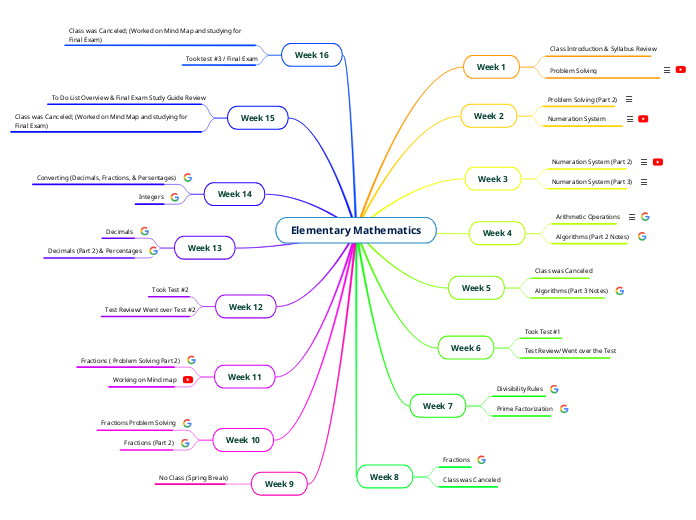
Class Introduction & Syllabus Review
Problem Solving
Problem SolvingProblem solving is a process.George PolyaProblem Solving steps/ processUnderstand the Problem.Devise a plan.Carry out the plan.Look Back *(Check if the plan worked and made sense)*
Problem Solving (Part 2)
Problem SolvingUnderstanding the Problem:What are you asked to find out or show?Can you restate the problem in your own words?Can you draw a picture or diagram to help you understand the problem?Devise a PlanWhat problem solving strategy are you going to use?Guess and Check/ Trail and errorDraw a picture or a diagramMake a tableAct it outMake the problem simplerLook for a patternWork backwardsMake a organized listCarry out the PlanCarry out the plan is usually easier than devising the plan.Be patient - most problems are not solved quickly nor on the first attempt. If a plan does not work immediately, be persistent. Do not let yourself get discouraged.If one strategy does not work, try a different one.Look Back (Reflect)Does your answer make sense? Is it a reasonable one?Did you answer all of the questions?Could you have solved this problem in a different way? Maybe an easier way? What did you learn from this?
Numeration System
Numeration SystemsBase - ten (Base - 10)0, 1, 2, 3, 4, 5, 6, 7, 8, 9, ...All numbers in the number system are made by combining these 10 numerals or digits. 0-9 are base - ten numerals One - to - ten relationshipA value between 1-10Representation of Base -ten (10's)Ones -- 1 -- 100Tens -- 10 -- 101Hundreds -- 100 -- 102Thousands -- 1000 -- 103Expanded NotationA way to write numbers that shows the place value of each digit. Its a way to break numbers down and understand their place value. Example: 377 = 300 + 70 + 7 = (3 x 100) + (7 x 10) + (7 x 1) = (3 x 10²) + (7 x 101) + (7 x 100)Base - five (Base -5)0, 1, 2, 3, 4, 105, 115, 125, 135, 145, 205, ...A numeral system with five (5) as the base. Representation of Base -five (5's)ones -- 1 -- 50fives -- 5 -- 51twenty-fives -- 25 -- 52one hundred twenty-fives -- 125 -- 53Example:1225 = (1 x 52) + (2 x 51) + (2 x 50) = (1 x 25) + (2 x 5) + (2 x 1) = 25 + 10 + 2 = 37 1225 = 37
Numeration System (Part 2)
Numeration SystemsBase - ten (Base - 10)0, 1, 2, 3, 4, 5, 6, 7, 8, 9, ...Ones -- 1 -- 100Tens -- 10 -- 101Hundreds -- 100 -- 102Thousands -- 1000 -- 103Base -five (Base - 5)0, 1, 2, 3, 4, 105, 115, 125, 135, 145, 205, ...ones -- 1 -- 50fives -- 5 -- 51twenty-fives -- 25 -- 52one hundred twenty-fives -- 125 -- 53 Base - three ( Base - 3)0, 1, 2, ...ones -- 1 -- 30threes -- 3 -- 31nines -- 9 -- 32twenty- sevens -- 27 -- 33Example:2123 = (2 x 32) + (1 x 31) + (2 x 30) = (2 x 9) + (1 x 3) + (2 x 1) = 18 + 3 + 2 = 232123 = 23Base - ten (Base - 10) digits : 0, 1, 2, 3, 4, 5, 6, 7, 8, 9, ...Base -five (Base - 5) digits : 0, 1, 2, 3, 4, ...Base - three ( Base - 3) digits : 0, 1, 2, ...Converting Bases Examples: *(Using the number 23)*Base 10 -- 23 23 = 232 -- Tens3 -- OnesBase 5 -- 435 23 = 435 4 -- Fives3 -- OnesBase 3 -- 2123 23 = 21232 -- Nines1 -- Threes2 -- Ones/Units
Numeration System (Part 3)
Numeration System Base - 10100101102103 ...Base - 550515253...Base - 330313233...Base - 2 *New Base that was learned* 20 ones21 twos22 fours23 eights24 sixteens, ... Practice Problems: *Practicing new bases* a.) 1112 = (1 x 22) + (1 x 21) + (1 x 20) (1 x 4) + (1 x 2) + (1 x 1) 4 + 2 + 1 = 7 1112 = 7b.) 367 = (3 x 71) + (6 x 70) (3 x 7) + (6 x 1) 21 + 6 = 27 367 = 27Practice Problems: *Practicing on finding out what's wrong* a.) 12342 * You can't have the number 2,3,4 in base 2 only the numbers 0,1. * b.) 2355 * You can't have the number 5 in base 5 only the numbers 0,1, 2, 3, 4. * Comparing the bases: ( >, <, = ) * Tip: if you have the same digits in the ones and other unit place values, just look at the bases, the larger base is going to be the larger number. * a.) 345 < 346 345 = (3 x 51) + (4 x 50) (3 x 5) + (4 x 1) 15 + 4 = 19346 = (3 x 61) + (4 x 60) (3 x 6) + (4 x 1) 18 + 4 = 22b.) 1112 = 71112 = (1 x 22) + (1 x 21) + (1 x 20) (1 x 4) + (1 x 2) + (1 x 1) 4 + 2 + 1 = 7c.) 435 > 256 435 = (4 x 51) + (3 x 50) (4 x 5) + (3 x 1) 20 + 3 = 23256 = (2 x 61) + (5 x 60) (2 x 6) + (5x 1) 12 + 5 = 17Practicing on writing a number in different Bases: * Using the number 45 *Visual Representation of the Number 45:x x x x x x x x x xx x x x x x x x x xx x x x x x x x x xx x x x x x x x x xx x x x x a.) Base - 5 = 1405 x x x x x x x x x xx x x x x x x x x xx x x x x x x x x xx x x x x x x x x xx x x x x 1 - 25's (twenty-fives)4 - 5's (fives)0 - 1's (ones)b.) Base - 4 = 2314x x x x x x x x x xx x x x x x x x x xx x x x x x x x x xx x x x x x x x x xx x x x x2 - 16's (sixteens)3 - 4's (fours)1 - 1's (ones)
Arithmetic Operations
Arithmetic OperationsAdditionTo put together and joinProperties: Identity: For any number when you add 0, the number remains the same. a + 0 = a Examples: 4 + 0 = 4 1/3 + 0 = 1/3 0.25 + 0 = 0.25Commutative: (Order) Add two numbers, the order doesn't matter. a + b = b + aExamples: 3 + 4 = 4 + 3Associative: (Grouping) You can put the numbers in a group, in any way. ( a + b ) + c = a + (b + c)Examples: ( 3 + 4 ) + 2 = 3 + ( 4 + 2 )MultiplicationMultiply is repeated addition of groups of equal sizes. Repeated addition, skip counting.Visual Representation:Repeated Addition:3 x 4 = 4 + 4 + 4xxxx xxxx xxxxSkip Counting:3 x 4 = 4 8 12xxxx xxxx xxxxProperties: Identity: Multiplying by 1, the number doesn't change. a x 1 = aExamples: 3 x 1 = 3Commutative: (Order) The order in which you multiply, doesn't matter a x b = b x aExamples: 3 x 4 = 4 x 3Associative: (Grouping) You can put the numbers in a group, in any way. ( a x b ) x c = a x (b x c)Zero Property: Any number multiplied by 0 is 0.a x 0 = 0Examples: 3 x 0 = 0 3/4 x 0 = 0 2/3 x 0 = 0Distributive: When multiplying a number by a sum, outcome is the same. a x ( b + c ) = ( a x b ) + ( a x c ) ( b + c ) is the sum ( a x b ) + ( a x c ) are partial productsExample: 3 x ( 5 x 2 ) = ( 3 x 5 ) + ( 3 x 2 )Subtraction To take away a - b = cExample: 7 - 3 = 4 Compare ?Daisy has 5 books xxxxxPaisley has 7 books xxxxxxxPaisley has 2 more books 7 - 5 = 2 or 5 + 1 + 1 = 7 5 + 2 = 7Missing Addend ?5 + 2 = 7
Algorithms (Part 2 Notes)
Class was Canceled
Algorithms (Part 3 Notes)
Took Test #1
Test Review/ Went over the Test
Divisibility Rules
Prime Factorization
Fractions
Class was Canceled
Class was Canceled; (Worked on Mind Map and studying for Final Exam)
Took test #3 / Final Exam
To Do List Overview & Final Exam Study Guide Review
Class was Canceled; (Worked on Mind Map and studying for Final Exam)
Converting (Decimals, Fractions, & Persentages)
Integers
Decimals
Decimals (Part 2) & Percentages
Took Test #2
Test Review/ Went over Test #2
Fractions ( Problem Solving Part 2)
Working on Mind map
Fractions Problem Solving
Fractions (Part 2)
No Class (Spring Break)