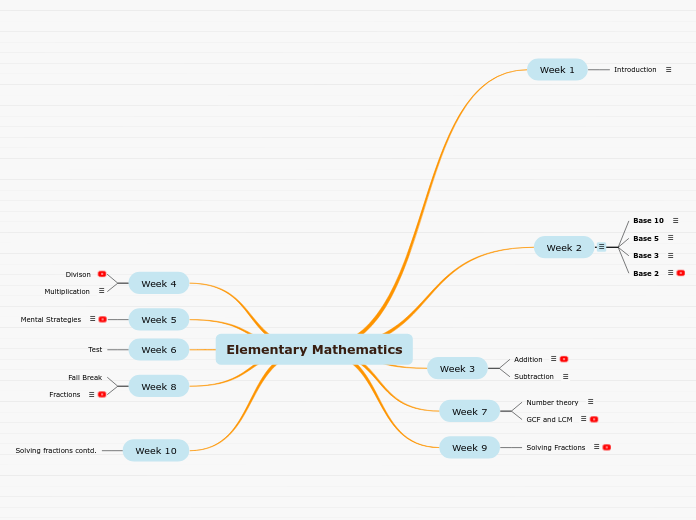
Introduction
Went over Course Syllabus, required materials and Classroom expectations
Base 10
Numeral system most commonly used throughout the western world Uses digits 0123456789
Base 5
Numbers are powers of 5 Uses digits 01234 223 base 5 50+10+3 (2x25)+(2x5)+(3x1) (2x5^2)+(2x5^1)+(3x5^0)
Base 3
Numbers are powers of 3 Uses Digits 0,1,2
Base 2
Also known as Binary Numbers are powers of 2 Uses digits 0,1
Addition
Joining3+4= 7 , 7 is the sum 3 and 4 are the add insThree properties of additionIdentity property of additiona+0= aZero does not change identity of a numberCommutative property of additionA+b is the same as b+a Order in which numbers are added does not matterAssociative property of additionA+b+c , c+b+a , b+c+aThe way in which numbers are grouped does not matterStandard American AlgorithmFamiliar but doesn’t explain additionRight to left Opposite of readingPartial sumsNo reference to place valuePartial sums with emphasis on place valueSame as partial sums but using a 0 for place holdingLeft to rightExpanded NotationLattice Algorithm
Subtraction
Number theory
Divisibility A number a is divisible by a second number b if there is a third number that meets this requirementcxb=a10/5=2Important terminology10 is divisible by 5 or 5 divides 105 is a divisor of 105 is a factor of 1010 is a multiple of 52 and 5 are factors of 10RulesEnding- last digit of a number2: 0,2,4,6,8= divisible by 25: 0,5= divisible by 510:0= divisible by 103: sum of the digits must be divisible by 39: sum of the digits must be divisible by 96: must be divisible by both 2 and 34: last two digits must be divisible by 48: last three digits must be divisible by 87: double the last digit, subtract it from the digits to its right11:Chop offDrop the last two digitsAdd the chopped part to the remainder of the sumChop off again and repeat
GCF and LCM
List MethodList factors of 2 numbersEg 24 & 3624:1,2,3,4,6,8,12,2436:1,2,3,4,6,9,12,18,36Both share the factor 12 Least common multipleList multiples of 24 and 3624:24,48,72,9636:36,72,108LCM = 72Used for adding or subtracting fractions with different denominatorsPrime factorization methodBreak a number down from its factors until there is only a sum of prime numbersStudents can use any shared prime factors to find GCFTo find Lcm= GCF x Left over factors that didn’t match
Solving Fractions
Divison
Multiplication
Multiplication is commutativeOnly half the multiplication must be learnedIdentity property of multiplicationA x 1= A Zero Property Anything times 0=0Associative property of multiplicationGrouping of numbers doesn’t matterDistributive propertyax(b+c)=(axb)+(a x c)
Mental Strategies
AdditionLeft to right (front end)Add hundred, tens units from left to rightCompensationChange number in way to solve in your headRounding number up then subtracting by total that was roundedCompatible numbersEasy to solve numbersBreaking up and BridgingBreak up one number into two parts so it becomes three part equationSubtractionLeft to right Subtract from left to rightCompensationRounding number up then adding number rounded by to the equationCompatible numbersEasy to solve numbersBreaking up and BridgingBreak up one number into two parts so it becomes three part equationMultiplicationLeft to rightUse expanded notation and distributeCompatible numbersDivisionCompatible numbersNo numbers given , look for easily divisible numbers of the quotient
Test
Fall Break
Fractions
MeaningDivision quotient: ⅗ = 3 divided by 5Part of a whole=0.5Percentage RatioOnly a ratio if it compares part to part and not part to a whole because that is a fractionDifferent ModelsSurface Area/ RegionUsing piece of paper to demonstrate a 3rdLengthLine segment Fraction barsThink of a turtle doing ¾ of a raceTends to be more difficult for students to understand than surface area/ sharingSetsGroups of thingsManipulativesx/x = 1 Any number over itself = 1 because its a wholeFractional parts are equivalent partsThe more pieces I cut my pie into the smaller they getEquivalent fractions work because of the identity property of multiplication.
Solving fractions contd.