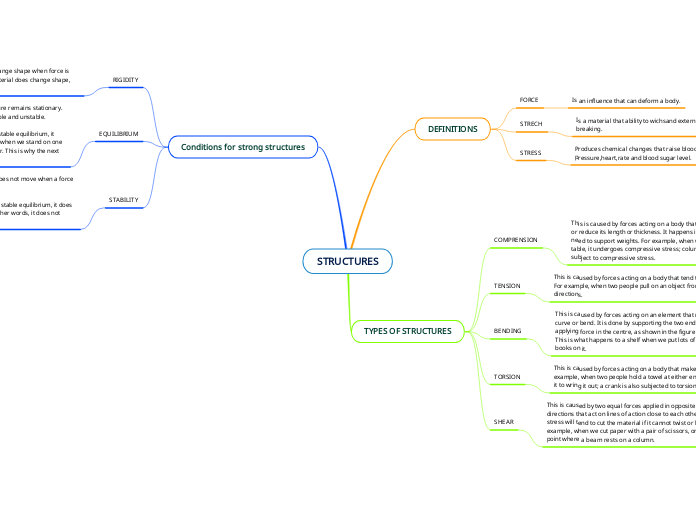
STRUCTURES
DEFINITIONS
FORCE
Is an influence that can deform a body.
STRECH
Is a material that ability to wichsand external forces without breaking.
STRESS
Produces chemical changes that raise blood pressure,heart,rate and blood sugar level.
TYPES OF STRUCTURES
COMPRENSION
This is caused by forces acting on a body that tend to flatten it or reduce its length or thickness. It happens in structures that need to support weights. For example, when we lean on a table, it undergoes compressive stress; columns are also subject to compressive stress.
TENSION
This is caused by forces acting on a body that tend to stretch it. For example, when two people pull on an object from opposite directions.
BENDING
This is caused by forces acting on an element that make it curve or bend. It is done by supporting the two ends and applying force in the centre, as shown in the figure to the right. This is what happens to a shelf when we put lots of heavy books on it.
TORSION
This is caused by forces acting on a body that make it twist. For example, when two people hold a towel at either end and twist it to wring it out; a crank is also subjected to torsion.
SHEAR
This is caused by two equal forces applied in opposite directions that act on lines of action close to each other. Shear stress will tend to cut the material if it cannot twist or bend. For example, when we cut paper with a pair of scissors, or the point where a beam rests on a column.
Conditions for strong structures
RIGIDITY
If a material is rigid, it does not change shape when force is applied to it. By contrast, if the material does change shape, we say that it is deformable.
EQUILIBRIUM
A body is in equilibrium when its structure remains stationary. There are two types of equilibrium: stable and unstable.
When a force is applied to a body in unstable equilibrium, it causes the body to move. For example, when we stand on one leg, the slightest push can knock us over. This is why the next condition is important.
STABILITY
A body is in stable equilibrium if it does not move when a force is applied to it.
When a force is applied to a body in stable equilibrium, it does not topple, tip over or collapse; in other words, it does not move.
