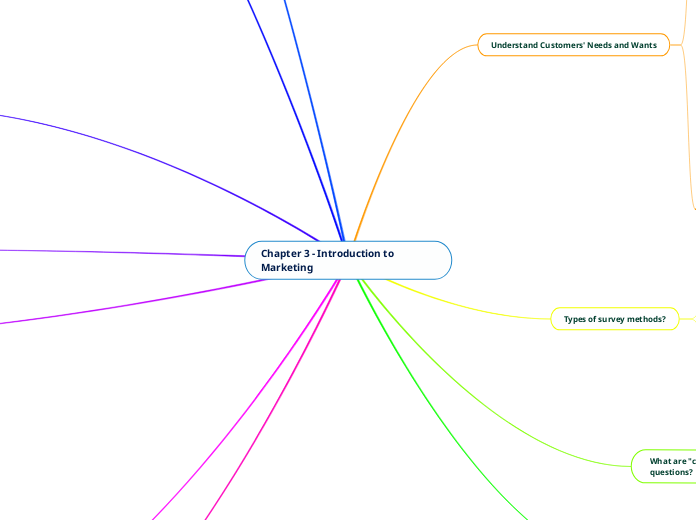
Chapter 3 - Introduction to Marketing
- Identify the needs and wants of target customers
- satisfy customers in ways that are better than competitors
From page 52
What is Marketing?
Name the 4Ps?
Price Place Promotion Product
Examples of questions asked with the 4Ps.
Price: What price range would they be able to afford?
Product: What kind of food do youths enjoy?
Place: Where do they like to eat or buy their food?
Promotion: What kind of promotion will attract them?
Know your customers process?
Identify potential customers
Who are the potential customers?
Understand customers and needs and wants.
What are the customers needs and wants?
From page 52
Applying the marketing mix process?
Apply the 4Ps of marketing
What product, price, place and promotion will attract the customers?
From page 52
Satisfy customers better than competitors?
How can the business be different from or better than its competitors?
Page 52
Identify the potential customer groups?
Customers with SIMILAR needs and wants can be GROUPED together.
They can be grouped according to:
BIG GOALS
Benefits sought(eg, convenience, low cost)
Income (eg cars for high income group, leather handbags)
Gender (eg, clothing for males and females, accessories)
Geographical location (eg convenience stores selling daily necessities.
Occupation (blue collar - labour jobs and white collar - executives working group)
Page 53
Types of tourists?
Know your customers
Age ( eg children, adults and senior citizens)
Lifestyle (eg, hobbies and interests)
Social group (who they hang out with - parents with children, friends)
Understand Customers' Needs and Wants
What is a market survey?
an investigation into the state of the market for a particular product or service, including an analysis of consumers' needs and preferences.
Page 56
Steps of conducting market survey? Describe the steps.
Step 1 – Decide on the objectives of the market survey.
Find out what does the business want to find out from the customers.
Step 2 – Choose survey methods
There are four main survey methods – Online, Postal, Telephone and Personal.
Which method is most suitable? Is it fast? Is it convenient? Is it expensive? Is it accurate?
Step 3 – Design the questionnaire
Ask questions that will give you the relevant answers that the business wants to know.
Step 4 – Conduct the survey
Set a deadline to complete the survey. Decide how the answers will be recorded? Is it by voice recorder? Or is it recorded on paper?
Step 5 – Analyse the data
Collect all the data from the survey.
Present the data in graph or bar charts.
The business should use these data to improve their business.
Page 56
Types of survey methods?
Online Surveys.
Paper Surveys.
Mail Surveys.
Telephone Surveys.
Personal Surveys
Page 58 to 60
What are "closed-ended" and "open-ended" questions?
A closed-ended question is a type of question that can be answered QUICKLY by CHOOSING from a set of options like MCQs.
An open-ended question is a type of question that respondents can create their own answers.
Page 61
Ways of presenting data?
Pie Chart, Maps, Line graphs
Page 64 to 65