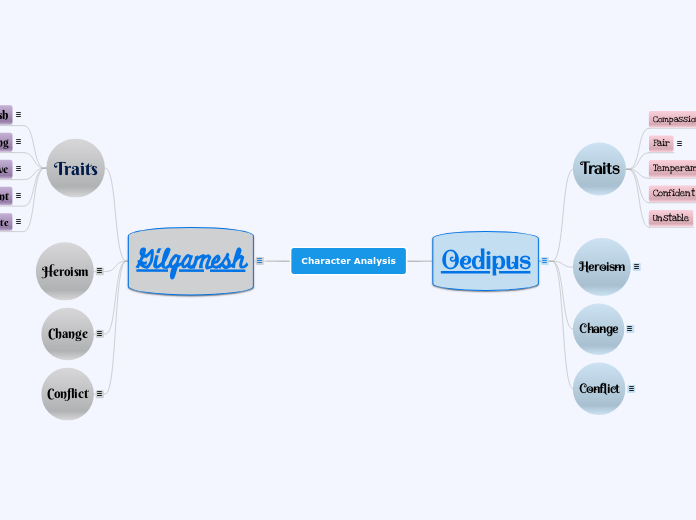
Oedipus has scars on his feet from injuries sustained as an infant where his feet were bound and pierced. He was not born physically blind, but does gouge his own eyes out causing physical blindness.Oedipus was adopted as an infant. Oedipus is married to his mother with whom he has children consisting of boys and girls. Oedipus killed his father. Oedipus is a foreigner to the country he rules.Oedipus is King of Thebes and lives in the palace in Thebes before his banishment.
Traits
Compassionate
"For my concern for their suffering is more than even that for my own psyche." -Oedipus
Fair
"I shall await that destiny which is mine-whatever its nature." -Oedipus
Temperamental
"But the one who had pushed me aside-the carriage driver-I hit in anger....and then I destroyed all the others." -Oedipus
Confident
"Question me well-for you will never convict me as the killer!"-Oedipus
Unstable
"For he tore from her those gold brooches with which she had adorned herself and raise them to assault his own circular organs.."-Messenger
Heroism
Oedipus is a protagonist because he is seeks justice for the people that he rules, even in light of evidence that he may be responsible for their curse. He begs for the punishment for his acts, despite the fact they were committed in his innocence.
Change
Oedipus is a static character. He is a bold and respected king admired by his people for the compassion that he shows to them. His greatest concern is the well-being of his people and that doesn't change even when he discovers that he is at fault for causing their curses. He seeks justice throughout the story for the culprit and insists on his punishment when he finds out that person is indeed himself.Oedipus' is also static in the fact that his temper is constant throughout his life. His temper is highlighted prior to his nobility (running away from home and murdering the King and his entourage.) and continues as he reigns (accuses Creon of being a traitor, self inflicted wounds to his eyes.).
Conflict
Oedipus experiences an internal struggle with shame. (He is ashamed of being adopted, being a murderer, having incestuous relationship with his mother, and producing children as a result of the incestuous relationship.)
Gilgamesh is two thirds God and one third man. He has a perfect body of strength and is described as beautiful with long locks of hair.Gilgamesh is the king of Uruk who is unmarried and has no children. He is favored by the gods and feared by his countrymen.
Traits
Selfish
"No son is left with his father, for Gilgamesh takes them all, even the children..."- townspeople
Strong
"So Gilgamesh followed the bull, he seized the thick of its tail, he thrust the sword between the nape and the horns and slew the bull."-author (regarding the bull of Heaven)
Brave
"I will go first although I am your lord and you may safely call out forward there is nothing to fear!" - Gilgamesh
Arrogant
"I will set up my name in the place where famous men are written and where no man's name is written yet I will make a monument to the gods."-Gilgamesh
Compassionate
"The next day also, in the first light, Gilgamesh lamented, seven days and seven nights for Enkidu until the worm fastened on him."-author
Heroism
Gilgamesh is an antagonist because of his character traits. Because he is two thirds god, he believes he is entitled to things that immortals are not which causes problems for himself. He believes is entitled to the virgin brides, fame, nobility, and immortality. By having this type of attitude, he creates the problems he encounters such as fighting Enkidu, fighting the creature of the forest, fighting the bull of heaven, and enduring a grueling journey.
Change
Gilgamesh is a static character. He remains the same throughout the story with his selfishness. He is selfish in the beginning by taking things that didn't belong to him and continues with his selfish ways to the end as he searches for a way to escape his fate only.Gilgamesh also remains static in the fact that he remains prideful of his country. He is proud of his country and his reign throughout the entire epic. (he adorned his city with walls and structures like no other in the world and he again brags about the beauty of his country to Urshanabi as they return from their long journey.)
Conflict
Gilgamesh suffers from an internal conflict. He struggles with the idea of not being fully mortal or fully immortal. He can't figure out who he should identify with, the gods or the people. He acts like a god in some ways which anger the people and in other ways he acts mortal which anger some of the gods.