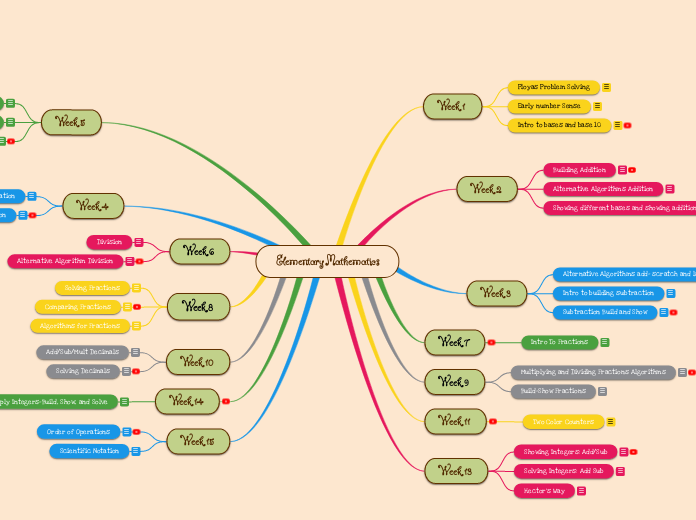
Ployas Problem Solving
Ploya's Problem SolvingUnderstand the problem Develop a planCarry out the planCheck that the answer makes sense
Early number Sense
One-to-one correspondence- counting each object, slowing down the pace of counting, to make an accurate answer.Subitizing- putting a certain amount of objects in front of students and they will recognize the number without counting.Cardinality - students grouping the objects in front of them and finding an answer from there.
Intro to bases and base 10
Introduction to basesFlats - 100sLongs- 10sCubes- 1s Building in bases45IIII ..... 4 longs and 5 cubes would be the representation of 45.125One FlatII, two longs5 units
aBuilding Addition
We were introduced to flats(100), longs(10), and cubes(1).Building AdditionWhen a number is placed into a different base that changes the amount of manipulatives used as well. For example, 25 in base 6. So each long would technically have 6 instead of the normal 10. An example of building a base would be 15 base 3Since the base is 3, that means each long that we make is technically made up of 3 cubes each.15 base three (IIIII) 5 longs there since we are skip counting three all the way to 15 which gives us 5 longs. Although since we are in base 3, every time we make three longs that technically makes a flat. Since three units would make a long, three longs should make a flat. In this example we would have one flat and two longs. 120 base3
aAlternative Algorithms Addition
Expanded FormEx) 123 + 45 = 100 + 20 +3 40+ 5This method separates the place values and makes it easier for kids to add the hundreds, tens, and ones in a simpler way. Trade-off Ex) 46 + 54, this method allows students to give the 4 in the ones place to the 6 which results in rounding both numbers making them even and they will not have to carry any numbers over. Left-to-right additionLeft to right addition its similar in the traditional way of adding, although in this algorithm it does not make students carry over. Instead of stacking the numbers on top of each other they would be added in their correct place value left to right.Ex) 123+ 456 = 100+400=500 / 20+50= 70 / 6+3 = 9500+70+9 = 579Friendly NumbersIs typically used for longer number sequences. In this alternative algorithm, it helps students not have to carry over and let them borrow numbers from each other so they can even each other out.
Showing different bases and showing addition
We were introduced to flats(100), longs(10), and cubes(1).Showing Addition For example 23six + 12six I(6) I(6) ... + I(6) .. = 35sixCount the longs and add the cubes to find the answer3 longs and 5 cubes all together
Alternative Algorithms add- scratch and lattice
Scratch Method Scratch Method is counting up to a base and any leftovers make an additional number. For example 243six + 154six243154 Since the base is 6, we would take three and count up to six and stop when we reach it. Whatever is left from the 4 is given to the next pair of numbersLatticeIn my opinion this is the easiest way for kids because not only is it easy to teach but makes adding big numbers easy as well. Numbers are stacked on top of each other just like the traditional way but at the bottom you would add boxes for each placement and split them in half. Add just like normal and split the answers up in the box and then add diagonally.
Intro to building subtraction
Building SubtractionIn this topic we would use our building blocks as usual, build both numbers shown. Then from there we would take away however many the problem is asking us to. Example: 37-24III ....... - II .... = 13In this problem it was simple because we had enough cubes and longs to use that we did not have to borrow from others.
Subtraction Build and Show
Subtraction Build and Show:For example: 74-65We have our 74 ( IIIIIII .... ). - 65 ( IIIIII .....)In this case we do not have enough cubes, we cannot take 5 away from 4.We would then have to take a long and break it down into 10 cubes.( IIIIII ..............) Now 6 longs and 14 cubesThen we can take 5 away from 14, leaving us with 9 and no longs since 6-6 = 0The answer is 9.
aIntro To Fractions
What do parts of a fraction tell us?1 - the number of things we have2 - the total possible
Multiplying and Dividing Fractions Algorithms
Multiplying FractionsWhen Multiplying Fractions, sometimes it can be as simple as multiplying straight across to receive an answer. For example:1 x 1 = 13 2 = 6However that will not be the case in each problem, the reason that worked out well was because the fraction did not need to be simplified.Heres an example of if the fraction would need to be simplified, but we will shorten it before we even receive an answer. 12 x 1615 30These are bigger numbers and therefore the students are not going to know how to multiply those off the top of their head. Instead we will use our "times tables" and elimination skills.For 12, we can simplify that down to "2x6"For 30, we can simplify that down to "5x6"In both of those they share a "6", so we can cross those off because they cancel each other outWe could simplify the 15 and 16, although they do not really share anything in common so we will leave it. We are then left with:2 x 1615 x 5Assuming the students can figure out the multiplication by then it would be:3275Dividing FractionsWhen dividing fractions we will use something called "KCF"K- keepC- changeF- flipFor example(with a mixed number):4 and 2/4 divided by 3 and 1/3We are going to start by getting the mixed number into an improper fractionMultiply the 4 x 4 and +2 = 18 and keep the denominator making it 184Onto the next, multiply the 3 x 3 and +1 = 10 making it103Now, we would get into the dividing18/4 divided by 10/3 We are going to keep 18/4, we are going to change the division into multiplication, and flip 10/3 into 3/10
aBuild-Show Fractions
Linear Set Area models described using "1/4"Linear- 1/4 of the LINE is scribbledSet- 1 out of 4 pieces are "yellow"Area- 1/4 of the AREA is shadedWhen drawing out fractions to SHOW them for multiplying, adding, or subtracting we will use mostly squares or rectangles.It is helpful to use different colors when drawing out fractions, so that when we overlap the "lines" we will be able to tell which is which.
Two Color Counters
TWO COLOR COUNTERSSorting, counting, and probability activities are all made easier with two-color counters. It's ideal for teaching a variety of early math concepts as well as developing counting skills.Red- negativeYellow- positive
Showing Integers: Add/Sub
SHOWING ADDING AND SUBTRACTING INTEGERSWe are going to start with "zero banks"ONLY use a zero bank if there is a problem asking to take away something you do not haveFor Example: 2 - 6We only have 2 to start with and we would need to add a zero bank to be able to complete the problemStart with 2 yellow counters and then add 6 yellow AND red counters. OO OOOOOO OOOOOO. Since we are taking 6 POSITIVE counters away we would be left with OO OOOOOOThe 2 yellow would cancel two red out, leaving us with negative 4 2-6= -4For addition problems we do not need a zero bank, we do not have to take anything away.For example: 3 + (-2)Start withOOOThen we are going to add two NEGATIVESOOOOOOOTwo POSITIVES and two NEGATIVES are going to cancel eachother outLeaving us with one positive, 3 + (-2) = 1
aSolving Integers: Add Sub
SOLVING INTEGERS: ADD/SUBAs we know, we ONLY need a zero bank if we are taking away something we do not already haveFor example: -2 + (-6)We do not need a zero bank for this problem since it is ADDITION OO + OOOOOO Add those all up, -2 + (-6) = -8 Example #2: -3 - (+5)We WILL need a zero bank for this one because we are starting off with 3 NEGATIVES and trying to TAKE AWAY 5 POSITIVESOOO ( OOOOO )bank: ( OOOOO ) We are going to take away 5 POSITIVESWe take 5 positives away leaving us with 8 negatives-3 - (+5) = -8
Hector's Way
INTEGERS: ADD/ SUB CONTINUED... HECTORS WAYWhen it comes to bigger numbers, we cannot continue using two color counters.It would be a lot of unnecessary work for kids to draw out or use two color counters for a problem such as: -58 + 50Instead we are going to look at both numbers and decide which one is biggerIt does not matter if 50 technically is bigger because it is positiveIf we look at it like if I have -58 gummy worms or I have 50 positive gummy worms, -58 is the larger amountSo we will add two -- above the -58 and one + above the 50Since the signs are different we are going to subtract, if the signs were the same we would addALSO since we have two -- signs and only ONE + sign, the answer will be negativeThen we subtract as normal and we would get 8 as an answer-58 + 50 = -8This mini diagram is similar to using the old method but for bigger numbers.
Alt Alg: Multiplication
Expanded Form Expand the number sentence in expanded form as usual. Then from there on multiply the numbers diagonally and up and down just like a normal multiplication problem.12 x 1310 + 210 + 3100 + 30 20 + 6 100 + 50+ 6 = 156Left to RightIn this method the students stack the problem like the traditional methodThe ones are multiplied, then the one and the two, then the one and three, then the 2 and the three. This method can be confusing for children because its not really a "one" and "one" multiplying, they are in the 100s place.12 13100 2030 6= 156Area ModelThis method is very accurate and easy to figure out for those that are just starting multiplication with bigger numbers. It involves expanded notation, which is a previous lesson that the students should already know how to apply. As shown below, the numbers are expanded and then from there we would multiply them as usual and make a box or rectangle depending on the amount of the numbers12 x 13 10 + 210 100 + 20 = 120+3 30 + 6 = 36=156
Solving Subtraction: Alt Algo
Subtraction: Expanded Form and Equal Addends Expanded FormIn expanded form, it is expanded notation like usual and then you add the numbers that are horizontal to each other. While still subtracting those numbers that are vertical to each other.66 - 5460 + 650 + 410 + 2 = 12Equal Addends In this alternative algorithm, this way helps students with those subtraction problems that are harder to complete because of the bigger numbers taking away from the smaller number. In this problem we would add the same number to both in this sequence making it even but still making it easier to subtract. Adding the +2 to the numbers made the problem simpler and still solvable, while getting the same answer. 54 - 2854 + 2 = 5628 + 2 = 30 26
Lattice Multiplication
Lattice MultiplicationLattice multiplication is similar to lattice addition. Say we had the problem 12x13The work would look like:1 213We would multiply 1x1, then 1x2, then 2x3, so on and so fourth.Add those numbers together diagonally and then the answer will be 156 at the bottom of the layout.
aIntro to multiplication
Teaching times tables is very important because it is the start of the multiplication curriculum. To make it an easy process there are 3 different groups to introduce in that exact order. First group is 1's, 2's, 5's and 10'sSecond group is 3's, 9's, and doublesTeach the leftovers last 4(5) means 4 groups of 5 Drawing that out would be 4 circles with 5 dots in each. Students would then count how many dots there are in each circle to find the answer.5(4) would be 5 groups of 4
Building and Showing Multiplication
Building and Showing MultiplicationWhen we build multiplication in building blocks it is just like normal. For example if we had 12x13We would put 12 as one long and two cubes going horizontally.We would put 13 as one long and three cubes going down vertically.These blocks should be making a sideways "L"We would then fill in between those shapes one flat, 5 longs, and 6 cubesGiving us 156, the answer to 12x13
aDivision
Divisibility Rules2- even numbers, end in 0,2,4,6,83-the sum of digits is divisible by 84-if last 2 digits are divisible by 45-last digit is a 5 or a 06-if 2&3 works, the 6 works8-if last 3 digits are divisible by 89-the sum of digits are divisible by 910-last digit is a 0For Example28,872- 2,3,6,8,9 are the numbers that divide evenly into the main number.
Alternative Algorithm Division
Repeated SubtractionThis is an alternative algorithm for students to use instead of long division. It is formatted similar, although it is easier for them to get an answer. example: 238/ 4The bigger number would still go into the "house" and the smaller one would go on the outside of the "house".The kids would first figure out how many times 4 could go into 438 (for kids it'll be easier for them to start with the lower times tables) 10 times and they would write that 10 on the other side of the math they are doing. The kids can continue doing 4x10 and subtracting that until they reach a number that the could possibly multiply more to, to shorten up the process. Looks like:4 l 433. -40 10 198 -40 10 158 .... So on and so forth
aSolving Fractions
What do parts of a fraction tell us?1 - the number of things we have2 - the total possibleWhen adding and subtracting fractions it is easier to do that when they have the same denominator. For example:9/11-4/11=5115/12 + 2/9 is a little more difficult because we are going to have to change the denominators so that they are the same. We will do that by finding the a common multiple of the 9 and the 12.12 and 9 both go into 36 3 x 4= 123 x 3= 9We are going to multiply 3/3 to 2/9 and 3/4 to 5/12Making 15/36 and 8/36, add those fractions together now that they have the same denominator. = 23/36
Comparing Fractions
With comparing fractions it can be tricky, especially without using a calculator to see which decimal is bigger.Sometimes a helpful little trick could be to draw the fraction out. For example: 7/11 versus 15/34It may appear that 15/34 is larder because it has bigger numbers in the fractionAlthough, 7/11 has bigger pieces and 15/34 is missing more than half of the pieces in the fraction.
aAlgorithms for Fractions
Adding1/3 + 1/2One box will have horizontal lines depicting the 1/3 in one color, shade it in.The second box will have vertical lines depicting 1/2 in a different color, shade it in.Add those lines to the two different boxes and we would end up with a box that is split into 6 different partsCount how many parts are shaded in out of 6, since that is what ended up being conjoined together. The results would be 5/6. Subtracting2/3 - 1/4Similar to the adding portion, we will draw two boxes depicting each fractions, except this time we will not need a third box at the end of the problem. Take 2/3 and draw that fraction and then in another box draw 1/4, one should be vertical lines and one should be horizontal lines. After doing that, there would be 12 boxes in the fractionAfter doing that take the 1/4 out of both boxes and count however many are left in the box.Count however many boxes are shaded that are left and that would be the answer. There would be 5 boxes that are shaded that are leftover, so 5/12. Multiplying(2/3) (1/2)In this strategy, we will only need to draw one box, but continue with the vertical and horizontal lines and different colors would also be helpful.Draw 2/3 vertically and 1/2 horizontally, shade in the parts of the fractions that are needed. Count the squares inside the fraction that are over lapping with color and go on from there. In this example the answer would be 2/6.
Add/Sub/Mult Decimals
Show Add/Sub/Mult DecimalsAddingThis is pretty similar to drawing fractions, we are going to start with a rectangle and split it into tenths If we were to have 0.4 + 0.2We are going to color 4 one color and 2 another color, count those all up and it would equal 6.SubtractingWe are going to draw another square/rectangle and split it into tenths. But with this example we are going to draw it into tenths horizontally and not just vertically, making it into hundredths. 0.42 - 0.07After filling in 4 of those tenths, we are going to fill in 2 of the hundredths We are going to take away 7 hundredths leaving us with 0.35 leftMultiplyingThis is also similar to multiplying fractions, we are going to count the colors that overlap. If we were to have 0.2(0.3) we will color 2 of the tenths going vertically and 3 of the tenths going horizontally. Count the ones that overlap and that will be the answer which is .6
Solving Decimals
Solving Decimals324.74-211.52 - we are going to start by finding an estimate of what the number could be so when we are done doing the math we can check if the estimate is at least close to the number.In this we would take the bigger numbers 324 - 211 = could equal about the 100 324.74-211.52 113.22The answer was around 100 so we could have more assurance that this is correct.If we were to have a problem with a whole number and a decimal we would "line up the whole numbers", and same goes if we were to have a bigger decimal.Multiplying decimalsWhen multiplying decimals we are going to remove the decimals and multiply them per usual.For example:25.3(4.02) 253x402
aMultiply Integers-Build, Show, and Solve
MULTIPLICATION OF INTEGERSJust like in the previous lessons, if we have a multiplication problem, such as 2(3)We would say that like "2 groups of 3"For multiplying integers we say it a little bit differently. For example: -5(2)Take away 5 groups of 2 positivesAs far as the diagrams go, let's do the problem -5(2)We are going to use "+" and "-" ++++++++++----------Since we are taking away 5 groups of 2 positives we would circle 5 groups of the positive symbols and 2 in each circle. The kids then count up whatever is leftover, which would be 10.Not just 10, but they are negative symbols, so it would be -10.For bigger numbers, we are going to use the same/diff strategy. For example, -20(4)= diff, so the answer will be negative-20(-4)= same, so the answer will be positive
Order of Operations
ORDER OF OPERATIONSTypically when we think of order of operations we think of, PEMDASInstead, we will be usingG GroupsE ExponentsDM -> L->RSA -> L->RWe are going to group the subtraction and addition problems togetherFor example:-5^2 + 12 - 3(2) + 4/8-7 + 4 - 4^2l -25 l +8 l +4 l +4 l -16 l -17 + 4 -13 + 4 -9 - 16 +25By grouping the addition and subtraction together a gets rid of that and it makes it simpler so that the kids don't have a lot to write down over and over again.In the example that I did I just kept bringing down the numbers that we had already solved four and the answer resulted in +25
aScientific Notation
Scientific NotationScientific notation is a method of expressing numbers that are either too large or too little to be expressed in decimal form.For example, 2.415 x 10^7 We are going to move the decimal over to the right 7 times leaving us with:24,150,000For negatives, ex: 4.372 x 10^-9 we are going to move the decimal over to the left 9 times0.000000004372