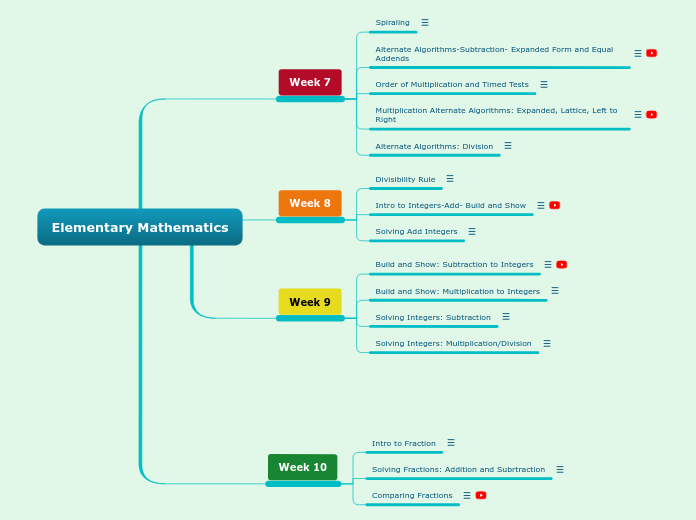
Spiraling
Spiraling: when you previously learn content and then go over it again and build onto it.
Alternate Algorithms-Subtraction- Expanded Form and Equal Addends
Alternate Algorithms- SubtractionExpanded Form: A way of writing a number in order to see it in its full valueEX: 425-204, 400+20+5 - 200+0+4, =200+20+1, =221Equal Addends: Eliminates having to borrow numbers.EX: 53-27, 53+3=56, 27+3=30, 56-30=26. 53-27 also equals 30.Both of these numbers are equivalent to 30 and because we added the same number to both 53 and 27, it equals the same distance apart.
aOrder of Multiplication and Timed Tests
Order of Multiplication:We want to teach our students their multiplication times table in this order:1s, 2s, 10s, 5s- First3s, 9s, doubles (2x2, 3x3)- Second4s, 6s, 7s, 8s- ThirdTimed tests are an inaccurate representation of a student's comprehension because they can severely stress out students because of being under a time crunch. Testing should represent a student's improvement and growth, not a competition of who can finish their test the fastest.
Multiplication Alternate Algorithms: Expanded, Lattice, Left to Right
MultiplicationExpanded FormExpand for place values and then multiply up then acrossEX: 35x28 30+5x 20+820x30=600, 20x5=1008x30=240, 8x5=40600+240=840100+40=140840+140=980Left to RightMultiply starting with the left side similar to expanded up and across then addEX: 47x53 47x5350x40=2000, 50x7=3503x40=120, 3x7=212000+350+120+21=2491LatticeDraw a lattice box with diagonal cuts and write one number on the top and the second number on the right then multiply across working right to left
aAlternate Algorithms: Division
DivisionThe best way to think of division is a number divided into a certain amount of groupsEX: 15/315 divided into 3 groupsTraditional DivisionStudents at this age will have a difficult time trying to figure out where the numbers go. Big numbers do not always go on the inside, with smaller numbers inside, but this is how their brain thinks it works. There is also trouble around the remainder and where to put the "extra" amount.Repeated SubtractionHave the students figure out the highest number that the factor will go into and have them write it on the side. Then, subtract and keep repeating. The remainder goes in the numerator and the outside number is the denominator. Upwards DivisionWrite the equation horizontal and spaced out. See how many times the denominator can go into the numerator and then write that on the side for the answer. Multiply the first two numbers from the numerator and answer the subtract that from the whole number. Continue this method until the whole number is complete. The remainder is the numerator leftovers and the denominator stays the same.
Divisibility Rule
Divisibility RuleHow students can tell if a number can be divided.
Intro to Integers-Add- Build and Show
IntegersBuilding: Red is always negative and Yellow is always positives.Positives are always on top and negatives are always on the bottom.Zero bank is always ZERO.EX: ++ --Showing: minus sign (-) is always used for negatives. Plus sign (+) is always used for positives.EX:Show 3 using 7+++ ++ --Show -6 using 8 +------ -AddingEX:5+2+++++ ++-3+4+++ +---
aSolving Add Integers
Small Groups and Large groups -2 + (-10) -2 small group, -10 large groupDifferent symbols you subtractSame symbols you addWrite 2 symbols for the larger pile and 1 symbol for the smaller pile-50+(-150)-150 has the larger pile so you write -- above it and -50 is the smaller pile so you write - above it Circle one symbol from each and follow the rule (different symbols: subtract/same symbols: add). 150+50=200 and the symbol outside of the circle determines what the answer is: -200
Build and Show: Subtraction to Integers
Say subtraction integers like: 5 positives take away 3 positives= 2 positives. ++ [+++]Show: 5-(-2)= +++++ ++ + {--} - = 7
aBuild and Show: Multiplication to Integers
4(3) four groups of three positives+++ +++ +++ +++5(-3) five groups of three negatives--- --- --- --- ----4(3) take away 4 groups of 3 positives+++ +++ +++ +++ TAKE AWAY THESE 4 GROUPS {++++} --- --- --- --- {----}
Solving Integers: Subtraction
Different symbols you subtractSame symbols you addwrite 2 symbols for the larger pile and 1 symbol for the smaller pile-5-(-4)=-1 5 negatives take away 4 negatives-5+4=-1 take away 5 negatives plus 1 positive~same answer by adding oppositesKEEP CHANGE CHANGE-45-30-45+(-30)-- ADD - you add 45+30=75 and the symbol leftover is negative which means the answer is -75
Solving Integers: Multiplication/Division
Negatives times Negative equals positiveSAME SIGNS= POSITIVEDIFF SIGNS= NEGATIVE-40(2)= -80 taking away 40 groups of 2 positivesdifferent signs-100(-20)= +2,000same signs16/(-8)= -2different signs
Intro to Fraction
FractionsThe top number is the numerator= # of things we haveThe bottom number is the denonemator= the size of the thingEX: 6/12 We have 6 things out of the 12 possible.
Solving Fractions: Addition and Subrtraction
AdditionAdding the whole number of a fraction is the easiest methodEX: 7 8/15 + 97+9=16answer =16 8/15To add fractions that are not similar, you need to make both of the denominators the same by finding the common denominator and then multiplying both the numerator and denominator by whatever is missingEX: 4/12 + 2/164/(4X3) + 2/(4x4)4(4)/12(4) + 2(3)/16(3)16/48 + 6/4816+6=22answer =22/48SubtractionSubtracting the whole number of a fraction is the easiest methodEX: 10 4/13 - 310-3= 7answer =7 4/13To subtract fractions that are not similar, you need to make both of the denominators the same by finding the common denominator and then multiplying both the numerator and denominator by whatever is missingEX: 3/12 - 2/203/(4X3) + 2/(4x5)3(5)/12(5) + 2(3)/20(3)15/60 + 6/6015-6=9answer =9/60
Comparing Fractions
Anchor Fractions: We know right away, the most common is 1/2We use (< less than,> greater than,= equal) to compare fractionsEX: 4/10 and 8/15 both are almost half. 4 is 6 away from 10 and 8 is 7 away from 15. The 7 pieces missing are smaller than the 6 pieces missing so you have more left from 8/15 than 4/10.EX: 3/6 and 6/12 both equal to 1/2. 3 is half of 6 and 6 is half of 12. These two fractions are equal to each other.
a