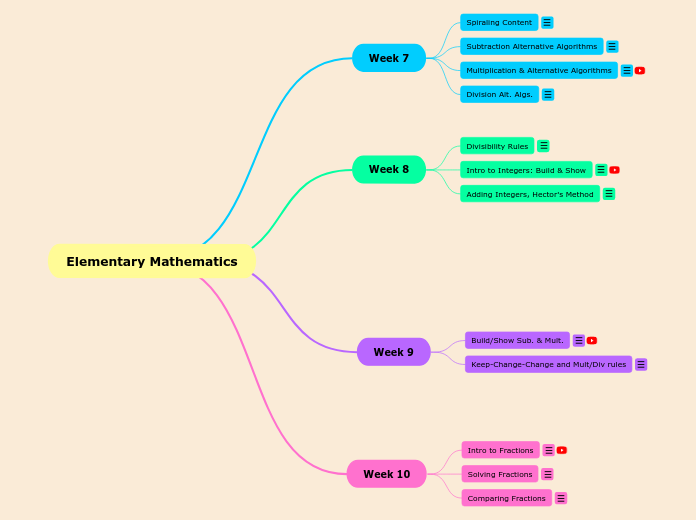
Spiraling Content
Revisit old content to help review when learning new contentReviewing old content helps to build on what they know and creates a better understanding of the content
Subtraction Alternative Algorithms
Expanded Form: write the numbers in expanded form, which they learned through addition alternative algorithms.Helps with place value425 - 204 = 400 + 20 + 5 - 200 + 0 + 4 = 200 + 20 + 1 = 221Introduces borrowingGood transition to get students to our traditional form of subtraction and borrowingEqual Addends: as long as you add the same (or equal) amount to both numbers, you can add anything you want without changing the difference between the two numbersAdding to make the bottom number smaller than the top 53 +3 56 - 27 +3 - 30 56 - 30 = 26Turn the number you are subtracting into a friendly number (# ending in 0)
Multiplication & Alternative Algorithms
4(6) = 4 groups of 6 ; 6(4) = 6 groups of 4Timed tests: ineffective, puts stress on young studentsFlashcards: effective, students can test themselves, automaticity, control which flashcards they are usingTricks: tricks using fingers/hands to count 9s is bad for learning math because students don't learn what the problem is actually composed of, they just know the trickuseful 9s tricks: digits of the answer add up to 9; the tens digit is always 1 less than what you are multiplying 9 byGroups: teach times tables in 3 groupsgroup 1: 1s, 2s, 5s, 10sgroup 2: 3s, 9s, double (4x4, 6x6...)group 3: the remaining 4s, 6s, 7s, 8sExpanded form: expand the number out (place value and place holders) then multiply outLeft to Right: multiply the numbers from left to rightLattice: draw out the lattice box and write one number on top and the other number on the right, multiply the numbers and put them in the diagonal spots in the box then add the diagonalsgives students a place for every digit
Division Alt. Algs.
12 ÷ 4 = 12 divided into 4 groupsTraditional Long Division:students have a hard time remembering where each number goesplace value is not definedremained ("r") gets confusingRepeated Subtraction:they don't need to know all of their times tables to get it rightdraw a line continuing all the way down the right sidecan use times tables and multiples that they know and are comfortable withmultiply by a number they won't get them over and subtract; repeat until eventually get down to the right answer and have 0 remaining or a remainder.add up the numbers on the right and carry the remainder overUpwards Division:write the problem the way you read it:532 ÷ 3 ; 532 divided by 3 ; 532 on top, 3 on the bottom (denominator)figure out how many times the denominator goes into the numerator and write that in the answer spot, then subtract that answer from the number in the numerator and continue on until you get the answerthe remainder stays in the numerator and the denominator stays the same
Divisibility Rules
Divisibility Rules:no rule for 72: even #'s that end in 0, 2, 4, 6, 83: the sum on the digits is divisible by 34: if the last two digits are divisible by 4, then 4 works5: last digit is a 5 or 06: if 2 and 3 works, then 6 works8: if the last three digits are divisible by 89: the sum of the digits is divisible by 910: last digit is 0
Intro to Integers: Build & Show
utilize countersall counters are red on one sidethe red counters represent negative integersBuilding:when building problems, put positives on the top row and negatives on the bottom romzero pair: when you're adding integers together that cancel out (to make zero) e.g. 1 positive and 1 negative = zeroex: build -5 using 9 tiles + + - - - - - - -
Adding Integers, Hector's Method
Hector's Method:instead of drawing out every single + and - (which is time consuming), draw out which one has more or less of the signex: 25 + (-12) + + -the number with two signs reminds us which is the "big pile" and the other with one sign is the "small pile"if the signs are the same, add; if signs are different, subtract25 + (-12)+ + - subtract 25 - 12whatever sign the "big pile" is, is the sign of your answer25 + (-12)+ + - = 13 positive
Build/Show Sub. & Mult.
sub. and mult. are two operations where you might have to make a zero bankSubtractioninstead of minus or subtract we say "take away" because it makes more sense through buildingBuilding:8 - 3 = 8 positives take away 3 positives++++++++ = 5 positives-4 - (-2) = 4 negatives take away 2 negatives- - - - = 2 negativeswhen subtracting a number that is larger than what is given, revisit building zero pairs that you can add in without changing the numberzero bank can be as big as we need it to be and won't change the value of the problemMultiplicationfirst number is number of groups and second number is the number of how many are inside the groups4(3) = 4 groups of 3 positives+++ +++ +++ +++ = 12instead of a negative number of groups we say take away that number of groupscreate a zero bank that you can take away from-6(2) = take away 6 groups of 2++++++++++++++++ - - - - - - - - - - - - - - - - = -12
Keep-Change-Change and Mult/Div rules
Solve Subtraction:subtraction is the same as adding the opposite12 - 4 = 812 + (-4) = 8Keep-Change-Change:another way of adding the oppositekeep the first sing the same, change the action from subtraction to addition, then change the sign of the second numberk c c24 - (-38)24 + 38 = 62in some cases, it turns the problem into something you already know and can use Hector's methodk c c27 - 5027 + (-50)+ - - subtract = -23Mult./Div. Rules:same signs = positivedifferent signs = negative-15 ÷ 3 diff. - 7(18) same +
Intro to Fractions
Parts of a fraction:the top number tells us the # of piecesthe bottom number tells us the size of the piecethe bigger the # in the denominator, the smaller the size of the piece; an inverse relationship # > # 10 20the numerator tells us how many of each size piece we have and have a direct relationship 8 > 5 # #
Solving Fractions
8 - 4/7borrow from the whole number and turn the 1 into something that makes it easy to subtract7 7/7 - 4/7 = 7 3/7no need for multiplying to find a common denominator, improper fractions, or putting a 1 on the bottomadd/subtract whole numbers firstCommon Denominators:we want denominators to be the same size pieceneed to figure out what one denominator has that the other is missingmultiply by what's missing so that it's equal to 1 and doesn't change the value of the fraction (ex: 3/3=1)creates common denominator or least common denominator (LCD)10 5/8 + 2 1/612 5/8 + 1/6 (2x4) (2x3)multiply 5/8 by 3/3 and multiply 1/6 by 4/4 to get common denominator12 15/24 + 4/24 = 12 19/24
Comparing Fractions
Ways to compare fractions:anchor fractions: fractions that are most commonly known like 1/2we can see if a fraction is bigger or smaller than 1/2ex: 7/13 > 11/23 2x7 = 14 > 13 2x11 = 22 < 23numerator has the same # of pieces, compare which pieces are bigger (denominator)/the size of the piecethe smaller the denominator, the bigger the pieceex: 2/9 < 2/7missing the same # of pieces, determine which is missing a smaller pieceex: 14/15 > 9/10 1/15 < 1/10 so 14/15 is missing lesswhole number comparisonex: 4 9/10 < 6 1/13 4 < 6comparing the same size piecesex: 3/12 < 4/12multiply to make the same size piecesex: 7/16 > 3/8 (2/2)x3/8 = 6/16 < 7/16