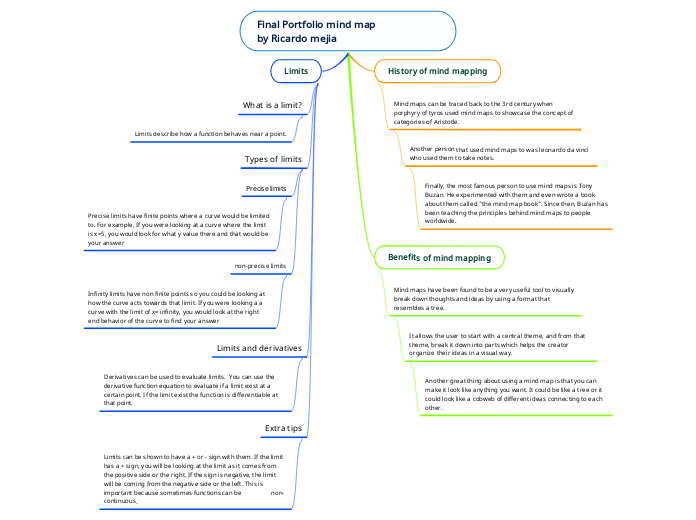
Mind maps can be traced back to the 3rd century when porphyry of tyros used mind maps to showcase the concept of categories of Aristotle.
Another person that used mind maps to was leonardo da vinci who used them to take notes.
Finally, the most famous person to use mind maps is Tony Buzan. He experimented with them and even wrote a book about them called "the mind map book". Since then, Buzan has been teaching the principles behind mind maps to people worldwide.
Mind maps have been found to be a very useful tool to visually break down thoughts and ideas by using a format that resembles a tree.
It allows the user to start with a central theme, and from that theme, break it down into parts which helps the creator organize their ideas in a visual way.
Another great thing about using a mind map is that you can make it look like anything you want. It could be like a tree or it could look like a cobweb of different ideas connecting to each other.
What is a limit?
Limits describe how a function behaves near a point.
Types of limits
Precise limits
Precise limits have finite points where a curve would be limited to. For example, If you were looking at a curve where the limit is x=5, you would look for what y value there and that would be your answer
non-precise limits
Infinity limits have non finite points so you could be looking at how the curve acts towards that limit. If you were looking a a curve with the limit of x= infinity, you would look at the right end behavior of the curve to find your answer
Limits and derivatives
Derivatives can be used to evaluate limits. You can use the derivative function equation to evaluate if a limit exist at a certain point. If the limit exist the function is differentiable at that point.
Extra tips
Limits can be shown to have a + or - sign with them. If the limit has a + sign, you will be looking at the limit as it comes from the positive side or the right. If the sign is negative, the limit will be coming from the negative side or the left. This is important because sometimes functions can be non-continuous.