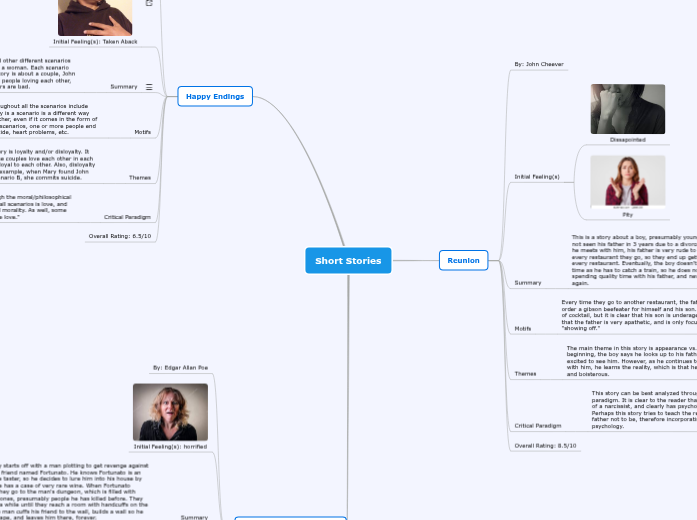
Short Stories
Reunion
By: John Cheever
Initial Feeling(s)
Dissapointed

Pity
Summary
This is a story about a boy, presumably young, who has
not seen his father in 3 years due to a divorce. However, when he meets with him, his father is very rude to every waiter at every restaurant they go, so they end up getting kicked out of every restaurant. Eventually, the boy doesn't have anymore time as he has to catch a train, so he does not end up spending quality time with his father, and never sees him again.
Motifs
Every time they go to another restaurant, the father wants to order a gibson beefeater for himself and his son. This is a type of cocktail, but it is clear that his son is underage. This implies that the father is very apathetic, and is only focused on "showing off."
Themes
The main theme in this story is appearance vs. reality. At the beginning, the boy says he looks up to his father, and is very excited to see him. However, as he continues to spend time with him, he learns the reality, which is that he is very selfish and boisterous.
Critical Paradigm
This story can be best analyzed through the psychoanalytical paradigm. It is clear to the reader that the father is somewhat of a narcissist, and clearly has psychological problems. Perhaps this story tries to teach the reader of what kind of a father not to be, therefore incorporating some slight reverse psychology.
Overall Rating: 8.5/10
Happy Endings
By: Margaret Atwood

Initial Feeling(s): Taken Aback
Summary
This short story consists of several other different scenarios that includes 2 people, a man and a woman. Each scenario has a different ending, but each story is about a couple, John and Mary. Each story has different people loving each other, some endings are good while others are bad.
Motifs
Motifs that are found throughout all the scenarios include
death and love. Each story is a scenario is a different way
that 2 people love each other, even if it comes in the form of disloyalty. In most of the scenarios, one or more people end up dying, either from suicide, heart problems, etc.
Themes
The main theme in each story is loyalty and/or disloyalty. It seems that the only time the couples love each other in each scenario is when they stay loyal to each other. Also, disloyalty seems to cause chaos. For example, when Mary found John with another woman, in scenario B, she commits suicide.
Critical Paradigm
This story can be best viewed through the moral/philosophical paradigm. The main theme/motif in all scenarios is love, and love deals with human emotions and morality. As well, some scenarios deal with infidelity, or "fake love."
Overall Rating: 6.5/10
The Cask of Amontillado
By: Edgar Allan Poe
Initial Feeling(s): horrified
Summary
The story starts off with a man plotting to get revenge against a former friend named Fortunato. He knows Fortunato is an avid wine taster, so he decides to lure him into his house by saying he has a case of very rare wine. When Fortunato comes, they go to the man's dungeon, which is filled with human bones, presumably people he has killed before. They walk for a while until they reach a room with handcuffs on the wall. The man cuffs his friend to the wall, builds a wall so he can't escape, and leaves him there, forever.
Motifs
The main motif that is used in this story is human bones and remains, to signify death. As the 2 characters are walking through the basement/dungeon, all there is on the ground is bones, which implies that the main character is a mass murderer. Also, wine is used as a motif to lure Fortunato to the house.
Themes
The main theme that is revealed in this story is revenge. The narrator states at the beginning that he has been wanting to get revenge against Fortunato for a long time, which explains the reasoning behind his actions. However, he does not state what Fortunato had done to him, so this can also reveal the theme of ambiguity as the reader does not know if the main character is just crazy, or was actually hurt by Fortunato.
Critical Paradigm
This story can be best analyzed through a moral/philosophical paradigm, since it deals with the concept of revenge. If it is true that Fortunato had hurt his friend, then it is up to the reader to decide if it is moral to torture him for it.