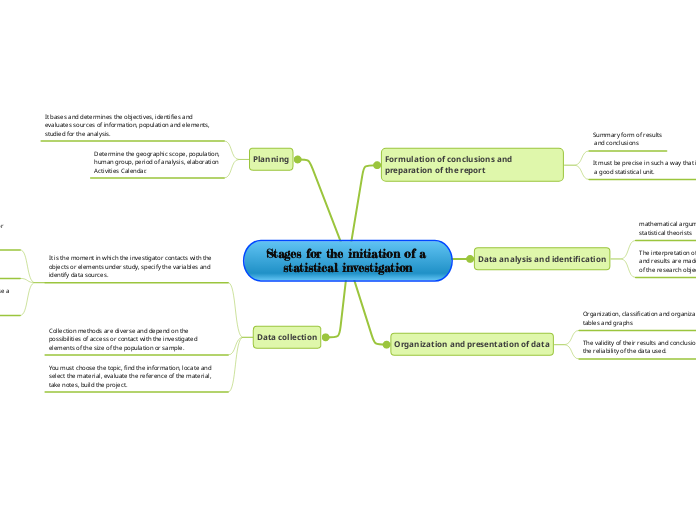
Stages for the initiation of a statistical investigation
Formulation of conclusions and preparation of the report
Summary form of results
and conclusions
It must be precise in such a way that it facilitates
a good statistical unit.
Data analysis and identification
mathematical arguments and
statistical theorists
The interpretation of the data
and results are made in the context
of the research objectives.
Organization and presentation of data
Organization, classification and organization in
tables and graphs
The validity of their results and conclusions depend
the reliability of the data used.
Planning
It bases and determines the objectives, identifies and evaluates sources of information, population and elements, studied for the analysis.
Determine the geographic scope, population,
human group, period of analysis, elaboration
Activities Calendar.
Data collection
It is the moment in which the investigator contacts with the objects or elements under study, specify the variables and identify data sources.
It can be carried out in two modalities: the documentary or bibliographical research technique, and the field work technique.
There are several techniques to collect data, such as: observation, interview, questionnaire, survey.
A group and practical work must be carried out, to propose a work with a question posed, population, sample, type of variable, table, graph.
Collection methods are diverse and depend on the
possibilities of access or contact with the investigated elements of the size of the population or sample.
You must choose the topic, find the information, locate and select the material, evaluate the reference of the material, take notes, build the project.