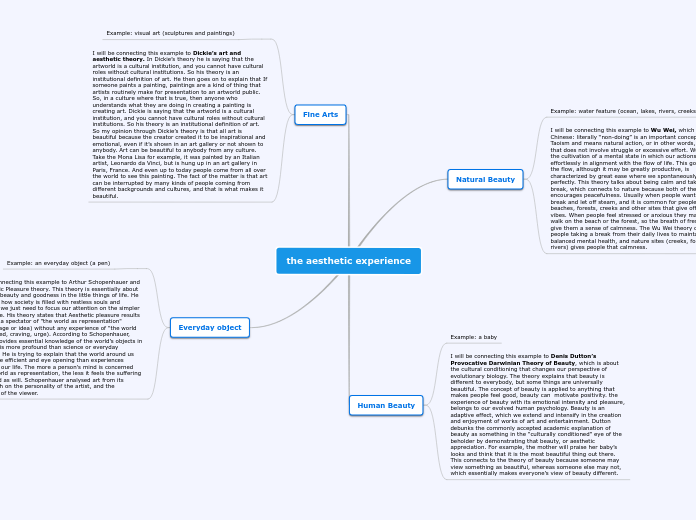
Example: water feature (ocean, lakes, rivers, creeks)
I will be connecting this example to Wu Wei, which means in Chinese: literally “non-doing” is an important concept of Taoism and means natural action, or in other words, action that does not involve struggle or excessive effort. Wu wei is the cultivation of a mental state in which our actions are quite effortlessly in alignment with the flow of life. This going with the flow, although it may be greatly productive, is characterized by great ease where we spontaneously act perfectly. This theory talks about being calm and taking a break, which connects to nature because both of these things encourages peacefulness. Usually when people want to take a break and let off steam, and it is common for people to go to beaches, forests, creeks and other sites that give off nature vibes. When people feel stressed or anxious they may take a walk on the beach or the forest, so the breath of fresh air will give them a sense of calmness. The Wu Wei theory consists of people taking a break from their daily lives to maintain a balanced mental health, and nature sites (creeks, forests, rivers) gives people that calmness.
Example: a baby
I will be connecting this example to Denis Dutton’s Provocative Darwinian Theory of Beauty, which is about the cultural conditioning that changes our perspective of evolutionary biology. The theory explains that beauty is different to everybody, but some things are universally beautiful. The concept of beauty is applied to anything that makes people feel good, beauty can motivate positivity. the experience of beauty with its emotional intensity and pleasure, belongs to our evolved human psychology. Beauty is an adaptive effect, which we extend and intensify in the creation and enjoyment of works of art and entertainment. Dutton debunks the commonly accepted academic explanation of beauty as something in the “culturally conditioned” eye of the beholder by demonstrating that beauty, or aesthetic appreciation. For example, the mother will praise her baby’s looks and think that it is the most beautiful thing out there. This connects to the theory of beauty because someone may view something as beautiful, whereas someone else may not, which essentially makes everyone’s view of beauty different.
Example: visual art (sculptures and paintings)
I will be connecting this example to Dickie’s art and aesthetic theory. In Dickie’s theory he is saying that the artworld is a cultural institution, and you cannot have cultural roles without cultural institutions. So his theory is an institutional definition of art. He then goes on to explain that If someone paints a painting, paintings are a kind of thing that artists routinely make for presentation to an artworld public. So, in a culture where that is true, then anyone who understands what they are doing in creating a painting is creating art. Dickie is saying that the artworld is a cultural institution, and you cannot have cultural roles without cultural institutions. So his theory is an institutional definition of art. So my opinion through Dickie’s theory is that all art is beautiful because the creator created it to be inspirational and emotional, even if it’s shown in an art gallery or not shown to anybody. Art can be beautiful to anybody from any culture. Take the Mona Lisa for example, it was painted by an Italian artist, Leonardo da Vinci, but is hung up in an art gallery in Paris, France. And even up to today people come from all over the world to see this painting. The fact of the matter is that art can be interrupted by many kinds of people coming from different backgrounds and cultures, and that is what makes it beautiful.
Example: an everyday object (a pen)
I will be connecting this example to Arthur Schopenhauer and his Aesthetic Pleasure theory. This theory is essentially about finding the beauty and goodness in the little things of life. He talks about how society is filled with restless souls and sometimes we just need to focus our attention on the simpler things of life. His theory states that Aesthetic pleasure results from being a spectator of "the world as representation" (mental image or idea) without any experience of "the world as will" (need, craving, urge). According to Schopenhauer, this also provides essential knowledge of the world’s objects in a way that is more profound than science or everyday experience. He is trying to explain that the world around us can be more efficient and eye opening than experiences throughout our life. The more a person's mind is concerned with the world as representation, the less it feels the suffering of the world as will. Schopenhauer analysed art from its effects, both on the personality of the artist, and the personality of the viewer.