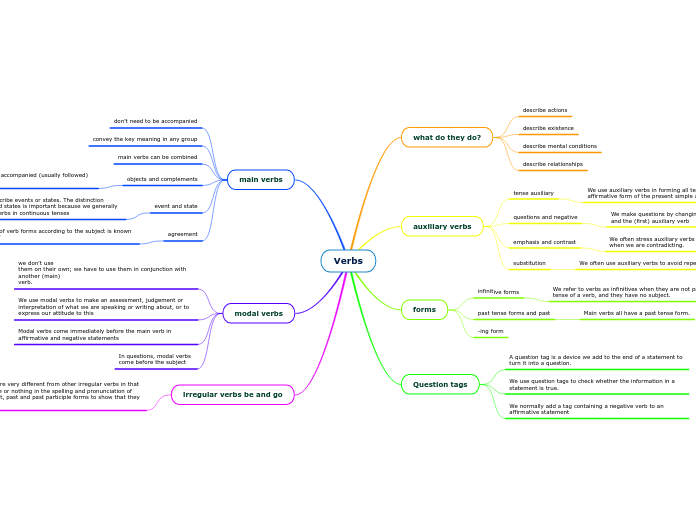
describe actions
describe existence
describe mental conditions
describe relationships
tense auxiliary
We use auxiliary verbs in forming all tenses other than the affirmative form of the present simple and the past simple.
questions and negative
We make questions by changing the usual order of the subject and the (first) auxiliary verb
emphasis and contrast
We often stress auxiliary verbs for emphasis, for example when we are contradicting.
substitution
We often use auxiliary verbs to avoid repeating a whole phrase
infinitive forms
We refer to verbs as infinitives when they are not part of the tense of a verb, and they have no subject.
past tense forms and past
Main verbs all have a past tense form.
-ing form
A question tag is a device we add to the end of a statement to turn it into a question.
We use question tags to check whether the information in a statement is true.
We normally add a tag containing a negative verb to an affirmative statement
don't need to be accompanied
convey the key meaning in any group
main verbs can be combined
objects and complements
Some main verbs need to be accompanied (usually followed) by further information.
event and state
Main verbs can describe events or states. The distinction between events and states is important because we generally avoid using state verbs in continuous tenses
agreement
This choosing of verb forms according to the subject is known as 'agreement'
we don't use
them on their own; we have to use them in conjunction with another (main)
verb.
We use modal verbs to make an assessment, judgement or interpretation of what we are speaking or writing about, or to express our attitude to this
Modal verbs come immediately before the main verb in affirmative and negative statements
In questions, modal verbs
come before the subject
Be and go are very different from other irregular verbs in that there is little or nothing in the spelling and pronunciation of their present, past and past participle forms to show that they are related.