Feasibility Study
AIM
Determine whether it would be
technically and financially feasible
to develop the product.
ACTIVITY
*Analysis of problem.
*Collection of relevant information.
TYPES
Technically Feasibility
Operational Feasibility
Economic Feasibility
Legal Feasibility
Schedule Feasibility
Requirement Analysis and Specification
AIM
Understand the requirements of the
customer exactly and to document properly.
ACTIVITY
Requirement Gathering
and Analysis
Requirements Specification
Design
AIM
Design phase is to transform the requirements specified in the SRS document into a structure that is suitable for implementation in some programming language.
TYPES
Traditional design
approach
Object Orientated
design approach
Coding and Unit Testing
In coding phase software design is translated into source code using any suitable programming language. Thus each designed module is coded. The aim of the unit testing phase is to check whether each module is working properly or not
Integration and System Testing
During this phase, the different
modules are integrated
in a planned manner.
SYSTEM TESTINGS
Alpha Testing
Beta Testing
Acceptance Testing
Maintenance
Maintenance involves monitoring and
improving system performance, enhancing
system services, and upgrading to newer versions.
TYPES
Corrective Maintenance
Perfective Maintenance
Adaptive Maintenance
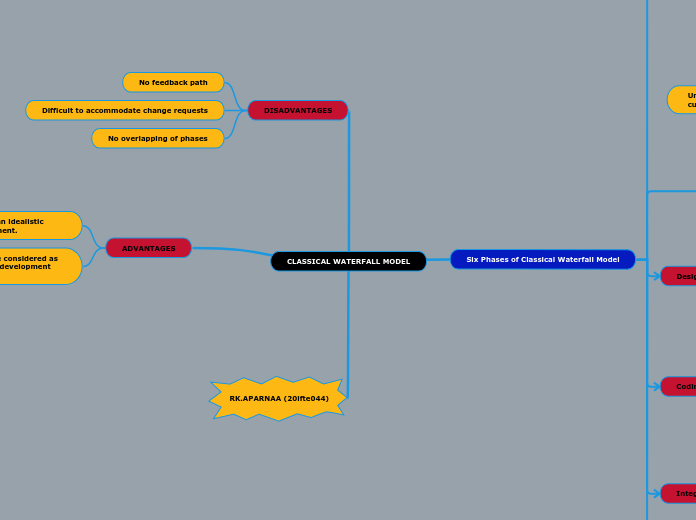
No feedback path
Difficult to accommodate change requests
No overlapping of phases
Classical waterfall model is an idealistic model for software development.
It is very simple, so it can be considered as the basis for other software development life cycle models.