Syllabus materials, book
The syllabus of the class was shared with us prior to starting class and was explained to us in class. Went through what is expected from us in class and what we will be learning in class. This class will help us understand the concepts of math in order help students understand math. When homework is due and to always write a self evaluation when turning in homework. Answer key will always be provided, so check homework before turning it in. Cell phones must be put on silence or turned off during class We also discussed grading rubric.Materials needed for class:This is three different examples of base ten blocks. I don't care which one you get.The rest of the materials:2-color counters:Fraction squares or Circles (circles not pictured):Color tiles or Connecting tiles (connecting tiles not shown):Bar ModelsLink for online book:https://pearhttps://pearsoncustomersuccess.co/ASUseamlessmlmstusoncustomersuccess.co/ASUseamlessmlmstu (Links to an external site.)
aJessies Story, Polyas 4 step process Juggling activity
Jessie's Story:The teachers experience with a defiant student at the beginning of his career. Which teaches that we can't judge a student without know his background. That making connections with students develops successful students.Polya's 4-step Process-Understand the problem-Develop a plan-Carry out the plan-Self Review (look back)Juggling Activity:Activity in which teacher had us practice juggling for the about 5 minutes. Which taught us that the more we practice something the better we get at it. Practice makes perfect.
aIntroduced base 10 manipluatives and meanings.
Vocabulary
More or less: More meaning bigger(addition) and less(subtraction) in math problems.Counting: how we figure out how many objects are in a group.One to one corresponding: counting exactly how many objects there is by moving them from one place to another.Cardinality: having to count the number of objects in a group.Subitizing: look at the objects in a group and know how many there is you don't have to count them. Number recognition: being able to recognize numbers and their names.Base: Number of units you have. No base written then it's base 10.Build: demonstrate with blocksShow: draw
Five Frame and Ten Frame
Five frames: used for when learning to count. Ten frames: also used in learning to count and for addition and subtraction.
adConverting from base 10 to different bases
Converting from 13 to base 4: you have 13 units. How many talls can you make with 4 units in each. Converting from a set base to base 10: is how many units do you have?
dAdding in different bases (build and show)
Build and add in different basesShow and add in different bases:
dVocabulary
Algorithm: Steps that can be used to solve a math problem.- -A good algorithm in math must be:Expandable: does it work no matter how hard the problem is.Efficient: easy to do.Solid mathematical understanding: does it make sense with prior knowledge.Expanded form: writing problem according to digit place value. Left to Right: starting to solve problem from the left to the right. Friendly numbers: numbers that are easy to work with such as 10.Trading off: similar to friendly numbers they go hand in hand only difference is that in trading off only one number will end in 0.
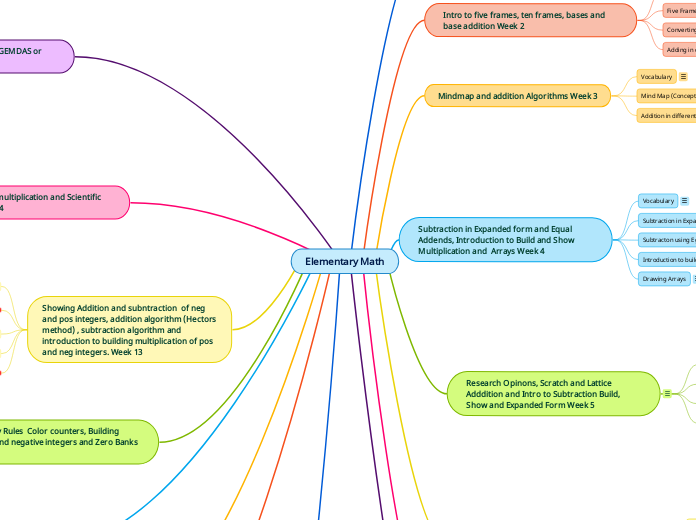
Mind Map (Concept Map)
Mind Map (also can be called a concept map): -A digital review of all semester. -All notes can be found in one place.Instructions for mind map (concept map_: -Look at agendas for topics -Notes can be done in examples, dont have to done in words. -Accuracy is important. -Every topic must have a link to a video related to topic. -Notes to go in live link. -Must make mind map public. -Keep adding to mind map on a weekly basis (easier) -Should have 15 weeks. -Look for links in Syllabus in purple (free download software).
aAddition in different Algorithms
Addition in: -Expanded form: according to digit place value 323: 300+20+3Left to Right: starting to solve problem from left to the right .Friendly Numbers: solving the problem with a number easy to work with such as 10.Trading off: similar to friendly numbers they go hand in hand only difference is that in trading off only 1 number will end in 0.
dVocabulary
Equal Addends: when you add the same number to both sides of the problem in order to solve it.Multiplication: a number of groups and what is inside of them, used to find the area of a rectangle.Array: when units are in a group not touching each other but arranged in columns.( ): in multiplication means the number of units in a group.Area model: A rectangular diagram used for multiplication.
Subtraction in Expanded form and bases
Expanded form subtracting without and with bases:
dSubtracton using Egual Addend and in Bases
Equal Addends Subtraction without and with bases:
dIntroduction to build and show multiplication
Example of meaning of () in multplication:Build multiplication problems:Show multiplication problems:
dDrawing Arrays
Arrays:
adFlash cards -should be used by writing same multiplication problem various times (more practice) and playing games such as memoryMultiplication grouping -times table should be taught by groups 1st--0,1,2,5 and 10 times tables 2nd--3,9 and doubles 4x4, 5x5, 6x6, etc. 3rd--4,6,7 and 8Procedure to teach 9 times table:
dVocabulary
Scratch Method: you add in single digits to get to higher than 9 and scratch(/) the number and put what's left over on the side.Lattice Method: let's you add large numbers without having to carry the 10 as much.
Research Opinions
Research Opinions: -Adding vertically in the traditional for is that good because: -too many numbers for kids to add accurately -more margin for error -confusing to add -not good for struggling students -We need to make some mistakes to make snapses in order to improve brain function. -Being wrong is not bad on the contrary it's what we've been taught. -Nobody wants to keep trying afraid of failure, but practice makes perfect!
Scratch and Lattice Addiition
Scratch Method Addition:Lattice Method for Addition:
adIntro to subtraction build and expanded form
Building with blocks for subtraction:Expanded form subtraction:
dHow multiplication is learned
Timed time tables - (scientific research says its not good) causes too much stress for students.Flash cards -not really good student don't really learn.Then -we had to learn times tables up to 12Now -we only have to learn times tables to 10Nine's finger trick -not good, students not learning factors
aBetter way of teaching multiplication
Flash cards -should be used by writing the problem various times (more practice and plaing games such as memoryMultiplication grouping -teaching multipication in groups 1st--0,1,2,5 and 10 2nd--3,9 and doubles 4x4, 5x5, 6x6, etc.. 3rd--4,6,7 and 8Better way to teach 9 times tables
dMultiplication Algorithms
Vocabulary
Numerator: -number on top of fration when dividing aslo called divisor or what you are dividingDenominator: -number on bottom of fraction, when dividing is called divisee, what group is being divided byRemainder: -number left over after dividingWhole number: -number that is not a fraction or decimal, counting numbers
Examples of numerator, denominator, remainder and whole number
Factor Activities
In and Out
Multiplication Algorithms
Struggling students not quite sure what to do with number left over in a division problem, it's easier if they put it in fraction formIf student is not good at estimating, they probably are not good at divisionIf student is not good at multiplyins they are probably not good at division.Algorithms might help
dVocabulary
Demoninator -Tells us the size of the pieces you haveNumerator -Tells us how many pieces you haveInverse Relationship -When smaller number represents more but the smaller number is a bigger piece.<less than, which fraction is smaller> greater than, which fraction is biggerAnchor Fractions-Fractions we aldeady knowCommon Demonimator -same size pieces
Purpoose of common denominators,
Why do we need common denominators when adding or subtracting fractions but not when we multiply fractions?When we multiply fractions we are multiplying number of groups. What you have in one group times what you have in other group.When adding or substracting fractions the pieces have to be the same size order to get an accurate answer.
Examples of which is bigger fractions and reasons.
Butterfly method
Butterfly method only good to tell us which fraction is bigger and which fraction is smaller in addition, subtraction and muliplication.
aStudents neede strength in Upward and Repeated Division
Students needed Strengths when using Upward and Repeated Division in order to properly understand the process of these algorithms.Students need to have a concrete prior understading of substraction, addition and multiplication when it comes to upward division. Place Value is not a benefit when doing this algorithm.Students need to have a solid understanding of place value in Repeated Division. Solid understanding of subtraction, addition and multiplication is not really a benefit when doing this algorithm.
Order of operations
PEMDAS
GEMOAS or GEDMAS
Examplesc
Build Mulptiplcaton
Show multiplication
Scientifc Notation
Vocabulary
Vocabulary Hectors method: -Algorithm for addition of positive and negative integers invented by prior stdent perfected by Mr. Miltenberger where the bigger pile gets two symbols and the smaller pile gets one symbol , circle one of each signs the sign that is left over is what the answer is going to be either negative or positive. When you circle two of the same sign you add the numbers. When you circle two different signs you subtract the numbers.Additive inverse: -Algorithim for substraction of positive and negative integers KEEP the first sign, CHANGE the addition or subtraction sign to its opposite, CHANGE the third sign. then bigger pile gets two symbols and the smaller pile gets one symbol , circle one of each signs the sign that is left over is what the answer is going to be either negative or positive. When you circle two of the same sign you add the numbers. When you circle two different signs you subtract the numbers.
Showing subtraction and addition of negative and positive integers
Show:
adAddition Algorithm (Hectors Method)
Hectors Method
dSubtraction Algorithm
Intro to building of multiplaction of pos and neg integers
When multiplying -same signs make a postive answer -different signs make a negative answer Build
adVocabulary
VocabularyDivisibility Rules - -understanding that numbers can be divided evenly with no remainder left over.Color Counters:two colored chips representing postive and negative integersYellow side represent positive integerRed side represent negative integerZero Bank:Many zero pairs+ + + +_ _ _ _
Diivisibility Rules
Divisibility Rules 1 is not listed because every integer ( positive or negative) can be divided by 1 evenly
adBuilding positive and negative integers
When building shape does not matter COLOR does: Red is always a negative and should be placed as a bottom row. Start by putting down the amount you want. Add Zero Pairs
dZero banks
Importance of ZERO Banks: -It is a physical way of seeing what is being taken away in subtraction problems. -Zero banks are only needed in subtraction problemsWhen showing Build a Zero BankRead problem how you would normally read 3 Take away what is needed circle zero bank What is left over is answer.
dVocabulary
Equivalent Fractions: -When fractions have the same numerator and denominator but represent the same amount.Estimating in fractions or decimals: -Rounding to the nearest whole number either up or down.Decimal: -When a period separates the whole number and the fraction.One, Tenths and Hundreths
dEquivalent Fractions
Showing how to Add, Subtract and Multiply Fractionss
Adding , Subtracting and Multiplying decimals
Showing how to Add, Subtract and Multiply Decimals
Vocabulary
Improper fractions: -When the numerator is bigger than the denominatorMixed numbers: -A whole number with a proper fraction next to itProper fractions: -When the numerator is smaller than the denominatorCommunitive fractions: -When how you add or multiply two numbers does not affect the outcome/answer.Simplify fractions: -reduce to smallest fraction possibleReciprocal: -Switching the numerator and denominator positionFunky ones: -When the numerator and denominator are the same number which equals 1 whole
Process for Subtracting Fractions
Process for subtracting fraction: Find lowest factors for denominator Find factor that is not the duplicate Multiply oposite fraction both numerator and denominator with factor not duplicatedDenominator should be sameRewrite simplified fractions Subtract numerators
adProcess for Addng Fractions
Process for adding fractions: Find lowest factors for denominator Find factor that is not the duplicate Multiply oposite fraction both numerator and denominator with factor not duplicatedDenominator should be sameRewrite simplified fractions Add numerators
dAlgorithms for Multiplying Fractions and Fractions with Whole numbers
Process for multiplying fractions:Simplify fractions Multiply numerator times numerator 3. Write answer as numerator 4. Draw fraction line 5. Multiply denominator 6. Write answer as denominator Multiplying mixed numbers:Turn it into improper fraction Simplify fractionsMultiply numerator times numeratorWrite answer as numerator Draw fraction lineMultiply denominator Write answer as denominator Turn improper fraction to mixed number
adAlgorithm of Dividing Fractions and Whole Numbers with Fractions
When dividing fractions Keep Change Flip (KCF) -Keep the first fractions as it is -Change the division sign to a multiplication sign -Flip or do the reciprocal of the second fraction Simplify fractionsMultiply numerator times numerator 3. Write answer as numerator 4. Draw fraction line 5. Multiply denominator 6. Write answer as denominator 7. If needed turn improper fraction to proper fraction with whole number(if needed)Dividing mixed numbers: 1.Turn it into improper fraction-Keep the first fractions as it is-Change the division sign to a multiplication sign-Flip or do the reciprocal of the second fraction 2.Simplify fractions 3.Multiply numerator times numerator 4.Write answer as numerator 5. Draw fraction line 6. Multiply denominator 7. Write answer as denominator 8. Turn improper fraction to mixed number (if needed)
d