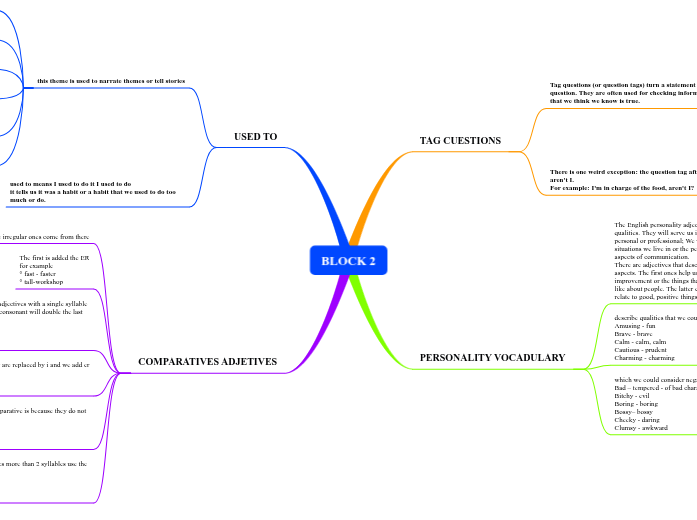
BLOCK 2
TAG CUESTIONS
Tag questions (or question tags) turn a statement into a question. They are often used for checking information that we think we know is true.
Tag questions are made using an auxiliary verb (for example: be or have) and a subject pronoun (for example: I, you, she). Negative question tags are usually contracted: It's warm today, isn't it (not 'is it not')
Usually if the main clause is positive, the question tag is negative, and if the main clause is negative, it's positive. For example: It's cold (positive), isn't it (negative)? And: It isn't cold (negative), is it (positive)?
If the main clause has an auxiliary verb in it, you use the same verb in the tag question. If there is no auxiliary verb (in the present simple and past simple) use do / does / did (just like when you make a normal question).
There is one weird exception: the question tag after I am is aren't I.
For example: I'm in charge of the food, aren't I?
PERSONALITY VOCADULARY
The English personality adjectives speak of their personal qualities. They will serve us in different contexts, whether personal or professional; We will also be able to define the situations we live in or the people around us: totally necessary aspects of communication.
There are adjectives that describe both negative and positive aspects. The first ones help us to express the points of improvement or the things that we consider that we do not like about people. The latter express those qualities that we relate to good, positive things that bring us into our lives.
describe qualities that we could consider positive
Amusing - fun
Brave - brave
Calm - calm, calm
Cautious - prudent
Charming - charming
which we could consider negative
Bad – tempered - of bad character
Bitchy - evil
Boring - boring
Bossy– bossy
Cheeky - daring
Clumsy - awkward
USED TO
this theme is used to narrate themes or tell stories
in the affirmative case, the pronoun first, then the used to, and a verb and complement
afirmative ° fernanda used to work in stationery on vacations.
In the case of negative, the pronoun goes first, then the didn't to, then the verb and complement.
negative ° fernanda didn´t use to work in stationery on vacations.
For questions, at first the did follows the use to verb and complement.
yes, I did or did not answer
sentences ° Did fernanda use to work in stationery on vacations?
used to means I used to do it I used to do
it tells us it was a habit or a habit that we used to do too much or do.
COMPARATIVES ADJETIVES
There are 4 rules and some irregular ones come from there
The first is added the ER
for example
° fast - faster
° tall-workshop
The second when you see the adjectives with a single syllable and end in a consonant vowel consonant will double the last consonant
for example
° big- bigger
° fat-fatter
Rule 3 if they end in Y, they are replaced by i and we add er
for example
° happy-happier
° dry-drier
There is also the irregular comparative is because they do not comply with the 4 rules
for example
° good-better
° little-less
Rule 4 when we have adjectives more than 2 syllables use the more
for example
° beautiful-more beatiful
° expensive- more expensive