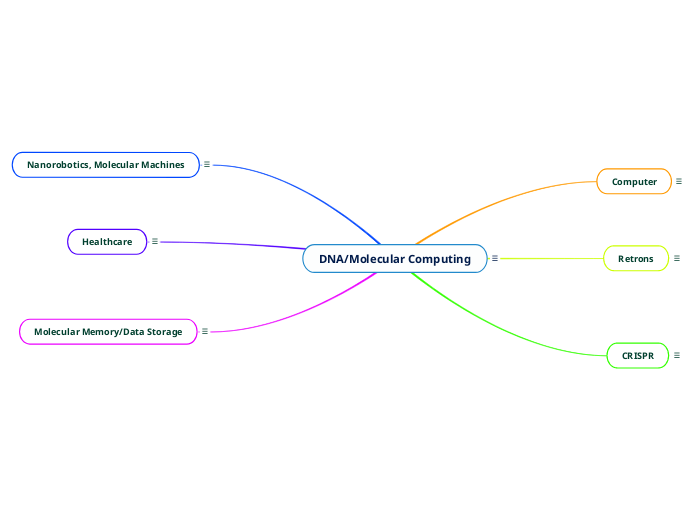
DNA computing is one of several radical new ideas emerging from a computing industry struggling to deliver faster chips. It uses the same chemical base pairs, represented by the letters C, A, T and G, as the DNA that stores your own genetic informationhttps://www.cnet.com/science/dna-data-storage-startup-expands-into-dna-computing-too/
DNA computing, the performing of computations using biological molecules, rather than traditional silicon chips. https://www.britannica.com/technology/DNA-computing
a distinct DNA sequence found in the genome of many bacteria species that codes for reverse transcriptase and a unique single-stranded DNA/RNA hybrid called multicopy single-stranded DNA https://en.wikipedia.org/wiki/Retron#:~:text=A%20retron%20is%20a%20distinct,%2Dstranded%20DNA%20(msDNA).
CRISPR-Cas9 is a genome editing tool that is creating a buzz in the science world. It is faster, cheaper and more accurate than previous techniques of editing DNA and has a wide range of potential applications.https://www.yourgenome.org/facts/what-is-crispr-cas9
measuring just 1-100 nanometers, are unique to their bulk material counterpart, with their small scale gifting them properties that can be leveraged into new applications, making technologies possible that previously had been out of reach.https://www.sciencedirect.com/topics/engineering/nanobots
aDiseases cured from CRISPRCervical cancer HPVSickle Cell AnemiaBeta ThalassemiaAlzheimer's B-cell Acute Lymphoblastic LeukemiaLung and Esophageal cancersNeurodegenerative DisordersHuntington’s DiseaseDuchenne Muscular DystrophyRetinitis PigmentosaLeber Congenital AmaurosisMultiple MyelomaSpecific Retinal DystrophyHIVhttps://www.synthego.com/blog/crispr-cure-diseases#how-crispr-is-curing-eye-diseases
By synthesizing DNA molecules making them from scratch researchers have found they can specify, or write, long strings of the letters A, C, G and T and then read those sequences back. The process is analogous to how a computer stores binary information. From there, it was a short conceptual step to encoding a binary computer file into a moleculehttps://www.scientificamerican.com/article/dna-the-ultimate-data-storage-solution/