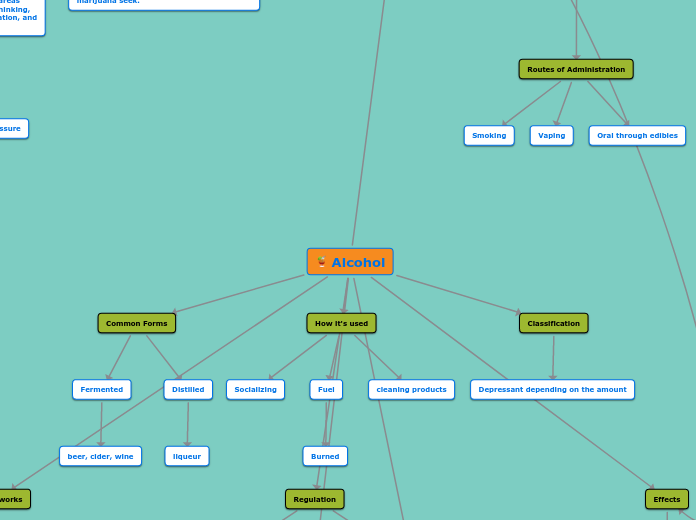
Fermented
beer, cider, wine
Distilled
liqueur
Socializing
Fuel
Burned
cleaning products
Depressant depending on the amount
It slowly moves through the body and is absorbed into the blood stream. The liver breaks it down and it is metabolized and passes through the system.
Alcohol and Tobacco Tax and Trade Bureau regulates Alcohol
21st amendment
The sale of alcohol within the state
The distribution of alcohol within the state
The importation of alcohol into the state
Statutes regarding who can possess alcohol within the state
Physical Effects
Trouble concentrating
Loss of coordination
Slower brain activity
Sleepiness
Mood swings
Dilated pupils
Stumbling
Passing out
Vomiting
Alcoholism
Falls, drownings, and other accidents
Head, neck, stomach, colon, breast, and other cancers
Heart attack and stroke
Motor vehicle accidents
Risky sex behaviors, unplanned or unwanted pregnancy, and sexually transmitted infections (STIs)
Suicide and homicide
Injuries
Health Problems
Birth defects
Alcohol Use Disorder
By mouth as a drink
Common Forms
Codeine
Fentanyl
Hydrocodone
Oxycodone
Oxymorphone
Morphine
How it's used
Opioids are often used as medicines because they contain chemicals that relax the body and can relieve pain. Prescription opioids are used mostly to treat moderate to severe pain, though some opioids can be used to treat coughing and diarrhea.
Classification
Schedule I: heroin
Schedule II: Dilaudid (hydromorphone), Demerol (meperidine), Dolophine (methadone), Duragesic or Sublimaze (fentanyl), morphine, opium, OxyContin and Percocet (oxycodone), Vicodin and other medications with hydrocodone (These were reclassified in 2014 in the Schedule II category regardless of the amount of hydrocodone they contain.)Schedule III: buprenorphine products, such as Buprenex, Suboxone, Subutex, and Temgesic
Schedule IV: tramadol
Schedule V: some preparations with codeine, such as Robitussin AC
Regulation
Almost half of the states in the U.S. and the District of Columbia currently have regulated mandatory three to seven day limits bounding the amount of opioids that a doctor can prescribe a patient.
How it Works
Concerns
Long-term
Addiction: Opioids can make your brain and body believe the drug is necessary for survival. Overdose and death.
Short-term
Shallow breathing
Slowed heart rate
Loss of consciousness
Opioids attach themselves to opiate-sensitive nerve cells that produce the same chemical that creates pleasure for performing survival tasks, like eating. Opioids can relieve pain, induce slow breathing, increase pleasure and relaxation, and reduce coughing.
Opioids attach to proteins called opioid receptors on nerve cells in the brain, spinal cord, gut and other parts of the body. When this happens, the opioids block pain messages sent from the body through the spinal cord to the brain.
Effects
Sleepiness
Constipation
Nausea
Routes of administration
Oral Route. Generally, the oral route is the preferred route of administration. ...
Enteral Tubes. Nasogastric (NG), percutaneous endoscopically placed gastrostomy (PEG) tubes, and jejunal (J) tubes, if already present, may also be used for drug delivery. ...
Transdermal Route. ...
Transmucosal. ...
Aerosol.
Hemp Plant
dried, shredded leaves, stems, seeds, and flowers
Hashish
Resins
Wax
Oils, sprays, tinctures
vape
Smoked
Edibles
Subtopic
Tinctures, oils, sprays
Depressant
Slows down messages that travel between the body and brain
Stimulent
Enhances mood and treats depression symptoms
It is regulated in the criminal justice system
Many states have deregulated marijuana and have made it legal for either or both recreational and/or medical use
Contain delta-9-tetrahydrocannabinol (THC), the main active chemical, as well as more than 500 other chemicals.
Functions as neurotransmitters because they send chemical messages between nerve cells (neurons) throughout the nervous system. They affect brain areas that influence pleasure, memory, thinking, concentration, movement, coordination, and sensory and time perception.
Activates the brain’s reward system, which includes regions that govern the response to healthy pleasurable behaviors such as sex and eating.
The flood of dopamine contributes to the "high" that those who use recreational marijuana seek.
Dependence
Can cause irritability, feeling restless, craving marijuana, having less of an appetite, moodiness, trouble sleeping
Addiction
Can't stop using it, despite the problems it may cause
A person’s risk of heart attack during the first hour after smoking marijuana is nearly five times his or her usual risk.
Marijuana may also cause orthostatic hypotension
increased risk for an aggressive form of testicular cancer
Smoking
Vaping
Oral through edibles
Crystal
smoked, injected
Powder
snorted, injected, swallowed
Pills
swallowed, injected
Schedule II stimulent
n 1971, Congress passed the Comprehensive Drug Abuse Prevention and Control Act, which classified amphetamine and methamphetamine as Schedule II drugs, the most restricted category for prescription drugs.
Methamphetamine is able to fool neurons into taking it up just like they would dopamine. Once inside a neuron, Methamphetamine causes that neuron to release lots of dopamine. All this dopamine causes the person to feel an extra sense of pleasure that can last all day.
Methamphetamine increases activity, decreases appetite and causes a general sense of well-being. Amphetamine has been used for weight control, for athletic performance and endurance, for treating mild depression
Long-term
Three years after long-time Methamphetamine users had quit using the drug, their dopamine neurons were still damaged. Scientists don't know yet whether this damage is permanent, but research shows that changes in the brain from Methamphetamine use can last a long time.
Short-term
Even small amounts of Methamphetamine can cause a person to be more awake and active, lose their appetite, and become irritable and aggressive. Methamphetamine also causes a person's blood pressure to increase and their heart to beat faster.
Methamphetamine can be swallowed, snorted, smoked and injected by users. The effects usually last from four to eight hours or more, depending on dosage.
Blocks Brain Adenosine
Mostly Self-Regulated
Elevated risk of panic attack due to irregular heart rhythm
Hormonal Changes
Increased Blood Pressure
Insomnia
Orally
Suppository
Pills
Liquid
Central Nervous System Stimulant
Addiction
Increased Health Concerns
Typically Ingested
Energy
Alertness
Cigarettes
Dissolvable Products
Electrical Cigarettes
Waterpipes
Smoke
Sniff
Chew
Nicotine
Marketing
Manufacturing
Sale of Tobacco Products
By inhaling tobacco, the average smoker takes in 1-2 milligrams of nicotine per Cigarettes
Contains 7,000 chemicals
Lung cancer
Asthma
Lung disease
Damage to airway and air sac
COPD
Emphysama
Chronic Bronchitas
smoked, chewe, sniffed
Spray paint
Deodorant
Hairspray
vegetable oil spray
Fabric protector spray
The term "inhalants" is used to describe a variety of substances whose main common characteristic is that they are rarely, if ever, taken by any route other than inhalation.
With huffing, a rag or washcloth is soaked with an aerosol inhalant product and then pressed to the mouth to be breathed in. ... Aerosol sprays can also be sprayed into the air and then snorted or sniffed into the nose, or sprayed into a paper or plastic bag before inhaling the fumes, practice termed bagging.
Depressants
Inhalants are not regulated under the Controlled Substances Act, thirty-eight states in the US have placed restrictions on the sale and distribution to minors of certain products that are commonly abused as inhalants.
Nearly all abused inhalants (other than nitrites) produce a pleasurable effect by depressing the central nervous system. Nitrites, in contrast, dilate and relax blood vessels rather than act as anesthetic agents.
Slurred speech
Drunk, dizzy or dazed appearance
Inability to coordinate movement
Hallucinations and delusions
Hostility
Apathy
Impaired judgment
Long-term
The neurotoxic effects of prolonged inhalant abuse include neurological syndromes that reflect damage to parts of the brain involved in controlling cognition, movement, vision, and hearing. Cognitive abnormalities can range from mild impairment to severe dementia.
Short-term
Can cause belligerence, apathy, impaired judgment, and impaired functioning in work or social situations; nausea and vomiting. Inhalant abusers may experience dizziness, drowsiness, slurred speech, lethargy, depressed reflexes, general muscle weakness, and stupor. Also can cause headache, euphoria, giddy feelings, and the inability to coordinate movements.
sniffing" or "snorting" fumes from containers;
spraying aerosols directly into the nose or mouth;
"bagging" — sniffing or inhaling fumes from substances sprayed or deposited inside a plastic or paper bag;
"huffing" from an inhalant-soaked rag stuffed in the mouth; and
inhaling from balloons filled with nitrous oxide.
LSD (lysergic acid diethylamide);
PCP (phencyclidine);
magic mushrooms (psilocybin);
ketamine;
mescaline (peyote cactus);
morning glory seeds;
datura.
Psychedelics have been used by people in many cultures for religious rituals, by artists to spark creativity or for recreation. The reasons people try hallucinogens are varied, but for most, they alter perception, thoughts, and feelings.
Psychedelics are a class of drug whose primary action is to trigger psychedelic experiences via serotonin receptor agonism, causing thought and visual/auditory changes, and altered state of consciousness.
Hallucinogens alter the perceptions of users by acting on neural circuits in the brain, particularly in the prefrontal cortex, a region of the brain involved in perception, mood, and cognition.
Long-term
Psychedelic drugs could cause an increase in neuron branches, dendritic spines and synapses. Visual disturbances
Disorganized thinking
Paranoia
Mood disturbances
Short-term
Increased heart rate.
Increased blood pressure.
Heart failure.
Abnormal, rapid breathing.
Lung failure.
Changed emotional feelings.
Confusion.
Disorientation.
Oral,injection, inhalation,transcutaneous,sublingual
Disassociatives
Empathogens
Serotonergic