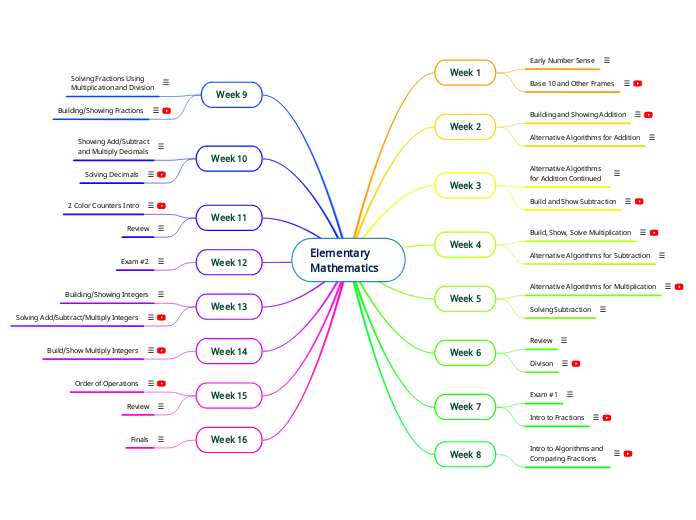
Early Number Sense
Vocabulary:Cardinality - When a student can count a pile once to determine the number of objects present and continue to know how many objects are in the pile without having to recount.One-to-One Correspondence - When a student can recognize that one object is equivalent to one number.More-or-Less - Looking at two piles of objects and being able to identify which pile has more or less items than the other.Subtilizing - When a student knows how many objects are in a pile without having to count.
Base 10 and Other Frames
Vocabulary:Five Frames - Used to help students understand early number sense, used as a tool before using ten frames.Ten Frames - Used to represent that ten units are equal to one long.Other Bases - Other Bases represent how many units it would take to create a long, and how many longs it takes to create a flat. examples -5 units create a long and 5 longs create a flat in base five. 2 units create a long and 2 longs create a flat in base two. 27 units create a long and 27 longs create a flat in base twenty-seven.Notes:*Default base is base ten if not otherwise stated examples - 27 not 27ten 14 not 14ten*All other bases are specified in a written form subscript after the number examples - 14five not 145 138nine not 1389
aBuilding and Showing Addition
Commas:Make numbers easier to readShow where the pattern of shapes repeatConverting Base 10 to Other Bases: 47 Units to Base Nine: 52Nine 19 Units to Base Four: 103FourBuilding Addition Problems in Different Bases:24Five24Five + 33Five = 112Five 4Six + 3Six + 5Six + 2Six + 20Six = 42SixShowing How to Add in Base Ten:Example One -Example Two -
adAlternative Algorithms for Addition
What Makes a Good Algorithm?It is EfficientIt is Expandable (Repeatable)It is Based on Prior Knowledge of MathematicsExpanded Form:Example One - Left-to-Right:Example One - Friendly Numbers:Example One - Trading-Off:Example One -
dAlternative Algorithms for Addition Continued
Scratch:Example One - Example Two - Lattice:Example One - Example Two -
dBuild and Show Subtraction
Building Subtraction:*In class activity, difficult to represent through photosShowing Subtraction:Example One - Example Two -
adBuild, Show, Solve Multiplication
Maturity x Understanding:Mental Maturity does NOT correlate with understanding of mathematics.The More EXPOSURE a child has, the easier concepts become to understand.When people are wrong, learning occurs, and MORE synapses formHow is Multiplication Formed?GroupsArraysArea3x5 = 3 groups of 55x3 = 5 groups of 3Building Multiplication:2 Groups of 5Showing Multiplication:2 Groups of 4
adAlternative Algorithms for Subtraction
Review:*Alternative Algorithms for Addition ReviewedExpanded Form Subtraction:Example One - Example Two - Equal Addends Subtraction:Example One - Example Two -
dAlternative Algorithms for Multiplication
Order to Teach Multiplication Table:Expanded Form for Multiplication:Example One - Example Two - Left-to-Right for Multiplication:Example One - Example Two - Area Model for Multiplication:Example One - Example Two - Lattice: Example One - Example Two -
adSolving Subtraction
Expanded Form:Example One - Example Two - Equal Addends: Example One - Example Two -
dReview
Review of Weeks 1 - 5Created the Mind-map
Divison
Divisibility Rules:2 - Ends in an Even Number (0,2,4,6,8) Ex. 2,5736 (ends in 6 so it IS divisible)3 - The sum of the digits is divisible by 3 Ex. 1425 (1+4+2+5=12 and 3x4=12 so it IS divisible)4 - Last two digits are divisible by 4 Ex. 2,5736 (ends in 36 so it IS divisible) (4 x 9 = 36)5 - Last digit is a 5 or 0 Ex. 1255 (ends in 5 so it IS divisible)6 - Ends in an even number AND the sum is divisible by 3 Ex. 342 (3+4+2 = 9 and 2 is an even number so it IS divisible)7 - NO RULE8 - Last three digits are divisible by 8 Ex. 25,648 (ends in 648 so it IS divisible) (81x 8 = 648) 9 - The sum of the digits is divisible by 9 Ex. 2,736 (2+7+3+6=18 and 9x2=18 so it IS divisible)10 - Last digit is a 0 Ex. 1250 (ends in 0 so it IS divisible)Repeated Subtraction:Focuses on what students already knowIs not efficient (can take as long as you need it to)Upward Division:Structured like a fraction, Reinforces future understanding
adExam #1
Exam taken in-class, on paperColorful markings were recommendedEntire class time to finish (75 Minutes)Extra Credit OpportunitiesScore: 87/87
Intro to Fractions
What is a Fraction?Determining if Fractions are >, <, or = (and Why?)
adIntro to Algorithms and
Comparing Fractions
Alternate Algorithm for Adding/Subtracting Fractions:Review of Comparing Fractions:
adSolving Fractions Using
Multiplication and Division
Multiplying Fractions:Dividing Fractions:
dBuilding/Showing Fractions
Showing Fractions via Drawings:AddingSubtracting
adShowing Add/Subtract
and Multiply Decimals
Show Adding with Decimals:Show Subtraction with Decimals:Only Count what is NOT circledShow Multiplication with Decimals:Only Count the DOUBLE Shaded Region
dSolving Decimals
Add/Subtract Steps to Solving Decimals:Make an estimate of the answerLine up the whole numbersWhy is it hard for students to add or subtract whole numbers with other numbers with decimals?They do not know where the decimal belongsrely on "lining" up the decimalswill forget that whole numbers have an infinite .000 attached to themMultiply Steps to Solving Decimals:Make an estimate of the answerLine up the whole numbersRemove the Decimals from the equation SOLVEAdd the decimal to make answer similar in size to estimation
ad2 Color Counters Intro
Review of Decimal VideosShort IntroductionTwo Color Counters have two different colorsOne side will ALWAYS be red, the other side is customizableUsed to represent positive and negative numbersUsed to teach adding and subtracting of integersEXAM #2 Review was given
aReview
Class period was spent working with classmates to show proficiency in topics represented on the review via whiteboards.
Exam #2
Exam taken in-class, on paperColorful markings were recommendedEntire class time to finish (75 Minutes)Extra Credit OpportunitiesScore: 107/107
Building/Showing Integers
Building Integers - Red is ALWAYS NegativeOne Row for positives, one row for negativesTypically negatives on bottom due to real world examples (thermostat)ALWAYS line them up in columnspairing a positive and a negative is a ZERO BANKShowing Integers - Use "+" to represent positivesUse "-" to represent negativesContinue to follow rules via assemblycircle and arrow to resemble taking awayGeneral Integers - Verbal explanation is so important! ex. -5 is not negative five, it is five negativesex. 9 is not nine, it is nine positives
dSolving Add/Subtract/Multiply Integers
Hector's Method
adBuild/Show Multiply Integers
Showing MultiplicationSolving Multiplication
adOrder of Operations
Order of OperationsTraditional MethodHaving to Rewrite integers too many timeseasier to write a mistakePEMDASMD and AS happen at the same time so can be confusingPreferred Method G E DM L->R S A L ->RScientific NotationFirst Digit must be larger than 1 and smaller than 10Exponent is positive = Huge numberExponent is negative = Small numberNever describe as move to left or move to rightex. - 351,000,000,000 = - 3.51 x 10^112.43 x 10^14 = 243,000,000,000,0004.372 x 10^-9 = 0.000000004372
adReview
Finals
Will NOT be a cumulative examWill only cover new material since past examTuesdayDecember 7, 202112:10PM - 2:30PM