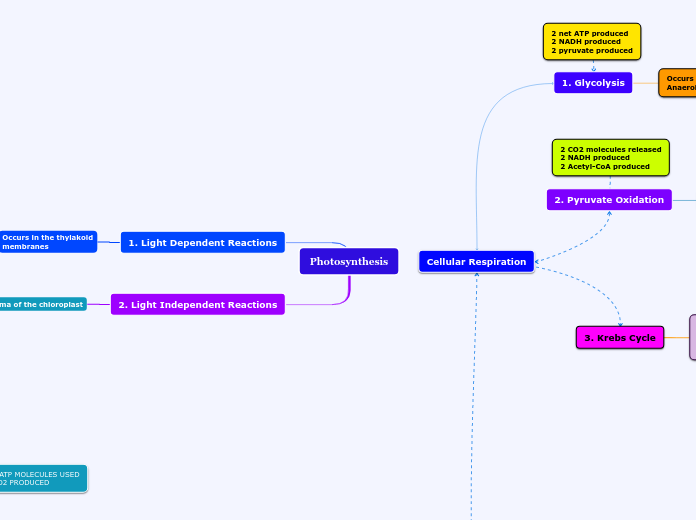
Occurs in the thylakoid
membranes
The ATP and NADPH produced here will
fuel the Light independent reactions.
`
The energy possessed by the photon
will release oxygen gas into the
atmosphere by splitting water. The
electrons from water leave to an
ETC, H+ is released.
The electrons from the previous
step move to a higher energy
level being boosted by the photons
where they will fall down the ETC
In the ETC the electrons are passed
from protein to protein. At every protein,
the energy from the falling electrons
is used to pump H+ into the thylakoid
After this, ATP is made when the H+
diffuses back into the stroma through
ATPase.
After passing through the primary
acceptor, the electrons move through
Pq and then the cytochrome complex.
After this, they move to the Pc then into
Photosystem I, or PSI/P700. Here, another
photon of light, measured at 700nm,
re-energizes the electron
Here the electrons jump to a higher
energy level and fall down the ETC again.
The process of electrons being passed from
protein to protein repeats and the
energy from the falling electrons
is used to pump H+ into the thylakoid
After this, ATP is made again when the H+
goes through ATPase.
Finally, low energy electrons are given to
NADP+ which becomes NADPH because of
the H+ from the stroma.
Occurs in the stroma of the chloroplast
Fueled by the ATP and NADPH from the
light dependent reactions. This is why
it is labeled the light INDEPENDENT
reactions, as it relies on these molecules.
The input is 3 CO2 molecules
CALVIN CYCLE
CO2 from the atmosphere is fixed to
ribulose biphosphate (RuBP), a
5-carbon compound.
The RuBP is split into two
3-phosphoglycerate molecules
(3-C).
The 3-phosphoglycerate is turned into
1,3-biphosphoglycerate using
phosphoglycerate kinase and
glyceraldehyde-3-phosphate dehydrogenase
The 1,3-biphosphoglycerate is turned into
glyceraldehyde-3-phosphate (G3P) by reducing
6 NADPH into 6 NADP+ and producing 6 Pi
The 6 G3P are split into 5 G3P
and 1 G3P
The 5 G3P molecules will be rearranged
to make 3 more RuBP molecules to help
restart the cycle all over again
RuBP functions as the
main CO2 acceptor
3 ATP molecules are used to turn the
5 G3P molecules into 3 RuBP molecules
The remaining 1 G3P molecule will
be used for carbohydrates such as glucose.
Note that one glucose molecule will be produced
for every time the cycle occurs twice
ONE GLUCOSE IS PRODUCED EVERY
2 TIMES THE CYCLE IS COMPLETED
(1)ATP phosphorylates glucose to
glucose-6-phosphate (G6P)
G6P made into F6P
(Fructose-6-phosphate)
The two pyruvate molecules that were formed during glycolysis are transported into the matrix through the mitochondrial membranes
The pyruvates are converted into acetyl CoA
(acetyl coenzyme A)
(2) CO2 molecules are released
1 from each pyruvate
(2) NAD+ molecules are reduced by two H+ atoms
meaning (2) NADH molecules are produced
The CoA is then attached to the acetyl group to form Acetyl-CoA
The NADH and FADH2 from the previous stages
of CR release their electrons, which pass along a
series of coenzymes or electron acceptors, releasing energy along the way.
This energy is used to pump protons out of the
matrix to the intermembrane space. This creates a gradient with a [H+] in the intermembrane space
One enough [H+] is built up in the system, protons
are diffused back into the matrix using the channel ATP synthetase or ATPase.
NADH passes its electrons through the first
protein complex, which is NADH dehydrogenase.
FADH transfers its electrons to ubiquinone,
component two of the chain.
This means that the energy released
when FADH2 is oxidized will pump two protons
into the intermembrane space, while the energy
from NADH will pump three.
This means that TWO(2) ATP is formed per FADH2
and THREE(3) ATP is formed per NADH
Subtopic
The NADH molecules in glycolysis diffuse
through the outer mitochondrial membrane into the intermembrane space, but not through the inner membrane into the matrix.
Since the inner membrane is impermeable to NADH, it has two shuttle systems that pass electrons from cytosolic NADH in the intermembrane space to the matrix. The first and most common shuttle, called the glycerol-phosphate shuttle, transfers the electrons from cystolic NADH to FAD to produce FADH2 . Like FADH2 produced in the Kreb’s cycle, it trans-
fers its electrons to Q, resulting in the synthesis of two ATP molecules by chemiosmosis.
The second shuttle, called the aspartate shuttle, transfers electrons to NAD1 instead of FAD, forming NADH, and then three ATP molecules. However, in this chapter we will
assume that the transfer is made to FAD, using the glycerol-phosphate shuttle.
note: PROTON MOTIVE FORCE is the name of the
energy created by this gradient.
note 2: For each H+ that diffuses back into the
matrix through ATPase 1 ATP IS PRODUCED
1. The acetyl portion of Acetyl-CoA (2C)
reacts with oxaloacetate (4C). This creates
citrate, a 6 carbon compound.
2. Citrate is rearranged into isocitrate.
Each are 6-carbon compounds.
3. Isocitrate is made into
a-ketoglutarate (5-C) by taking away a CO2 and two H atoms that
reduce NAD+ to NADH.
4. The alpha-ketoglutarate is converted
to succinyl CoA (4 carbon compound).
Here, another CO2 molecule is produced
in the reaction, a coenzyme A is added,
and two more H atoms reduce NAD+ to NADH..
5. The succinyl CoA is converted
into succinate. During this, ATP
is formed during substrate level
phosphorylation. A coenzyme A is also released
6. The succinate is turned into
fumarate. Both are 4-carbon
compounds. During this, 2 H
atoms reduce FAD to FADH2.
7. Fumarate is turned into
malate (both 4-C)
8. Malate converted to oxaloacetate
to restart cycle. Two H atoms reduce
NAD+ to NADH.
1 NADH PRODUCED
1 FADH2 PRODUCED
1 ATP PRODUCED
1 coenzyme A RELEASED
1 NADH PRODUCED
1 CO2 PRODUCED
1 NADH PRODUCED
1 CO2 PRODUCED
G3P converted to BPG
(1, 3-biphosphoglycerate)
1 NADH Produced
BPG converted to 3PG.
1 ATP PRODUCED
3PG rearranged to 2PG
2PG converted to PEP
by removal of water molecule
1 H2O PRODUCED
PEP converted to (1) pyruvate molecule
1 ATP PRODUCED
G3P converted to BPG.
1 NADH Produced
BPG converted to 3PG.
(3-phosphoglycerate)
1 ATP PRODUCED
3PG rearranged to 2PG
(2-phosphoglycerate)
2PG converted to PEP
(phosphoenolpyruvate)
by removal of water molecule
1 H2O PRODUCED
PEP converted to (1) pyruvate molecule
1 ATP PRODUCED