Conflict theory helps to explain events of change as it highlights how social conflicts can arise due to unequal distribution of resources, status, and power among different groups in society. The theory argues that these conflicts can become the driving force for social change, which could be positive or negative. Positive changes occur when the oppressed group gains more power, status, and resources, leading to a more equitable society. On the other hand, negative changes occur when the dominant group becomes more oppressive and maintains its power by suppressing the rights of the oppressed group.
The theory explains that change occurs when there is a conflict between the bourgeoisie and the proletariat. The working class, who are the proletariat, becomes aware of their exploitation and oppression by the capitalist class, the bourgeoisie. They develop a class consciousness that reveals their exploitation, and then they revolt, demanding changes to smooth the conflict. The conflict theory also explains that the unequal social order is maintained through ideological coercion, which creates consensus and acceptance of the values, expectations, and conditions as determined by the bourgeoisie.
Furthermore, conflict theory can be applied to different types of conflicts beyond class conflicts, such as feminist theory, critical race theory, postmodern and postcolonial theory, queer theory, post-structural theory, and theories of globalization and world systems. This application is useful for understanding the impact of various social factors, such as race, gender, sexuality, religion, culture, and nationality, among others, on contemporary social structures and how they affect our lives.
In conclusion, conflict theory provides a useful perspective for understanding events of change in society. It highlights the role of power, status, and resources in shaping social conflicts and how these conflicts can lead to positive or negative change. Conflict theory also emphasizes the importance of understanding the impact of various social factors on social structures and how they affect our lives.
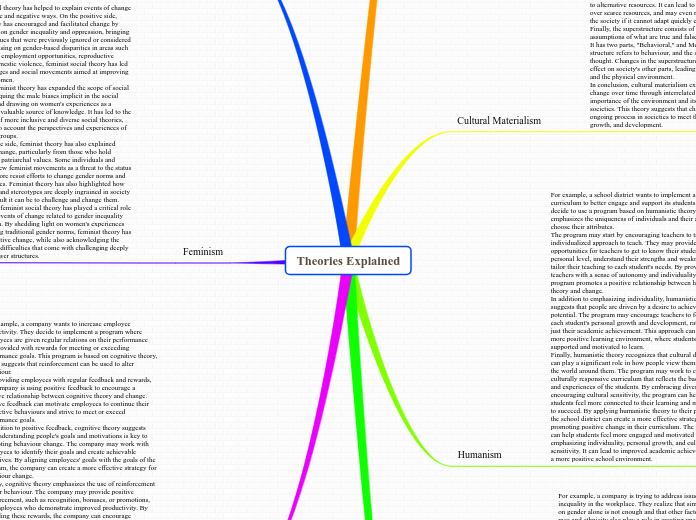
The cultural materialism theory proposed by Marvin Harris explains how societies change over time. According to this theory, societies consist of interrelated parts, and changes in one part will inevitably affect other parts. The foundation of any society is its environment, which provides the energy and resources necessary for its survival. All societies are patterned along similar lines, with an infrastructure, structure, and superstructure.
The infrastructure of a society is its most basic component, and without it, physical survival is impossible. It consists of the technology and social practices by which a society fits into its environment. The infrastructure has two parts, the "mode of production" and the "mode of reproduction." The mode of production refers to the technology and social practices used to draw energy and raw materials from the environment and fashion them for human use, while the mode of reproduction refers to demographic factors such as population size, density, and growth, among others. These factors are important in determining the amount and type of resources needed from the environment.
The social structure of a society consists of actual behaviour patterns, including political and domestic economies. The political economy consists of groups and organizations that regulate production, reproduction, exchange, and consumption within and between groups and sociocultural systems. The domestic economy consists of the organization of reproduction, basic production, exchange, and consumption within domestic settings. Elite groups and hierarchies exist throughout all social structures, and it is their needs that have the highest priorities.
Cultural Materialism as a theory provides both positive and negative explanations for events of change. On the positive side, it explains how societies must adapt to their environment to survive. It means that when the environment changes, societies must change as well. For example, when a natural disaster such as a drought or flood occurs, societies must adjust their modes of production and reproduction to obtain the necessary resources. It can lead to innovations in technology and social practices that improve a society's ability to survive and thrive in its environment.
On the negative side, Cultural Materialism also explains how resistance to change can occur when societies are unable or unwilling to adjust to environmental constraints. For example, if society relies heavily on a particular resource that becomes depleted or polluted, it may be difficult for society to switch to alternative resources. It can lead to conflict and competition over scarce resources, and may even result in the collapse of the society if it cannot adapt quickly enough.
Finally, the superstructure consists of beliefs, shared assumptions of what are true and false and mental processes. It has two parts, "Behavioral," and Mental, where the structure refers to behaviour, and the superstructure refers to thought. Changes in the superstructure can have a profound effect on society's other parts, leading to changes in behaviour and the physical environment.
In conclusion, cultural materialism explains how societies change over time through interrelated parts. It emphasizes the importance of the environment and its constraints on human societies. This theory suggests that change is a necessary and ongoing process in societies to meet their needs for survival, growth, and development.
For example, a school district wants to implement a new curriculum to better engage and support its students. They decide to use a program based on humanistic theory, which emphasizes the uniqueness of individuals and their ability to choose their attributes.
The program may start by encouraging teachers to take an individualized approach to teach. They may provide opportunities for teachers to get to know their students on a personal level, understand their strengths and weaknesses, and tailor their teaching to each student's needs. By providing teachers with a sense of autonomy and individuality, the program promotes a positive relationship between humanistic theory and change.
In addition to emphasizing individuality, humanistic theory suggests that people are driven by a desire to achieve their full potential. The program may encourage teachers to focus on each student's personal growth and development, rather than just their academic achievement. This approach can create a more positive learning environment, where students feel supported and motivated to learn.
Finally, humanistic theory recognizes that cultural differences can play a significant role in how people view themselves and the world around them. The program may work to create a culturally responsive curriculum that reflects the backgrounds and experiences of the students. By embracing diversity and encouraging cultural sensitivity, the program can help students feel more connected to their learning and motivated to succeed. By applying humanistic theory to their program, the school district can create a more effective strategy for promoting positive change in their curriculum. The program can help students feel more engaged and motivated to learn emphasizing individuality, personal growth, and cultural sensitivity. It can lead to improved academic achievement and a more positive school environment.
For example, a company is trying to address issues of gender inequality in the workplace. They realize that simply focusing on gender alone is not enough and that other factors such as race and ethnicity also play a role in creating unequal opportunities.
By applying intersectionality theory, the company can understand how different forms of discrimination overlap and create unique experiences for different individuals. They can recognize that individuals' social locations, such as gender, race, ethnicity, and class, all contribute to their experiences of discrimination and privilege.
The company may start by conducting an intersectional analysis of its workplace, examining how different groups of employees experience discrimination and what factors contribute to this. They may use this information to develop targeted initiatives that address the unique challenges faced by different groups.
For example, they may recognize that women of colour are more likely to experience discrimination than white women or men of colour and that they face unique barriers to advancement. They may develop mentorship programs or leadership training specifically tailored to address these challenges.
By taking an intersectional approach, the company can create a more nuanced understanding of discrimination and privilege and develop strategies that address the root causes of inequality. It can lead to a more diverse and inclusive workplace, where all employees feel valued and supported.
By recognizing and addressing the intersectional nature of discrimination and inequality, organizations can create a more positive relationship with their employees and promote positive change. By taking an intersectional approach, the company can demonstrate a commitment to understanding the unique challenges faced by different groups and developing targeted solutions to address them.
For example, an organization that implements policies to promote gender equity but fails to recognize the unique challenges faced by women of colour may inadvertently perpetuate inequality. However, an organization that takes an intersectional approach and recognizes the specific challenges faced by women of colour can create policies and initiatives that address these challenges and promote positive change.
By taking a positive approach to intersectionality, organizations can create a more inclusive workplace where all employees feel valued and supported. It can lead to higher employee engagement, retention, and productivity, as well as increased profitability and reputation for the organization. Additionally, by promoting diversity and inclusion, organizations can attract top talent from a wider pool of candidates, further contributing to their success. Intersectionality theory can help to explain how different forms of discrimination intersect and contribute to social inequality. By understanding the complexity of these issues, organizations can develop more effective strategies for creating positive change and promoting equity and inclusion.
Functionalism is a structural theory that views society as a system with interconnected parts that work together to maintain social order and integration. The theory suggests that social structure is more important than the individual and that individuals are socialized by various institutions such as the family, education, media, and religion. In this report, we will discuss how Functionalism helps to change events.
Functionalism explains change as evolutionary, as the change in one part of society eventually occurs in another. Social ills such as crime and deviance have disabling effects on society and gradually affect other parts. The theory recognizes interconnections between various parts of society due to a value consensus, which helps to maintain social order and integration. Talcott Parsons, a main supporter of Functionalism, believed that society is the way it is because social structures are interconnected and dependent on each other.
Functionalism helps to explain the positive change in society by highlighting the importance of social consensus, order, and integration. Shared norms and values mean that all individuals have a common goal and a vested interest in conforming, reducing the potential for conflict. The theory also highlights the importance of institutions such as the family, the educational system, and religion in maintaining the basic pattern of values institutionalized in society, leading to social solidarity.
On the other hand, Functionalism can also explain resistance to change, particularly when it comes to changes that threaten the existing social structure and the institutions that support it. The theory suggests that society is based on a value consensus and social solidarity achieved through socialization and social control. Any change that threatens this consensus and solidarity is likely to meet resistance from those who benefit from the existing social structure.
In conclusion, Functionalism provides a top-down perspective on social change, emphasizing the importance of social structures and institutions in maintaining social order and integration. The theory helps to explain positive change through social consensus, order, and integration, but also explains resistance to change when it threatens the existing social structure and institutions. Functionalism is a crucial tool for understanding events of change in society.
When?
Feminist social theory has helped to explain events of change in both positive and negative ways. On the positive side, feminist theory has encouraged and facilitated change by shedding light on gender inequality and oppression, bringing attention to issues that were previously ignored or considered taboo. By focusing on gender-based disparities in areas such as legal rights, employment opportunities, reproductive health, and domestic violence, feminist social theory has led to policy changes and social movements aimed at improving the lives of women.
In addition, feminist theory has expanded the scope of social theory by critiquing the male biases implicit in the social theory itself and drawing on women's experiences as a legitimate and valuable source of knowledge. It has led to the development of more inclusive and diverse social theories, which take into account the perspectives and experiences of marginalized groups.
On the negative side, feminist theory has also explained resistance to change, particularly from those who hold traditional and patriarchal values. Some individuals and groups may view feminist movements as a threat to the status quo and therefore resist efforts to change gender norms and power structures. Feminist theory has also highlighted how gender norms and stereotypes are deeply ingrained in society and how difficult it can be to challenge and change them.
In conclusion, feminist social theory has played a critical role in explaining events of change related to gender inequality and oppression. By shedding light on women's experiences and challenging traditional gender norms, feminist theory has facilitated positive change, while also acknowledging the resistance and difficulties that come with challenging deeply entrenched power structures.
Pet name
For example, a company wants to increase employee productivity. They decide to implement a program where employees are given regular relations on their performance and provided with rewards for meeting or exceeding performance goals. This program is based on cognitive theory, which suggests that reinforcement can be used to alter behaviour.
By providing employees with regular feedback and rewards, the company is using positive feedback to encourage a positive relationship between cognitive theory and change. Positive feedback can motivate employees to continue their productive behaviours and strive to meet or exceed performance goals.
In addition to positive feedback, cognitive theory suggests that understanding people's goals and motivations is key to promoting behaviour change. The company may work with employees to identify their goals and create achievable objectives. By aligning employees' goals with the goals of the program, the company can create a more effective strategy for behaviour change.
Finally, cognitive theory emphasizes the use of reinforcement to alter behaviour. The company may provide positive reinforcement, such as recognition, bonuses, or promotions, for employees who demonstrate improved productivity. By providing these rewards, the company can encourage employees to continue their productive behaviours.
However, by applying cognitive theory to their program, the company can create a more effective strategy for increasing employee productivity. By using positive feedback, goal-setting, and reinforcement, they can encourage positive behaviour change and help employees achieve their goals.