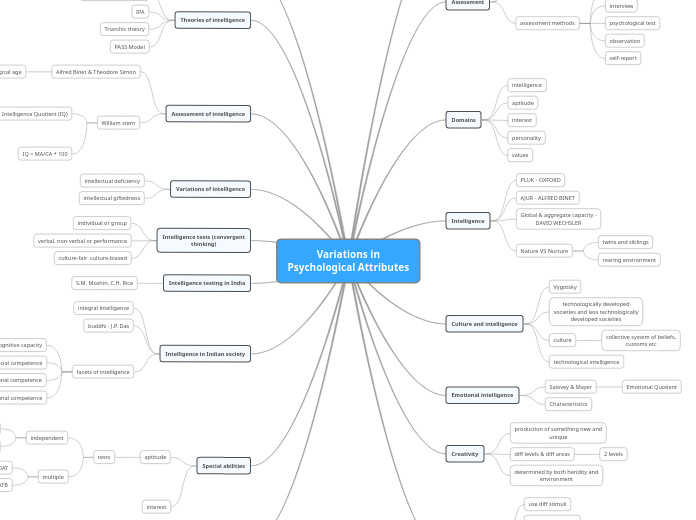
person act diff in diff situations
1st step in understanding psych.
attributes.
informal and formal
assessment methods
case study
interview
psychological test
observation
self-report
intelligence
aptitude
interest
personality
values
PLUK - OXFORD
AJUR - ALFRED BINET
Global & aggregate capacity -
DAVID WECHSLER
Nature VS Nurture
twins and siblings
rearing environment
Vygotsky
technologically developed
societies and less technologically
developed societies
culture
collective system of beliefs,
customs etc
technological intelligence
Salovey & Mayer
Emotional Quotient
Characteristics
production of something new and
unique
diff levels & diff areas
2 levels
determined by both heridity and
environment
use diff stimuli
divergent thinking
Guilford, Torrance, Khatena
has a standardized procedure,
complete set of manual &
interpretation
used only after extensive training
in administration & interpretation
of test scores
distinctive charateristics
psychometric approach
IPA
Triarchic theory
PASS Model
Alfred Binet & Theodore Simon
mental & chronological age
William stern
Intelligence Quotient (IQ)
130 and above - Very Superior
120–129 - Superior
110–119 - High Average
90–109 - Average
80–89 - Low Average
70–79 - Borderline
69 and below - Extremely Low
IQ = MA/CA * 100
intellectual deficiency
intellectual giftedness
individual or group
verbal, non-verbal or performance
culture-fair culture-biased
S.M. Moshin, C.H. Rice
integral intelligence
buddhi - J.P. Das
facets of intelligence
cognitive capacity
social competence
emotional competence
entrepreneurial competence
aptitude
tests
independent
mechanical aptitude
clerical aptitude
multiple
DAT
8 independent subtests
GATB
interest
Terman, 1920s
high IQ - may be creative
creative people - have certain level
of intelligence