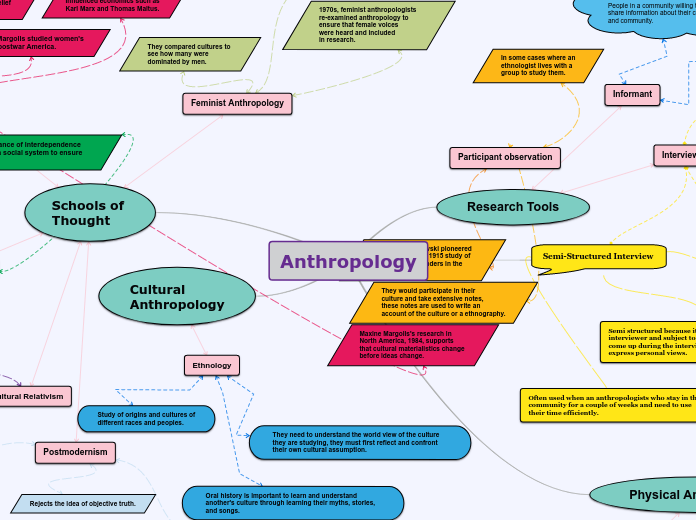
People in a community willing to share information about their culture and community.
They are a big help to anthropologists when they are conducting research on a large community.
Unstructured Interviews
They allow the researcher to test out his/her initial ideas and can lead to a greater understanding on the topic.
Between anthropologist and an informant.
Semi-Structured Interview
Bronislaw Malinowski pioneered this method in his 1915 study of the Trobriand Islanders in the South Pacific.
Often used when an anthropologists who stay in the community for a couple of weeks and need to use their time efficiently.
Allows the researcher time to prepare questions in advance and end up with reliable and qualitative data.
Semi structured because it is flexible and lets the interviewer and subject to follow leads that may come up during the interview and for the subject to express personal views.
Structured Interveiws
Uses a set list of questions that do not change.
Used when the researcher is very clear on the topic and their is other information that can be easily available.
Does not require a relationship between interviewer and interviewee can produce consistent data that can be compared between respondents.
Researchers might obtain limited answers because questions are rarely open ended.
Participant observation
In some cases where an ethnologist lives with a group to study them.
Informant
Interviews
Ethnology
Study of origins and cultures of different races and peoples.
They need to understand the world view of the culture they are studying, they must first reflect and confront their own cultural assumption.
Oral history is important to learn and understand another's culture through learning their myths, stories, and songs.
Cultural Relativism
Two cultures cannot be compared because they both have their own internal rules that must be accepted, everyone sees other cultures through the lens of their own culture.
Franz Boas, pioneer of modern anthropology in the early 20th century promoted this idea.
Functional Theory
Every belief, action, or relationship in a culture functions to meet the needs of individuals.
This stresses the importance of interdependence among all things within a social system to ensure its long time survival.
Malinowski saw this at work in the Trobriand Islands during WW1, every year two men would exchange of a necklace and an arm band on each island in the South Pacific.
Cultural Materialism
States that materials or conditions within the environment, (climate, food supply, geography) influence how a culture develops, creating the ideas and ideology of a culture.
One criticism of cultural materialism is that it is too simplistic and ignores spiritual considerations or that humans are thinking beings.
Pioneered by Marvin Harris in the 1960s, he applied the theory to the Hindu belief in the sacred cow.
Influenced economics such as Karl Marx and Thomas Maltus.
Maxine Margolis studied women's roles in postwar America.
Feminist Anthropology
1970s, feminist anthropologists re-examined anthropology to ensure that female voices were heard and included in research.
They compared cultures to see how many were dominated by men.
Ernstine Friedl concluded that in forager societies that the amount of freedom women had was strongly tied to their contributions to the food supply.
Postmodernism
The belief that it is impossible to have any “true” knowledge about the world.
Rejects the idea of objective truth.
Canadian anthropologist and director Sam Dunn and the study of subculture heavy metal music and heavy metal fans.
Palaeontology
Study of human ancestors based on evidence from the distance evolutionary past, in the form of preserved remains or impressions of biological matter or fossils such as skeletal remains, animal bones, ancient tools and vegetable matter.
Primotology
1974 palaeontologist Donald Johanson found a skeleton in Ethiopia that was 40% complete he named her "Lucy" she walked the earth 3.2 million years ago.
We share many characteristics with primates; grasping hands, forward facing eyes, and a large brain. Primotologists study the anatomy and behaviours of living primates.
Jane Goodall, Dian Fossey observed primates in the field.
Human Variation
Charles Darwin established the concept of natural selection to explain how animals and plants evolved, he mainly studied the Galapagos Islands.
All species either; evolve or face extinction.
The Leakey family and their use of radiometric dating.
They would participate in their culture and take extensive notes, these notes are used to write an account of the culture or a ethnography.
Maxine Margolis's research in North America, 1984, supports that cultural materialistics change before ideas change.