Concept: Epistemology
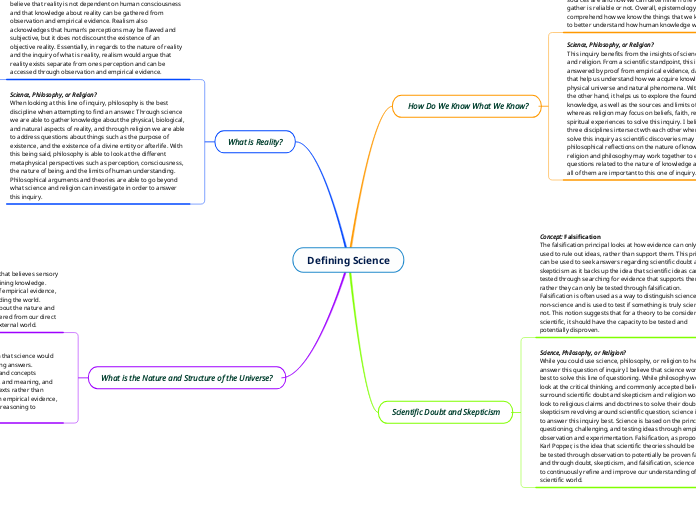
Epistemology examines questions about how we acquire the knowledge we have and how valid this knowledge is. In essence, epistemology works to answer the question of how do we know what we know? Epistemology also explores things such as perception, memory, testimony, and reasoning and the validity of those sources from which we gather our knowledge. Epistemology also examines how reliable and unreliable those sources are and how we can determine if the knowledge we gather is reliable or not. Overall, epistemology works to comprehend how we know the things that we know and works to better understand how human knowledge works.
Science, Philosophy, or Religion?
This inquiry benefits from the insights of science, philosophy, and religion. From a scientific standpoint, this inquiry could be answered by proof from empirical evidence, data, and theories that help us understand how we acquire knowledge about the physical universe and natural phenomena. With philosophy on the other hand, it helps us to explore the foundations of knowledge, as well as the sources and limits of knowledge whereas religion may focus on beliefs, faith, revelation, and spiritual experiences to solve this inquiry. I believe that these three disciplines intersect wth each other when looking to solve this inquiry as scientific discoveries may prompt philosophical reflections on the nature of knowledge, and religion and philosophy may work together to explore questions related to the nature of knowledge and belief. Thus all of them are important to this one of inquiry.
Concept: Falsification
The falsification principal looks at how evidence can only be used to rule out ideas, rather than support them. This principal can be used to seek answers regarding scientific doubt and skepticism as it backs up the idea that scientific ideas can’t be tested through searching for evidence that supports them, but rather they can only be tested through falsification. Falsification is often used as a way to distinguish science from non-science and is used to test if something is truly scientific or not. This notion suggests that for a theory to be considered scientific, it should have the capacity to be tested and potentially disproven.
Philosopher
Karl Popper emphasized the importance of empirical testing and argued that in order for a theory to be proven as scientific it must make specific predictions that can either be proven or disproven through observation and experimentation.
Science, Philosophy, or Religion?
While you could use science, philosophy, or religion to help answer this question of inquiry I believe that science works best to solve this line of questioning. While philosophy would look at the critical thinking, and commonly accepted beliefs surround scientific doubt and skepticism and religion would look to religious claims and doctrines to solve their doubt and skepticism revolving around scientific question, science is able to answer this inquiry best. Science is based on the principle of questioning, challenging, and testing ideas through empirical observation and experimentation. Falsification, as proposed by Karl Popper, is the idea that scientific theories should be able to be tested through observation to potentially be proven false and through doubt, skepticism, and falsification, science aims to continuously refine and improve our understanding of the scientific world.
Concept: Realism
Realism is associated with studying the world we live in and the nature of reality. According to realism, reality only exists independently of our perception and understanding of it and that objects and events exist objectively and are not dependent on whether we are aware of them or not. Essentially, realists believe that reality is not dependent on human consciousness and that knowledge about reality can be gathered from observation and empirical evidence. Realism also acknowledges that human’s perceptions may be flawed and subjective, but it does not discount the existence of an objective reality. Essentially, in regards to the nature of reality and the inquiry of what is reality, realism would argue that reality exists separate from ones perception and can be accessed through observation and empirical evidence.
Philosopher
Aristotle believed in the existence of an objective reality that could be known through empirical observation and rational inquiry. He believed that there is a true reality, and things exist whether humans perceive them or not.
Science, Philosophy, or Religion?
When looking at this line of inquiry, philosophy is the best discipline when attempting to find an answer. Through science we are able to gather knowledge about the physical, biological, and natural aspects of reality, and through religion we are able to address questions about things such as the purpose of existence, and the existence of a divine entity or afterlife. With this being said, philosophy is able to look at the different metaphysical perspectives such as perception, consciousness, the nature of being, and the limits of human understanding. Philosophical arguments and theories are able to go beyond what science and religion can investigate in order to answer this inquiry.
Concept: Empiricism
Empiricism is a philosophical perspective that believes sensory experience is a fundamental mean of attaining knowledge. Empiricism emphasizes the importance of empirical evidence, observation, and experience in understanding the world. Empiricists would argue that knowledge about the nature and structure of the universe can only be gathered from our direct senses and through interaction with the external world.
Philosopher
John Locke supports this idea as he argued that all knowledge is ultimately derived from experience. He believed that all knowledge is ultimately derived from experience.
Science, Philosophy, or Religion?
I would say when it comes to this question that science would be the most appropriate domain for seeking answers. Philosophy more looks into the questions and concepts surrounding reality, existence, knowledge, and meaning, and religion relies more on faith, and biblical texts rather than empirical evidence, while science relies on empirical evidence, experimentation, observation, and logical reasoning to understand the natural world.