Phobias
what are phobias?
Intense, unreasonable and persistent fear caused by the presence or anticipation of a specific object or situation
In México the 5 most common phobias are:
* Aracnofobia
* Fobia social
* Aerofobia
* Agorafobia
* Claustrofobia
Social Anxiety
Formerly called social phobia
Is characterized by extreme and persistent fear or anxiety and avoidance of social situations in which the person could potentially be evaluated negatively by others (APA, 2013)
Panic disorder
Common symptoms of panic attack
Feeling Dizzy, Unestedy, Lightheaded
Shortness of breath
Chest pain, Palpitations and/or Accelerated heart rate
Nausea or Abdominal distress
Imagine that you are at the mall one day with your friends and—suddenly and inexplicably—you begin sweating and trembling, your heart starts pounding, you have trouble breathing, and you start to feel dizzy and nauseous. This episode lasts for 10 minutes and is terrifying because you start to think that you are going to die.
Generalized Anxiety disorder
Is a relatively continuous state of excessive, uncontrollable, and pointless worry and apprehension.
People with generalized anxiety disorder often worry about routine, everyday things, even though their concerns are unjustified.
OCD
Involve intrusive, unpleasant thoughts and repetitive behaviors.
We all have unpleasant thoughts and repetitive behaviors from time to time, however, obsessive-compulsive and related disorders elevate the unwanted thoughts and repetitive behaviors to a status so intense that these cognitions and activities disrupt daily life.
People with this disorder experience thoughts and urges that are intrusive and unwanted (obsessions) and/or the need to engage in repetitive behaviors or mental acts (compulsions).
Causes of OCD and related disorders
The disorder is five times more frequent in the first-degree relatives of people with OCD than in people without the disorder.
Body Dysmorphic
The person is preoccupied with a perceived flaw in their physical appearance that is either nonexistent or barely noticeable to other people.
The person engages in repetitive and ritualistic behavioral and mental acts, such as constantly looking in the mirror, trying to hide the offending body part, comparisons with others, and, in some extreme cases, cosmetic surgery.
Hoarding disorder
People with hoarding disorder cannot get rid of personal possessions, regardless of value
PTSD
Extremely stressful or traumatic events, such as combat, natural disasters, and terrorist attacks, place the people who experience them at an increased risk for developing psychological disorders such as posttraumatic stress disorder (PTSD).
Major depressive disorder
Symptoms include:
Depressed mood most of the day, nearly every day (feeling sad, empty, hopeless, or appearing tearful to others)
loss of interest and pleasure in usual activities.
Feeling overwhelmingly sad most of each day.
No interest or enjoyment in activities that previously were gratifying.
To receive a diagnosis of major depressive disorder, one must experience at least five symptoms for at least a two-week period.
+Significant weight loss (when not dieting) or weight gain and/or significant decrease or increase in appetite;
+Difficulty falling asleep or sleeping too much;
+Psychomotor agitation or psychomotor retardation;
+Fatigue or loss of energy;
+Feelings of worthlessness or guilt;
+Difficulty concentrating and indecisiveness; and
+Suicidal ideation or attempt.
Most people recover from Major Depression within a year but their chances to get another episode increase each time they have one.
It is more common among women than
among men, affecting approximately 20% of women and 13% of men at some point in their life.
Subtypes of depresion
Seasonal pattern
Postpartum depression
Persistent depressive disorder: depressed moods most of the day nearly every day for at least two years, as well as at least two of the other symptoms.
Bipolar disorder
The person often experiences mood states that vacillate between depression and mania.
Symptoms
+Mood that is almost euphoric.
+Excessively talkative.
+Spontaneously starting conversations with strangers.
+Excessively irritable.
+Abruptly switching from one topic to another.
+May exhibit grandiosity.
+Engage in recklessly pleasure activities that could have harmful consequences. (Gambling, reckless driving, etc.)
According to the DSM-5, a manic episode is characterized as a “distinct period of abnormally and persistently elevated, expansive, or irritable mood and abnormally and persistently increased activity or energy lasting at least one week,” that lasts most of the time each day.
Schizophrenia
Is considered a psychotic disorder - the person’s thoughts, perceptions, and behaviors are impaired to the point where he/she is not able to function normally in life.
SYMPTOMS
Hallucination: a perceptual experience that occurs in the absence of external stimulation.
Delusions: beliefs that are contrary to reality and are firmly held even in the face of contradictory evidence
Disorganized thinking: incoherent thought processes.
Disorganized or abnormal motor behavior: unusual behaviors and movements
Negative symptoms: noticeable decreases and absences in certain behaviors, emotions, or drives.
Causes
Both genetic vulnerability and environmental stress are necessary for schizophrenia to develop.
Obstetric complications. (That affect brain development)
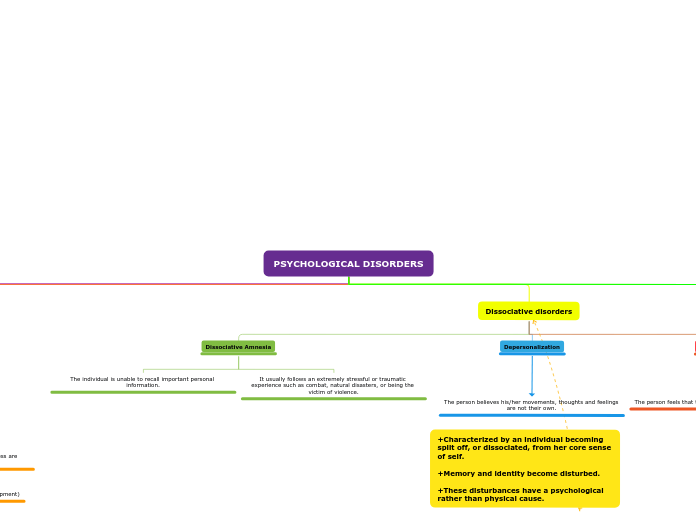
Dissociative Amnesia
The individual is unable to recall important personal information.
It usually follows an extremely stressful or traumatic experience such as combat, natural disasters, or being the victim of violence.
Depersonalization
The person believes his/her movements, thoughts and feelings are not their own.
Derealization
The person feels that the world surrounding them is not real.
DID
Formerly called multiple personality disorder.
People with dissociative identity disorder exhibit two or more separate personalities or identities, each well-defined and distinct from one another.
Causes: About 95% of people with DID were physically and/or sexually abused as children.
paranoid
Disorders include paranoid personality disorder, schizoid personality disorder, and schizotypal personality disorder. People with these disorders display a personality style that is odd or eccentric.
antisocial
Disorders include antisocial personality disorder, histrionic personality disorder, narcissistic personality disorder, and borderline personality disorder. People with these disorders usually are impulsive, overly dramatic, highly emotional, and erratic.
avoidant
Disorders include avoidant personality disorder, dependent personality disorder, and obsessive-compulsive personality disorder. People with these disorders often appear to be nervous and fearful.
Children may also develop conditions such as:
Depression, Anxiety, Obsessive-Compulsive Disorder (OCD) and Post-traumatic Stress Disorder (PTSD)
Oppositional Defiant Disorder (ODD)
ODD usually starts before 8 years of age, but no later than by about 12 years of age.
When children act out persistently so that it causes serious problems at home, in school, or with peers, they may be diagnosed with Oppositional Defiant Disorder (ODD).
Children with ODD are more likely to act oppositional or defiant around people they know well, such as family members, a regular care provider, or a teacher.
Examples of ODD behaviors include
+ Often being angry or losing one’s temper
+ Often arguing with adults or refusing to comply with adults’ rules or requests
+ Often resentful or spiteful
+ Deliberately annoying others or becoming annoyed with others
+ Often blaming other people for one’s own mistakes or misbehavior
Attention-Deficit/Hyperactivity Disorder (ADHD)
DHD is one of the most common neurodevelopmental disorders of childhood. It is usually first diagnosed in childhood and often lasts into adulthood.
It is normal for children to have trouble focusing and behaving at one time or another. However, children with ADHD do not just grow out of these behaviors. The symptoms continue, can be severe, and can cause difficulty at school, at home, or with friends.
A child with ADHD might
Talk too much
Squirm or fidget
Daydream a lot
Have a hard time resisting temptation
Have trouble taking turns
Forget or lose things a lot
Make careless mistakes or take unnecessary risks
Have difficulty getting along with others
Children with ADHD may have trouble paying attention, controlling impulsive behaviors (may act without thinking about what the result will be), or be overly active.
There are three different types of ADHD, depending on which types of symptoms are strongest in the individual:
Predominantly Inattentive
It is hard for the individual to organize or finish a task, to pay attention to details, or to follow instructions or conversations. The person is easily distracted or forgets details of daily routines.
Predominantly Hyperactive-Impulsive
The person fidgets and talks a lot. It is hard to sit still for long. Smaller children may run, jump or climb constantly. The individual feels restless and has trouble with impulsivity.
Someone who is impulsive may interrupt others a lot, grab things from people, or speak at inappropriate times. It is hard for the person to wait their turn or listen to directions. A person with impulsiveness may have more accidents and injuries than others.
Tourette Syndrome
Tourette Syndrome (TS) is a condition of the nervous system. TS causes people to have “tics”.
Tics
Tics are sudden twitches, movements, or sounds that people do repeatedly. People who have tics cannot stop their body from doing these things. For example, a person might keep blinking over and over.
There are two types of tics
Motor Tics
Motor tics are movements of the body.
Vocal Tics
Vocal tics are sounds that a person makes with his or her voice.
Tics can be either simple or complex:
Simple tics involve just a few parts of the body.
Complex tics usually involve several different parts of the body and can have a pattern.
Diagnosing
There is no single test, like a blood test, to diagnose TS. Health professionals look at the person’s symptoms to diagnose TS and other tic disorders. TS can be diagnosed if a person has both motor and vocal tics, and has had tic symptoms for at least a year.
Symptoms
The main symptoms of TS are tics. Symptoms usually begin when a child is 5 to 10 years of age. The first symptoms often are motor tics that occur in the head and neck area. Tics usually are worse during times that are stressful or exciting. They tend to improve when a person is calm or focused on an activity.
The types of tics and how often a person has tics changes a lot over time. Even though the symptoms might appear, disappear, and reappear, these conditions are considered chronic.
In most cases, tics decrease during adolescence and early adulthood, and sometimes disappear entirely. However, many people with TS experience tics into adulthood and, in some cases, tics can become worse during adulthood.
Although the media often portray people with TS as involuntarily shouting out swear words (called coprolalia) or constantly repeating the words of other people (called echolalia), these symptoms are not required for a diagnosis of TS.
Conduct Disorder (CD)
Conduct Disorder (CD) is diagnosed when children show an ongoing pattern of aggression toward others, and serious violations of rules and social norms at home, in school, and with peers.
Children with CD are more likely to get injured and may have difficulties getting along with peers.
Examples of CD behaviors include
* Breaking serious rules, such as running away, staying out at night when told not to, or skipping school
* Being aggressive in a way that causes harm, such as bullying, fighting, or being cruel to animals
* Lying, stealing, or damaging other people’s property on purpose
These rule violations may involve breaking the law and result in arrest.