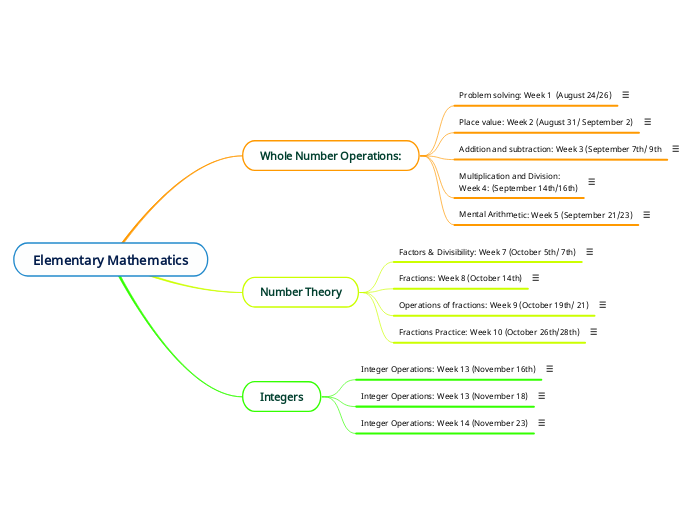
Problem solving: Week 1 (August 24/26)
This week we explored problem solving. We discussed Polya's four step from solving technique: Understand the problem What are you looking for after reading the problem. Is there a better way to look at the questionDevise a planWhat method do you plan on using to solve this problem? i.e guess and check, drawing a picture and look for a patter Carry out the planWork on the problem but do not get discouraged. Look back ( reflect) Does the answer make sense? Did you answer the full questionWhat did you learn?We discussed some examples of Polya's four step solving We worked on the problem: Recently Mr.Smith cleaned out his office and decided to give his unwanted books way to his students. His first class took 1/6th of the books. His second class took 1/5th of the books. 3rd period took 1/4th of the books. 4th period took 1/3rd of the books, 5th period took 1/2 of the books. This left 14 books which the 6th period took and left 0. How many books did mr. Smith have to begin with? After discussing multiple techniques such as writing it out, drawing pictures, using manipulatives we discovered mr. smith had 84 books to begin with.
Place value: Week 2 (August 31/ September 2)
This week we discussed place value and different bases to better help our students in the future learn base 10. Through place value we reviewed each number value and what information it holds when a number is placed there. We talked about how in America we categorize most of our numbers in phase 10. The base 10 system works with: 0,1,2,3,4,5,6,7,8,9 digits. There are different bases as well, such as base 3. In base 3 the only digits are: 0,1,2. We also learned how to convert between different bases. For example: 221 becomes 61 in base 5. We learned how to convert from a number in base 10 to a number in different base and a number from a different base into base ten. In order to convert a number from base 10 you need to understand their number systems. For example, base two can only be 0,1.
Addition and subtraction: Week 3 (September 7th/ 9th
This week we discussed number operations. We talked about addition, and the different properties that fell under addition. We talked about the identity property: (a+0=a). the communicative property: a+b=b+a, and the associative property: (a+b)+c = a+(b+c). While talking about addition we discussed the different algorithms for solving math problems. These include:the Standard American Algorithm Partial sumsPartial sums with an emphasis on place value left to right, expanded notation lattice. Next we discussed the different algorithms of subtraction. These algorithms include: American Standard European StandardReverse IndianLeft-to-RightExpanded notation integer subtraction. Throughout the time period of the class we reviewed and practiced these new styles of subtraction. These are all great tools to use when teaching subtraction to my future students.
Multiplication and Division:
Week 4: (September 14th/16th)
This week we discussed different algorithms and properties for multiplication The commutative property/ order: a*b=b*a The Identity property: a*1=1 The zero property: a*0=0 Associative property/ grouping: (a*b)*c= a*(b*c) Distributive property: a(b+c)= (a*b)+(a*c)These properties help identify the different ways to multiply in order to better understand multiplication. The different algorithms of math are: Standard: Lacks place value and reasoning Place value: 23*14. This method helps demonstrate place value and allows students to see what is happening and why. 4*3= 124*20= 80 10*3= 30 10*20= 200 = 322 Expanded Notation: 23*14 Helps show place value and break it up further, so students can better understand the problem 23 = 20+3 14= 10+4 12 (4*3) + 90(4*20+10) 200( 20*10) +30(10*3) 90+30 = 120 200+120+ 2 = 322 Lattice, this helps break up the partial products into simpler multiplicatives. Next we discussed division. We first discussed the different vocab associated with division: quotient, dividen, divisor, remainder. We then discussed the different algorithms we can use for division: Standard, standard with an emphasis on place value, and the alternative method.
Mental Arithmetic: Week 5 (September 21/23)
This week we discussed mental addition, subtraction, multiplication and division. Mental arithmetic is the process of producing an answer to computation without using and computational aids such as calculators, computers, tables, etc. Mental Addition: Left to right: 347+129(300+100)= 400(40+20)= 60(7+9)=16400+60+16= 476 Compensation 67+29= 67+30=97-1= 96 (this is to compensate for the extra 1) Using Compatible Numbers 130+50+70+20+50 130+70=20050+50= 100100+200+20= 320 Breaking up & Bridging 67+36 67+30=9797+6=103 Mental SubtractionLeft-to-Right: 93-3890-30= 60 8-3=5 60-5= 55 47-3240-30=10 7-2=5 10+5=15 Breaking up and Bridging 67-36 67-30= 3737-6= 31 Compensation47-29= 48-30 (you have to add the same number on each side. 48-30= 18Drop 0's 8700-50087-5=82 (then add back 2 0's) 8,200Compatible Numbers170-50-30-50170-30=14050+50=100140-100=40Mental Multiplication Compatible Numbers2x9x5x20x5 9x(2x5)x(20x5)9x(10)x(100)=9000Left-to-Right123x33x100=3003x20=603x3=6300+60+6= 366 Multiplying Powers of 10 12,000 x110,00012 x 11= 132 add the 7, 0's back 1,320,000,000Mental DivisionCompatible Numbers 105/3 Divisible by 3 -90Sum of 105 -15 90/3= 30, 15/3=5 30+5=35
Factors & Divisibility: Week 7 (October 5th/ 7th)
On Tuesday, October 5th we discussed divisibility rules. We talked about what divisibility means: "a is divisible by b if there is a number c that meets the requirements b*c=a. We also discussed the difference between a prime number, a number that only have one factor; a composite number, a number that has multiple factors; and how 0 and 1 are neither. 0 is a additive identity element, and 1 is a multiplicative identity element. We also discussed different factors, and how we can easily find the different factors of a number. example: 91: 1,7,13,91 Next we talked about the important terminology: 10 is divisible by 5 or 5 divides 10 5 is a divisor of 10 5 is a factor of 10 10 is a multiple of 5 Then we talked about the different divisibility rules. Endings, we look at the end of the number:by 2: 0,2,4,6,8by 5: 0,5 by 10: 0 Sum of Digits, We look at the sum of all the numbers:by 3: example: 543 (5+4+3)= 12, divisible by 3 by 9: the add the total number, and see if its divisible by 9. Other: by 6: a number is divisible by 6 if it is divisible by both 2 and 3. Last Digits:by 4: we see if the last two digits are divisible example: 3,728. 28 is divisible by 4 so the whole number is. by 8: we see if the last 3 digits are divisible by 8 Special 7: You double the last digit, then you take away from the original. example: 826 6*2=12 82-12=70. This is divisible by 7 Special 11 "Chop off" example: 29,194 you "chop off the last two digits and add them to the remaining 291+94= 385 Then repeat 85+3= 88. This number is divisible by 11 because of this method. On Thursday October 7th, we discussed the Greatest Common Factor and the Least Common Multiple. We then discussed the different methods of trying to find these. List method. In the list method you list out the factors and multiples of a number and find which factor the two numbers have in common. 24 : 1,2,3,4,6,8,12,2436: 1,2,3,4,6,9,12,18,36 The GCF: 12 24: 24,48,72,96 36: 36,72The LCM: 72 Prime Factorization. Through prime factorization you create a tree for the numbers and break them down into their prime factors to find GCF and LCM. 24 2^12 24= 3x2x2x2 3^4 2^2 36 6^63^2 3^2. 36=3x3x2x2GCF: 2x2x3=12 (you multiply all the common prime factors) LMC: 12x2x3= 72 (you multiply the GCF by the remaining numbers).
Fractions: Week 8 (October 14th)
On Thursday October 14th, we discussed factions. We discussed how fractions are part of a whole; they are a symbol that represents the relationship between a part & a whole. 3/10 (3 is the part) (10 is the whole) We also discussed the difference between ratios and fractions. Ratio can have part to part or part to whole; whereas a fraction can only be part to whole example: there are 20 students. 12 girls, 8 boys. 12/20 of the students are girls. 12:20 8/20 of the students are boys. 8:20 There are 8 boys for every 12 girls 8:12 Different Models of Fractions Address surface area, region (shading in a regio) address length (folding paper) (number line) addressing sets of things/groups (use students) At 9:45 we discovered that when we use all of our pieces we have a whole (when the numerator and denominator match: 4/4, 7/7) We also talked about equivalent fractions, even though they do not appear the same, they have the same overall value. ex: 1/2=2/4=4/8ex: 3/7=6/14 (multiplied the bottom and top by 2) ex: 2/6 (x top and bottom by 5) = 10/30
Operations of fractions: Week 9 (October 19th/ 21)
On Tuesday we discussed the four operations for fractions. Addition With addition you may only add fractions if they have the same common denominator. If they do not have the same denominator, you need to find the least common multiple of the two fractions' denominators. Ex: 3/12+2+12= 5/12 1/2+1/6= 3/6+1/6 (6 being the least common multiple. A great way to demonstrate fractions is with manipulatives and pictures. Subtraction It is the same as addition, you may not subtract fractions if they do not have the same common denominator. If they do not have the same common denominator you need to find the least common multiple of the denominators. ex: 5/12-1/12=4/12 1/2-1/6= 3/6-1/6=2/6 (6 being the least common multiple) Multiplication As you multiply fractions the product gets smaller and smaller. Manipulatives and pictures are also a great way to explain multiplying fractions. When multiplying fractions you multiply the numerator by the numerator and the denominator by the denominator. ex: 1/2 of 1/4= 1/8 1/2 of 1/8= 1/16 3/4 of 1/3= 3/12 Division Division makes you ask the question of how many does __ go into. For example 6/3 means how many times does 3 go into 6? 2. When dividing fractions you start by writing the problem and then you take the reciprocal of the second fraction and multiply the two. ex: 1/2 / 1/4= 1/2* 4/1= 4/2= 2. On Thursday (October 21st) we practiced fractions and fraction word problems.
Fractions Practice: Week 10 (October 26th/28th)
On Tuesday and Thursday October 26th, we reviewed and practiced fractions to better prepare us for the test.
Integer Operations: Week 13 (November 16th)
Tuesday November 16th, Today we discussed Decimals and the four operations of decimals. Decimals are a one-to-ten relationship, meaning that decimals separate the whole from the part in groups of tens. 375.253= 3 hundreds 7 tens 5 ones .2 tenths 5 hundredths 3 thousandths There is no oneths because 5 is the reference point. The decimal always sits to the right of the reference point. Examples: 3/10 of a dollar is 3 dimes= 0.30 or 0.3 0.30= 30 hundredths= 30/1003/100 of a dollar is 3 pennies= 0.03 0.03= 3 hundredths Comparisons: 0.3>0.03 0.9>0.12 (remember place value) Four operations Addition: (add the same quantity) Line up the decimals: 3.23 +1.2 = 4.43 Subtraction: Line up the decimals 3.23-1.2= 2.03 Multiplication Move the decimal In order to move the decimal, you need to remember place value and why you are adding those specific numbers. Example: 1.9 x 2.1= -------3.99Example: 2.3x1.2= Move the decimal over at the end by how many decimals there are on the top. Since there are two decimals on the top, you move the decimal on the bottom over 2 times. This is because when you break it down it looks like : 3/10x2/10=6/1002x2/10= 4/10 1x3/10= 3/10 1x2=2 2+4/10+3/10+6/100= 2.76 DivisionBring the decimal up When dividing decimals you bring the decimal up above the divisible line. This helps keep the place values where they need to be. You may also need to multiply by 10 when dividing two decimals. This makes the numbers easier to compute, and the new answer will have the same answer as it did before you multiplied by 10 due to the place value.
Integer Operations: Week 13 (November 18)
On Thursday we discussed percentages. Percentages mean per 100, out of one hundred. Example: $200-20= $180. We then talked about how to turn decimals into percentages and vice versa. Example: 1/10=0.1=0.10=10% 33%=0.33=33/100We learned how to convert fractions that aren't already 100, in order to get a percentage. Example: 2/5=20/100=20%3/10=30/100=30%1/8= One divided by 8= 0.125= 13% After discussing how to figure out how to get a percentage from a fraction, we learned about terminating and repeating decimals. Terminating decimal: has an end. Ex: 0.125 Repeating: Can go on forever. The way we show a repeating decimal is if we put a bar over the number that keeps repeating. Ex: 5/6=0.83333 we would put a bar over the three to indicate that 3 is the repeating decimal. We then discussed how pi 3.14 is neither a repeating or terminating decimals, because it goes on for a very long time (Not terminate), but without any repeating numbers (Not repeating).
Integer Operations: Week 14 (November 23)
On Tuesday November 23rd, we discussed integer. We talked about positive and negative numbers. We discussed the chip method. This is when you use a chip with two different colored faces to show positive and negative numbers. The red side represents negative numbers and the yellow side represents positive numbers. When you have a positive and a negative chip together it equals zero. Example: +5= +++++ (+1)= ++++++= (+6) +5+(-1)= +++++-= +4 because of the zero pair -5+(+1)= - - - - - += -4 -5-(-1)= - - - - - - = -6 -5 - (+1) = - - - - - (-) (+-) = -6 ^ Zero Pair is used when you can't take a positive or negative number. When multiplying and dividing fractions you have to remember that multiplication and division works with pairs. Example: +3*+2= 3 groups of +2= +6 +3*-2= -6 3 groups of -2= -6 -3*+2 -> +2* -3 = 2 groups of negative 3 = -6 -3 * -2 -> treat the - (negative sign) as an "opposite of" meaning that the answer is the opposite of the negative numbers. Example: -3 * -2 = +6 (because of the opposite of rule) When dividing integers, you have to remember how you got there. Example: +3*+2= +6 +6/+2= +3 +6/+3= +2 -3*-2= +6 +6/-2= -3 +6/-3= -2