Balance Sheets
Assets
Stuff you won with a $value
Liabilities
Something you owe to a business or person
Owners Equity
What's "Leftover"
Fundamental Accounting
Equation
A = L + OE
Asset = Liabilites + Owner Eqity
More rules
-Only 4 dollar signs ($)
- Cash comes first when listing assets
- Account Recieveable comes secound
when listing assets
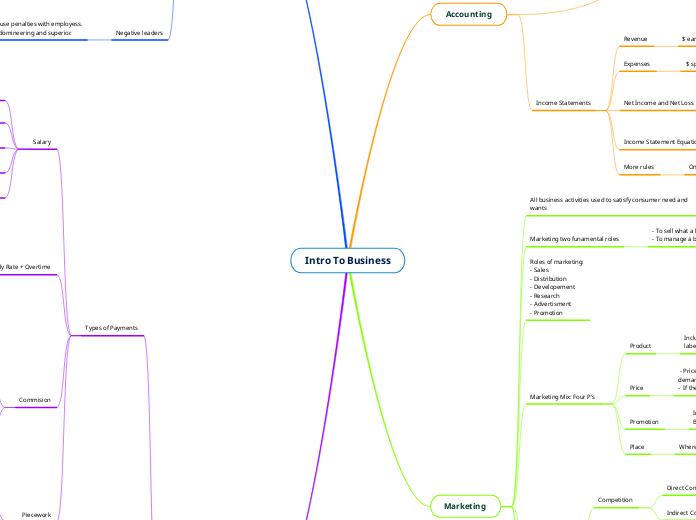
Income Statements
Revenue
$ earned from performing a service or selling goods
Expenses
$ spent
Net Income and Net Loss
Net Income - Profit
Net Loss -
Expenses are greater than your revenue
Income Statement Equation
Revenue - Expenses = Net Profit or (Net Loss)
More rules
Only 3 dollar signs ($)
All business activities used to satisfy consumer need and wants
Marketing two funamental roles
- To sell what a businees makes
- To manage a business's brand or brands
Roles of marketing:
- Sales
- Distribution
- Developement
- Research
- Advertisment
- Promotion
Marketing Mix: Four P's
Product
Includes name, slogan, jingle, trademark, packaging,
labelling and gurantee
Price
- Price of a product will often be determined by the quantity demanded
- If the demand is high, people will be willing to pay more
Promotion
Informs consumers about a product and encourages them to BUY it
Place
Where consumers can get the product they want
The two C's:
Competition
Direct Competition
Very similar products addressing the same need.
i.e. Coke vs Pepsi
Indirect Competition
The options are not directly related to each other.
Consumer
Consumers and Target Market: The specific
segment of population that buys your product is your
Target Market.
Target Market can be segmented in two ways:
Demographics
Relating to the structure of population
Lifestyle
Not easily defined. Examples include:
- Social Class
- Opinion
- Activities
- Attitudes and Beliefs
Branding: Businesses spend money (hundreds
of thousands of dollars) to create a image
Brand Name
A word, or group of words, to dinguish a businesses
product from its competitiors
Logo/Trademark
A business combines their name with a special symbol
Slogan
Shorty catchy phrase. i.e Eat Fresh (Subway)
Colours
Warm Colours
Warm couolrs send an more outgoing and
energetic message.
i.e. red,orange
Cool Colors
Cool Colours send a more cooler and calmer
message.
3 types of leaderships
Autocratic
Tells others what to do and
is not open to new ideas
Effective when:
- Little time
- Members don't know how to do their job
- Members don't knwo each other
Ineffective when:
- Trying to team build
- Members know how to do their job
- Members want variety
Democratic
When all members are involved and
supports teamwork
Effective when:
- More time
- Members are interested
- Members know how to their job
Ineffective when:
- Group is not interested (lazy)
- Memebrs don't know how to do the job
- Memebrs don't like each other
Laissez - Faire
When no one is in charge and
give little to no direction
Effective when:
- Memebrs really like the job and know how to do it
- True teamwork
- All members know what has to be done
Ineffective when:
- Memebrs don't value each other
- Members don't know how to their job
- Group needs to be told what to do
Positive Leaders
Postitive leaders use rewards
to motivate employess
- Independence
- Development Oppurtunities
- Acknowledgement
- Raises, Bonuses
- Lieu time off
Negative leaders
Negatives leaders use penalties with employess.
These leaders act domineering and superior.
- Days off without pay
- Reprimanding in front of others
- Assigning unpleasant job tasks
Types of Payments
Salary
- Based on an annual (yearly) amount
- Get paid on a regular schedule
- Pay peroids can be weekly,
bi-weekly (every two weeks) or monthly
Formual to Calculate
Annual Salary ÷ # of pay peroids
Weekly
Salary/ 52 = $ amount paid per week
Bi - weekly
Salary/ 26 = $ amout paid every two weeks
Monthly
Salary/ 12 = $ amount paid per month
Hourly Rate + Overtime
Regular Earnings
Paid by the # of hours worked
Formula to Calculate
Hourly rate x # of hours worked
Overtime Pay (OT)
Recieve a higher rate of pay after you work more than 44 hours during the week.
Overtime Rate usually:
Time + 1/2
Paycheque Formula
Regular Pay + OT Pay
Commision
Paycheque is based on a % of what you sell. - Sales commission
2 types of commission
Straight Commission
Formula to Calculate
% rate x amount sold
If you don't sell anything you don't get paid at all.
So you must sell to get paid.
Salary + Commission
Formula
% rate x amount sold + salary
If you don't sell anything you still will get paid something.
Piecework
You get paid based on the # of items you make or sell.
Formula to Calculate
Piecework Rate x # of items
Deductions
Goverment Deductions
Income Tax
Anyone who earns income has to pay
Federal and Proinvial income tax.
CPP (Canada Pension Plan)
Anyone who works or and is over 18 years old
must contribute to CPP. Its paid into from every paycheque.
EI (Employment Insurance)
You pay into it every paycheque even if your not 18.
If you get laid off and you have worked 420 hours then you can collect your employment insurance.
Voluntary Deductions
Savings Plan
Takes money off your pay cheque
and puts in into a savings account.
Life Insurance
Deducts money from your pay chaque
so your family can recieve the money after you pass away.
Union Dues
Automatically takes money from your pay cheque
to pay for union dues.
Cheques
A cheque is a piece of paper that you can give to
someone in exchange for a good or service.
Must Have:
- Due date
- Name of the person the payment is going to.
- The amount that is being paid.
- Reason to write the cheque
- And signture of the person who wrote the cheque.
Rule of 72
Using the rule of 72 you can find out how long it take to double your money.
Formula
72/ I (interest rate) = # of years to double money.