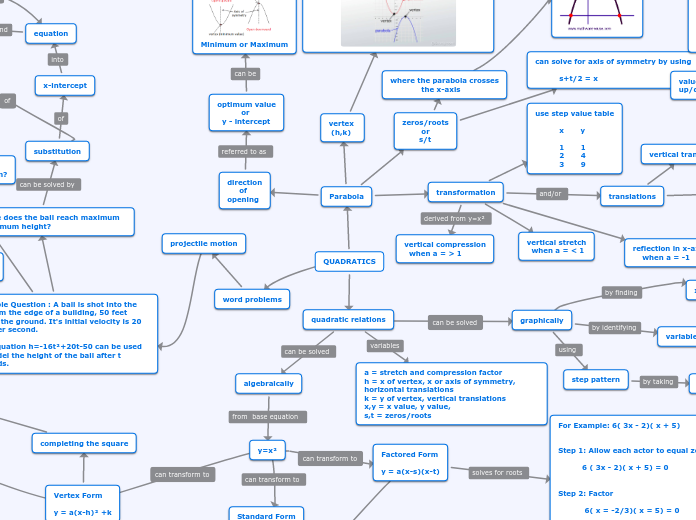
QUADRATICS
quadratic relations
algebraically
y=x²
Standard Form
y = ax²+bx+c
a = stretch and compression factor
h = x of vertex, x or axis of symmetry, horizontal translations
k = y of vertex, vertical translations
x,y = x value, y value,
s,t = zeros/roots
Parabola
direction
of
opening
optimum value
or
y - intercept
Minimum or Maximum
vertex
(h,k)
the point where the axis of symmetry and the parabola meet. This point is where the parabola is at its max or min.
zeros/roots
or
s/t
where the parabola crosses
the x-axis
can solve for axis of symmetry by using
s+t/2 = x
transformation
vertical compression
when a = > 1
vertical stretch
when a = < 1
translations
vertical translation
value of 'k' determines units shifted up/down
horizontal translation
value of 'h' determines units shifted left/right
reflection in x-axis
when a = -1
use step value table
x y
1 1
2 4
3 9
word problems
projectile motion
x= −b±√b²-4ac
__________
2a
a quadratic equation cannot be factored
Vertex Form
y = a(x-h)² +k
completing the square
For Example: y = 2x² + 12x - 3
Step 1: remove common factor from x² and x-term
y = 2( x² + 6x ) - 3
Step 2: find the value of half the x-term coefficient. This value squared is equal to the constant that needs to be added and subtracted to make a perfect square.
a) (6/2)²
b) y = 2( x² + 6x + 9 - 9 ) - 3
Step 3: group the terms that make the perfect square. Move the subtracted value outside the brackets by multiplying it by the common factor.
y = 2( x² + 6x + 9 ) - 18 - 3
Step 4: factor and collect like-terms.
y = 2( x + 3)² - 21
to solve: isolate for 'x'
y = 2(x - 1)² + 5
Step 1: Move 'k' to other side of equal sign. It is now negative.
-5 = 2( x -1)²
Step 2: Move 'a' to other side of equal sign. It's function changes from multiplication to division.
-5/2 = (x - 1)²
Step 3: Solve left side, while finding the square root of the right side of equal sign.
-5/2 = √(x - 1)²
↓
-2.5 = (x- 1)
Step 4: Rearrange sides of the equal sign
(x-1) = -2.5
Step 5: Isolate 'x' by moving -1 to the other side of equal sign. -1 then becomes positive.
x = -2.5 + 1
Step 6: Solve.
∴ x = -1.5
Factored Form
y = a(x-s)(x-t)
For Example: 6( 3x - 2)( x + 5)
Step 1: Allow each actor to equal zero
6 ( 3x - 2)( x + 5) = 0
Step 2: Factor
6( x = -2/3)( x = 5) = 0
∴ x = 2/3
x = -5
factoring
1. Common factor
For Example: 4x² - 48x + 144
Step 1: Find the G.C.F → 4
Step 2: Divide each term by G.C.F
4(x² - 12x + 36)
Step 3: Factor fully using the ABC method
a = 1 -6 x -6 = 36
b = -12 -6 + -6 = -12
c = 36
∴ ( x - 6 )(x - 6)
2. Trinomials
simple
a = +1
For Example: x² + 9x + 20
Step 1: Start with an 'x' in each bracket
( x ) (x )
Step 2: Use the ABC method to solve
a = 1 4 x 5 = 20
b = 9 4 + 5 =9
c = 20
∴ ( x + 4 ) ( x + 5 )
complex
a is not equal to +1
For Example: 6x² + 13x + 5
Step 1: Use the ABC method
a = 6 10 x 3 = 30
b = 13 10 + 3 = 13
c = 5
Step 2: break down 'b' or middle term
6x² + 10x + 3x + 5
Step 3: group terms
2x(3x + 5 ) + 1(3x + 5)
Step 4: factor out G.C.F from each group
(3x + 5) ( 2x + 1)
∴ x = 5/3
x = 1/2
3. difference of squares
a² - b²
OR
√(a+b) √(a-b)
x² - 9
Step 1: Find square root
√(x² + 9) √(x² - 9)
Step 2: ( x + 3 ) ( x - 3)
∴ x = -3
x = 3
* to check answer: expand using F.O.I.L*
quadratic formula
Discriminant
3 possibilities
0 real roots
√b²-4ac < 0
1 real root
√b²-4ac =0
2 real roots
√b²-4ac >0
√b²-4ac
is use to find ( h,k ) which is the vertex
horizontal shifts ( left, right)
vertical shits ( up,down)
Step 1: x= -5±√25+24
__________
4
Step 2: x= -5±√49
_______
4
Solve for negative √ x = -5 -√49
______
4
x = -3
Solve for positive √ x= -5 + √49
_______
4
x = 0.5
graphically
x-intercepts
graph
zeros/roots
zeros/roots
For Example: y=x²+2x-3
Step 1: Use x=-b/2a to find axis of symmetry
x=-2/2(1), x=1
Step 2: Sub x=1 into equation to find
y-intercept
y=(1)²+2(1)-3, y=-4
So vertex is (1,-4)
Step 3: sub x=0 into equation to find
y-coordinate to create another point
y=(0)²=2(0)-3, y=-3
2nd coordinate, (o,-3)
Step 4: Plot axis of symmetry, x=1
Plot vertex, (1,-4)
Plot 2nd coordinate, (0,-3)
Step 5: coordinates even, then connect the dots
variables a,b,c
axis of symmetry
x= -b/2a
x-value
equation
coordinates
vertex
x=0
equation
coordinates
2nd coordinate
step pattern
'a'
vertex form
y
1
4
9
coordinates
Example: y=-2x²+9
x y
1 1x2, (1,2)
2 4x2, (2,8)
3 9x2, (3,18)
graph
Example Question : A ball is shot into the air from the edge of a building, 50 feet above the ground. It's initial velocity is 20 feet per second.
The equation h=-16t²+20t-50 can be used to model the height of the ball after t seconds.
at what time does the ball reach maximum height? Minimum height?
substitution
x-intercept
equation
max/min height
About how long does it take for the ball to hit the ground?
quadratic formula
x= −b±√b²-4ac
__________
2a
x-intercept
at what time will the ball
have a height of exactly 35m?
substitution
equation
time/x-intercept