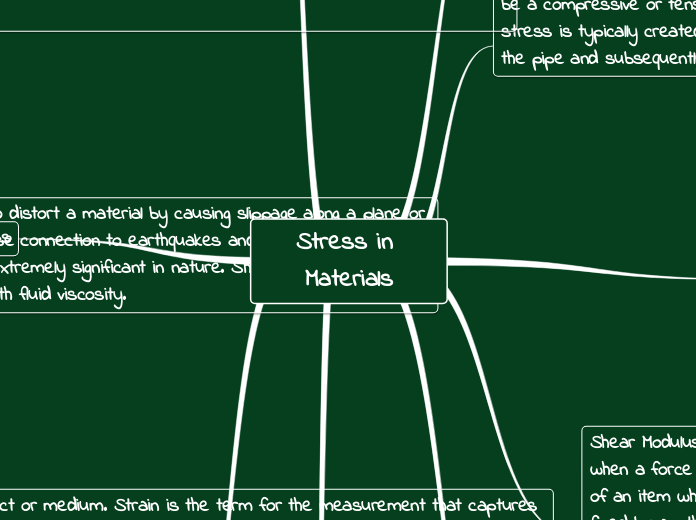
Definition : When a given cross-sectional area of an item is loaded with force, it is expressed as stress (σ). Stress is a system of forces that is delivered to a body that tends to cause deformation from the standpoint of loading.
Formula : σ = F/A
Longitudinal : The strain put on a shape's long axis. It may be a compressive or tensile stress. For a pipe, the stress is typically created by the fluid pressure inside the pipe and subsequently acts on the pipe wall.
Volumetric : Volumetric stress, also known as bulk stress, is the term used when a deforming force or applied force affects an object in all three dimensions, changing its volume. Simply said, volume stress occurs when a body's volume changes as a result of a bending force.
Modulus of Rigidity : Shear modulus, sometimes referred to as the Modulus of Rigidity, is a measurement of a body's rigidity that is determined by the relationship between shear stress and shear strain.
Shear Modulus : The deformation that occurs when a force is applied parallel to one face of an item while holding the opposite face fixed by another equal force is referred to as shear deformation. The shear modulus is the elastic modulus we use for this deformation.
Modulus of Elasticity : A material's capacity to endure length changes when subjected to lengthwise tension or compression is measured by its Young's modulus. The longitudinal stress divided by the strain results in Young's modulus, also known as the modulus of elasticity.
Elastic modulus : Although the relationship between stress and strain does not necessarily have to be linear, the greater the stress, the greater the strain. The amount of deformation that stress causes is only directly proportional to the amount of stress when it is low enough. The elastic modulus in this relationship is the proportionality constant.
Types
Compressive : the stress that develops when an elastic body shortens in one dimension as a result of opposing collinear forces that are attempting to crush it
Tensile : A physical parameter associated with tensile forces and stretching operations is called tensile stress. Any material subjected to it will elongate along the axis of the load. When a load is given to an object, the material has a tendency to pull or stretch in the direction of the force. Tensile stress is the amount of direct load connected to the tensile loads that cause an object to stretch.
Shear stress : Shear stress is a force that tends to distort a material by causing slippage along a plane or planes parallel to the imposed stress. Due to its close connection to earthquakes and the downslope movement of earth elements, the resulting shear is extremely significant in nature. Shear stress can exist in both solids and liquids; in the latter, it is correlated with fluid viscosity.
Strain : Stress results in the deformation of an object or medium. Strain is the term for the measurement that captures this distortion. In terms of tensile stress, volume under bulk stress, or geometry, strain is expressed as a fractional change in one of these three variables.
Hooke’s Law : The displacement or magnitude of a deformation of an item, for relatively minor deformations, is exactly proportional to the deforming force or load.
Bulk Modulus : a numerical constant that explains how elastic a solid or liquid is under pressure on all sides. A material's volume decreases when pressure is applied, but it recovers its normal volume when the pressure is released.