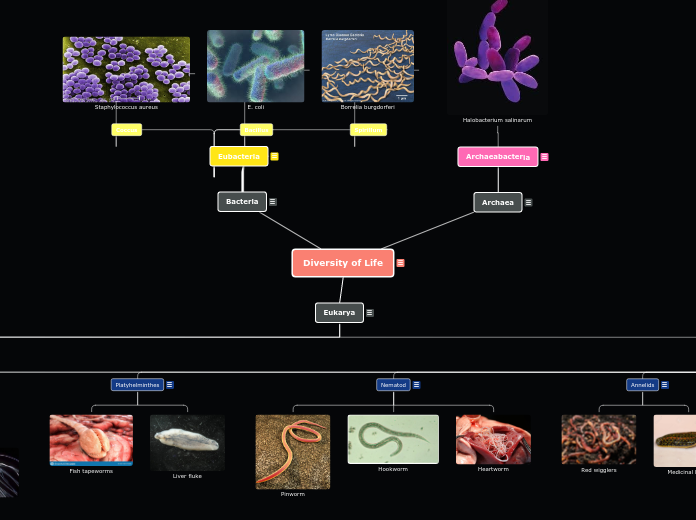
Diversity of Life - Mind Map

Diversity of Life

r

Sub phyla= text in redSuper class= text in yellowGroupings= text in greenDivisions= text in purple

Eukarya

r

Eukarya= Any organisms containing cells each with a distinct nucleus within which the genetic material is containedCharacteristics:Has cells with their own nuclei Contains genetic material in the nucleus Contains membrane bound organelleLarger and more complex than prokaryote

Protists

r

Most diverse kingdomAll protists are aquaticMay be heterotrophic or autotrophicMotileMost are unicellular/ some may be multicellularLarge, complex cells, with many organellesMove using pseudopods, cilia or flagellaCan reproduce both asexually or sexuallyGrouping (Plant like, Animal like, Fungus like) based on their behaviours

Animal Like

r

Feeding characteristsics:Target slow moving prey as they move at a slow paceSurround the prey by extending part of the cell and creating a mouth openningEncloses the prey preventing it from escaping and it is eatenMost cells also carry a contractile vacuole that gets rid of the excess water within each cell**Animal like protists are heterotrophic, meaning they are unable to produce their own food, being the reason they hunt for their food**

Sarcodines

r

Movement patterns:As a portion of the cell moves forward, creating a foot like shape, the rest of the cell follows in behind the "false foot"

Ameoba Proteus

Ciliates

r

Movement patterns:The paramecium have cilia covered pellicle that are equivalent to tiny oars, allowing the cell to move

Paramecium Caudatum

Zooflagellates

r

Movement patterns:Zooflagellates are able to move through the wiggling of the flagella back and forth

Trypanosoma Gambiense

Sporozoan

r

Movement patterns:Sporozoan are not motile. This means they are unable to move themselvesThey must rely on other organisms to carry and distribute them

Plasmodium falciparum

Plant Like

r

Feeding characteristsics:**Plant like protists are autotrophicProduce its own foodNo hunting requiredRetrieve their energy from sunlight through photosythesis

Rhodophyta

Cyanidioschyzon merolae

Euglenoids

Euglena gracilis

Fungus Like

r

Feeding characteristsics:Similar to fungi, fungus like protists decompose materials found around that are already in the process of decayingThey obtain all nutrients required from his process

Myxogastria

Fuligo septica

Oomycota

Potato late blight fungus

Fungus

r

EukaryoticHeterotrophCannot produce own food and must absorb it (chemoheterotrophic)Reproduce through sporesReproduction is both sexual and asexualAre typically not motileAlteration of generationhave cell walls made up of chitinFungus reproduction: 

Zygomycota

r

Reproductive structure:Asexual reproductionNon motile spores are produced at the tipsThis process produces more fungus

Mucorales

Ascomycota

Cladosporium

Basidiomycota

Gilled Mushrooms

Deuteromycota

Chytridiomycota

Batrachochytrium dendrobatidis

Plants

r

Characteristics:MulticellularPhotosynthetic (contain chlorophyll)Alternation of generationsDevelop from embryosStored in maternal tissue from a multicellular structureProduct of sexual fusion

Non vascular

Penicillum marneffei

Bryophytes

Mossess

Mountain fern moss

Liverworts

Ciliated fringewort

Hornworts

Anthoceros crispulus

Vascular

Seedless

r

Vascular tissue is presentLive in moist habitatsContain leaves called frondsSporophyte is dominant

Ferns

Bird's-nest fern

Club mosses

Stag's-horn clubmoss

Seeded

r

Gametophyte in reducedReproduction replaces sperm with pollinationZygote is protected in a seed

Angiosperms

r

Flowering plantsReproduction takes place within the flowerSporophyte is dominant

Anthophyta

San Pedro cactus

Gymnosperms

r

Naked seed (not coved with fruit)Sporophyte produces both male and female cones

Conifer

Douglas fir

Cycads

Wood's cycad

Ginkgo

Maidenhair tree

Gnetophyte

Eru

Animals

r

Characteristics:Heterotrophic DiploidMulticellularDeveloped from a blastula (except sponges)

Porifera

r

AsymmetricalNo tissueLacks skeletonMade of spiculeAsexual and sexual reproduciton

Giant barrel sponge

Cnidarians

r

Two body formsGastrovascular cavityRadical symmetryNematocysts2 tissue layers

Hydrozoa

The clinging jellyfish

Scyphozoa

Moon jelly

Anthozoa

Antipathes dichotoma

Cubozoa

Sea wasp

Platyhelminthes

r

Bilaterally symmetrical with a head and a tailCentralized nervous systemThree tissue layersAcoelomate ( no body cavity)No hard skeletonNo circulatory system

Fish tapeworms

Liver fluke

Nematod

r

Bilateral symmetryComplete digestive tractPseudocoelomate- body cavity

Pinworm

Hookworm

Heartworm

Annelids

r

Digestove tractBody segmentationSegmentation= repeated body unitsCoelomClosed circulatory system

Red wigglers

Medicinal leech

Arthropods

r

Hard exoskeleton made of chitin and proteinNumerous jointed appendagesSegmented bodyMust molt to grow

Chelicerates

Arachnida

Brown widow

Merostomata

Atlantic horseshoe crab

Pycnogonida

Achelia laevis

Hexapoda

Insecta

Fire ant

Entognatha

Snow flea

Crustacea

Malacostraca

American lobster

Maxillopoda

Semibalanus balanoides

Branchiopoda

Riverside fairy shrimp

Ostracoda

Limnocythere inopinata

Myriapoda

American giant millipede

Molluscs

r

Body planVisceral mass with complex internal organsMantle covers visceral mass (may secrete a shell)Foot is modified for functions including locomotion, feeding and attachmentRadula= rough structure near the mouth used for scraping foodMost have shellsCoelom

Gastropod

Garden snail

Cephalopod

Colossal squid

Bivalves

Hard clams

Echinoderms

r

Marine speciesLarval form shows bilateral symmetryAdult for shows radial symmetryCoelomUnique body shape

Asteridea

Giant sea stars

Echinoidea

Pacific purple sea urchin

Holothuroidea

Sandfish

Crinoidea

Elegant feather stars

Ophiuroidea

Ophiothrix fragilis

Chordates

r

Characteristics:Dorsal nerve cordNotochordPaired gill slitsPost-anal tail

Urochordates

Cephalochordates

Vertabrates

r

Vertebrate characteristics:Spinal column or backbone Anterior part of the dorsal hollow nerve cord is a brain3 body segments: Head, Neck, TrunkHas a tail once in their lifetimeA jointed internal skeletonTwo pairs of appendages Closed circulatory system REd blood cells that contain hemoglobin Two to four chambered heartRespiratory structure: Lungs or gillsTwo layered skin

Agnathans

Atlantic hagfish

Gnathostomata

Osteichthyes

r

External fertilization

European eel

Chondrichthyes

r

Chondrichthyes have adapted internal fertilization, allowing the embryo to remain inside the female

Great white shark

Amphibians

r

Amphibians have adapted over time to live on land. They have evolved with protective skin and eyelids that allow them to adapt to vision outside of the water

Gray tree frog

Reptiles

r

Reptiles have adapted dry skin covered with scales or bony plates to minimise water lossTheir eggs have shell for protection and to survive on terrestrial places They have strong limbs and tail to catch their prey.

Panther chameleon

Aves

r

The beaks shape and size has been adapted depending on the destint environment where they must catch their food

Pygmy owl

Mammals

r

Some mammals have adapted to extremem climates through hibernationSome mammals who live in extreme heat conditions have adapted to only need very small amounts of water Sweat less

Monotreme

r

Characteristics: Lay eggs equivalent to human child birthHave no nipplesYoung suck milk from th fur of the parent organism

Platypus

Marsupials

r

Marsupials do not lay eggsThe mother has a mrsupial pouch where the embryotic developement takes placeEx. Kangaroo

Red kangaroo

Placental orders

Primate

Mandrill

Archaea

r

Cells lack a defined nucleusNo membrane bound organelles

Archaeabacteria

r

Archaeans include inhabitants of some of the most extreme environments on the planet.Some live near rift vents in the deep sea at temperatures well over 100 degrees Centigrade.Others live in hot springsOr in extremely alkaline or acid waters.Found thriving inside the digestive tracts of cows termites, and marine life where they produce methane.They live in the anoxic muds of marshesBottom of the oceanThrive in petroleum deposits deep underground.

Halobacterium salinarum

Bacteria

r

Bacteria are unicellular prokaryotesLack of membrane- bound organellesMicroscopic in size

Eubacteria

r

Includes majority of the bacteriaNo indefinate membrane nucleus

Coccus

Staphylococcus aureus

Bacillus

E. coli

Spirillum

Borrelia burgdorferi

Clique aqui para centrar o seu mapa.