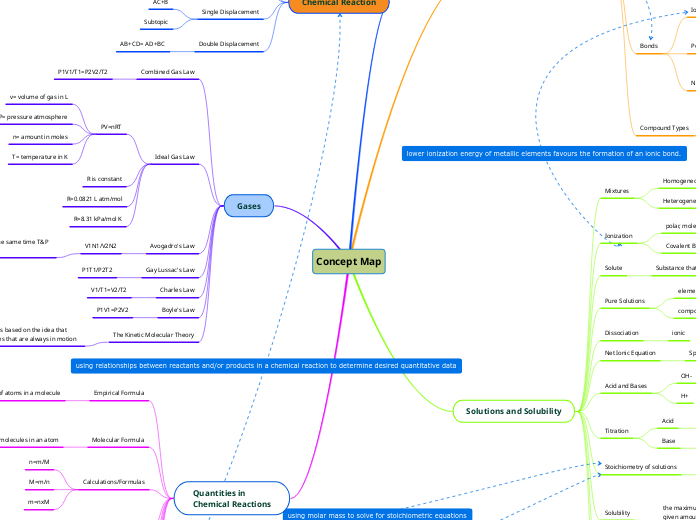
Atomic Radius
radius from nucleus and electron
Ionization Energy
amount of energy required to remove the outermost electron from an atom
Electronegativity
a chemical property that describes the tendency of an atom or a functional group to attract electrons in the formation of ionic bonds
Types of groups
Non-metals (group 14-16)
Alkali metals (group 1)
Alkaline earth metal (group 2)
Transition Metals (group 3-12)
Halogens (group 17)
Noble Gases (group 18)
Bonds
Ionic
High Melting, high boiling points soluble in H2O
Polar Covalent
Low melting points, not soluble in H2O
Non-metal consists of two electrons shared between two atoms
Non Polar Covalent
low melting points, partially soluble in H2O
Compound Types
Polyatomic
Multivalent
More than one charge
Binary
Mixtures
Homogeneous
Heterogeneous
Ionization
polar, molecular compounds
Covalent Bonds
Solute
Substance that is dissolved in a solvent
Pure Solutions
elements
compounds
Dissociation
ionic
Net Ionic Equation
Spectator Ions
Acid and Bases
OH-
H+
Titration
Acid
strong and weak
Base
strong and weak
Stoichiometry of solutions
moles : moles
Limiting reagent
the substances that are completely consumed in the completion of a chemical reaction
Solubility
the maximum amount of a substance that will dissolve in a given amount of solvent at a specified temperature
Saturated
A solution in which the maximum amount of solvent has been dissolved.
Super Saturated
a solution that contains more than the average solvent that can be dissolved at a given temperature
Solutions
Homogenuos mixure of two or more solutions
"Like Dissolves Like"
Polar
Non Polar
Concentrations
molar concentration
c=n/v
v=n/c
C1V1=C2V2
Synthesis
A+B =AB
Decomposition
AB= A+B
Single Displacement
AC+B
Subtopic
Double Displacement
AB+CD= AD+BC
Combined Gas Law
P1V1/T1=P2V2/T2
Ideal Gas Law
PV=nRT
v= volume of gas in L
P= pressure atmosphere
n= amount in moles
T= temperature in K
R is constant
R=0.0821 L atm/mol
R=8.31 kPa/mol K
Avogadro's Law
V1N1/V2N2
Avogadro's Law (Equal volume of gases at the same time T&P have the same # of molecules)
Gay Lussac's Law
P1T1/P2T2
Charles Law
V1/T1=V2/T2
Boyle's Law
P1V1=P2V2
The Kinetic Molecular Theory
explains the states of matter, and is based on the idea that matter is composed of tiny particles that are always in motion
Empirical Formula
EF the simplest ratio of atoms in a molecule
1) Determine moles of each element using m/M
2) Divide each value of moles by the smallest of the values
3) Multiply each number by an integer to obtain all whole numbers
Molecular Formula
MF: the exact number of molecules in an atom
Calculations/Formulas
n=m/M
M=m/n
m=nxM
Molar Mass
Unit 'U' the added amount of mass in a compound
Mole
The SI unit that is used to measure amount of a substance
1 mole= 6.02 x 10^23
% Yield Of Products
% yield= actual yield/theoretical yield x 100%
Limiting and Excess quantities
Stoichiometry
the quantitative study of the reactants and products involved in a chemical reaction
Mole to Mole Ratio
Chemical Equations