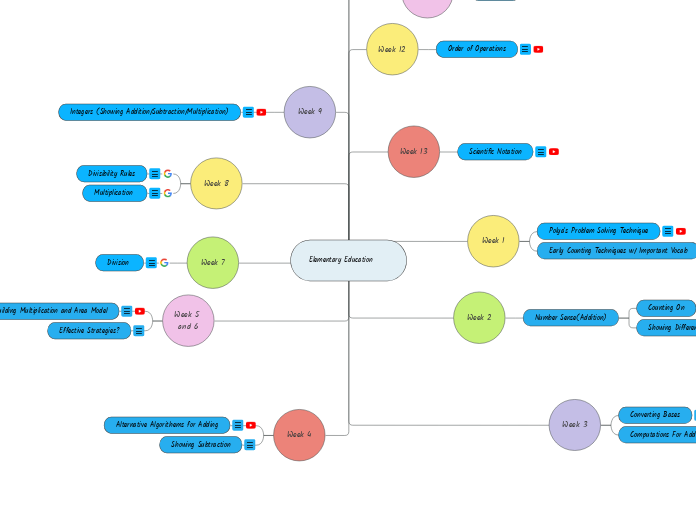
Decimals
DecimalsA decimal number (based on 10) contains a decimal point. Anything on the left of a decimal point represents normal place values such as ones, tens, hundreds and etc.Anything on the right of a decimal point represents decimal place values such as tenths, hundredths, thousandths. <- ->Ex: 135.453Decimals are also represented by the word "And"Ex: 23.146 is twenty three and one hundred, forty - six thousandthsShowing Addition/Subtraction/Multiplication Notes:https://docs.google.com/document/d/1Zg1YQm1CbdOso0V3_Aox95pYuSUyalkfd-OG4JfEkYs/edit?usp=sharingVideo Demonstrating Showing Multiplication on Decimals:https://www.youtube.com/watch?v=t7m3yAk-7xs
aOrder of Operations
Order of OperationsOrder of Operations is a rule or algorithm that we follow in order to solve multi-operation equations. Generally we casually know it as PEMDAS.ParenthesesExponentsMultiplicationDivisionAdditionSubtractionBut It is should be known as GroupingE (Degrees or Roots)MultiplicationsDivisionAdditionSubtractionREMEMBER THERE IS NO PRIORITY BETWEEN MULTIPLICATION AND DIVISION.SAME GOES FOR ADDITION AND SUBTRACTION.Its should just be read as left to right. Video Demonstration: https://www.youtube.com/watch?v=dx-FYVa6r94
Scientific Notation
Scientific NotationScientific Notation is a method of writing very large or very small numbers. A number is written in scientific notation when a number is between 1-9 is multiplied by a power of 10.Positive Exponents in Scientific Notation represents large numbers.It typically represents a whole number.45,000 = 4.5 x 10^4Negative Exponents in Scientific Notation represents very small numbersIt typically represents a decimal.0.00076 = 7.6 x 10^(-4)StepsStep 1: Insert or remove the decimal so that 1-9 is left to the decimalStep 2: Multiply by 10Step 3: Include Proper ExponentVideo Demonstration: https://www.youtube.com/watch?v=TQTMcUWG6QU
Polya's Problem Solving Technique
Polya's Problem Solving TechniquePolya's First Principle: Understand The ProblemThe first step of the plan is to understand the problem. Students should ask themselves these questions:Do you understand all the words used in stating the problem?What is asked of you to find or explain?Can you re-word the problem in a way that best helps you?Polya's Second Principle: Devise a PlanThe second principle is to devise a plan. There are many ways to solve problems but what is the most appropriate and comfortable strategy you would like to do to solve the problem.Many Examples my include:Looking for a patternDrawing a pictureUsing a FormulaUse a ModelPolya's Third Principle: Carry out the planThe third step is to carry out the plan or strategy you have chosen to solve the problem. If the strategy you've used did not work, then you can always use a different strategy.Polya's Fourth Principle: Look BackThe last principle of the four step plan is to reflect. There is so much to be learned and gained when taking the time to look back at what you have done. You can reflect on what has worked and what hasn't worked.
Early Counting Techniques w/ Important Vocab
Number Sense(Addition)
Counting On
This is an addition strategy where addition is performed by counting from the initial number. An example would be if the problem was 5 plus 2, then the counter would start at 5 then continue to count to 7.
Showing Different Bases/Representing Bases other than 10
Representing Bases other than 10It is good to work with numbers in a diffferent base system as it wil help children get a better grasp on how numeric bases work.Showing Different BasesHow would you show 22 base 9 with base blocks?First, you have to recognize that a long is now consisted of 9 units instead of the normal 10 units.Second, you must recognize the place values in 22 and how it relates to units, longs and flats. In this case, we would have 2 longs and 2 units. The two longs are two rows of 9 units The two units are just 2 unitesShowing Adding BasesIn some cases, we will have to add numbers that are in bases other than 10.15 base 5 + 23 base 5 There would be 1 long and two units plus another 1 long and three units.It would then end up as 2 longs and 5 units. Here, we would have to realize that the 5 units can be converted to a long.The end result would be: III
Converting Bases
Converting BasesThe Steps to converting numbers to different bases using blocks can be split up into 4 steps.Step 1:Use units to respresent the number.Step 2:The base amount is equivilent to how big the long is. Construct the max amount of longs with the units. The leftover units can be left alone for later calculation.Step 3:In this stage, you will convert all of the longs to flats.Step 4:Count the amount of units, longs and flats. Additional Conversions might be required.
Computations For Adding
Friendly Method/ Trading OffFriendly Numbers MethodThis Method converts numbers into more familiar numbers such as numbers that end with 5s or 0s.54 + 31 -> 55 + 30 = 85Trading OffThis Method focuses on the idea of moving or trading numbers around to make an equation easier or simpiler.259 + 353Traded off a 1 from the 353 to add into the 259. The Trade off made it easier since a more simpler number comes from the result of it.260 + 352Scratch MethodThis is the process of taking a series of numbers and setting them up vertically. Afterwards, the digits in the ones place are then added downwards until they add up to ten. A one is then carried over the digits in the tens place. This process is repeated until a result.
Fractions
FractionsFractions represent parts of a whole. It is shown with a numerator and a denominator.numeratordenominatorEx: 1/2 or 3/4Real-World Applications:Slices of a pizzaFood Recipes MeasurementsAdding Fractions with same or different denominatorAdding fractions when the denominator is the same is simple!1/4 + 2/4 = 3/4 The denominator doesn't change but there are cases where the two fractions will have different denominator!1/4 + 1/2 In this case, we have to make a common denominator! To find the common denominator, you must find the Least Common Multiple (LCM) of the smaller denominator. In this case, it will be 2. The LCM of 2 and 4 is 4! The new denominator is 4. To get to 4 on the denominator, the 2 has to be multiplied by 2, so we do the same of the numerator!1/2 = 2/4 2 x 2 = 4 (Denominator) and 1 x 2 = 2 (Numerator) results in 2/4 1/4 + 2/4 = 3/4 Video Demonstration: https://www.youtube.com/watch?v=CoCmsyFQ_Xc
Integers (Showing Addition/Subtraction/Multiplication)
IntegersIntegers include positive and negative whole numbers. Zero is neither positive or negative.Rules of IntegersPos. + Pos. = Positive or Neg + Neg = NegativeNegative + Positive = Use the sign of the larger absolute value number. Ex: 12 + (-7) = 5 or (-13) + 16 = 3Showing IntegersShow - 3 using 9+ + + Positive and Negatives Cancel out- - - - - - 3 negatives leftover so it equals -3 Adding IntegersIn this method, you focus on what is larger or what has more in terms of the number in absolute value.++ -25 + (-12) = 1325 has more so the result will be positive Showing SubtractionIts typically best for student to think of this method as "take away"6 - 3 or can be worded as " 6 positives Take away 3 Positives"+ + + (+ + +) -> take awayShowing Multiplication Its best to think of this as "grouping"4(-2) is the same as 4 groups of 2 negatives ( - - ) ( - - ) ( - - ) ( - - ) = - 8Video: Showing Subtraction of Integers with Counters
Divisibility Rules
Divisibility Rules Divisibility rules is a really useful tool. It can be used to test whether a number is a multiple of another or to help check for prime numbers. List of Divisibility Ruleshttps://docs.google.com/document/d/1UJiQ8DqODj0aKS99pInfr7ipHzV1HuuNFc9WksnIEek/edit?usp=sharing
aMultiplication
There are 3 different types of methods that we learned in class.Expanded FormThe expanded form of a number is splitting up a number by its multiple place values. A number can be represented in an expanded form by expressing it as the sum of the products of the digits of their place valueLattice Form Also known as Chinese Multiplication, this method is usually used when multiplying 2-digits by 2-digits numbers. It can also be used on multi-digit numbers. Right to Left FormKnown as the Traditional method, the left to right method is done by an order in which you compute multiplication and division by which one comes first, reading left to right. Placement of numbers and "carrying-over" is very important here.Visual/Notes: https://docs.google.com/document/d/1PwkzIZxXd2W6yYwO-DPaCJdLFVXCLaBqv9oNd4tSECo/edit?usp=sharingVideo Demonstration of Left to Right Method: https://www.youtube.com/watch?v=fJYXIQhqALU
aDivision
It is typically best for students to understand Division in terms of grouping! 15 / 3 = 15 into 5 groups (How many groups can be obtained) Long Division - is an instrument that allows you to divide large groups or parts. When we divide a dividend with a divisor, the quotient obtained is the number of groups that can be obtained. The remainder represents the numbers that were left ungrouped.Two common issues with Long division:Complex method as it requires many different stepsPLACEMENT of numbers matterRepeated Subtraction - Similar method to Long division but simpler as it acts as an introductory to traditional division. Upwards Division - This is another method of division but this method focuses on splitting up the digits of a dividend.Visual/Notes:https://docs.google.com/document/d/1-kjwW4qThjUCJ1-umgfomMvoca8-3RCEVku6bm2H52Q/edit?usp=sharingVideo Demonstration of Long Division: https://www.youtube.com/watch?v=SLze82Zcc4Y
aShowing/Building Multiplication and Area Model
In this lesson, we learned that unit blocks can be used in demonstrating multiplication.What does 2 x 4 mean?It can mean 2 + 2 + 2 + 2 or 4 + 4. Showing/Building MultiplicationExample: 2 x 4 I = 1 unitStep 1:Line up units perpendicular to each other but there should not be a unit in the top left of the area. That should create a an "L" shape. In this case, there will be 2 units set up vertically and 4 units set up horizontally. I I I I I IStep 2: After setting up the table, fill it in. In this case, it will take 8 units to fill the table in I I I II I I I II I I I IThe units, longs or flats ,that were needed to fill in, is the answer. In this case, it would be 8.Area ModelMultiplication can also be solved with the use of an Area model instead of traditional means.In this method, an array or group of boxes are used. The Area Model Method is useful when multiplying large numbers.Video Demonstration: https://youtu.be/NbheCaFQ-cI
Effective Strategies?
As a class, we went over strategies and see if they were effective or not.Timed tests: Timed tests are ineffective because it causes stress, pressure and questioning to peer ability. It is useful in increasing automaticity.Progress Charts:This is ineffective as it can cause self doubt and dread over taking a test. This does help with tracking individual progress and is useful in seeing changes.Flash Cards:This is a great way of showing automaticity. They can test themselves or in pairs. This also allows for repeated practice. Tricks: This only helps in certain situations but it doesn't give understanding in any process. Students shouldn't be too reliant on this.
Alternative Algorithems for Adding
Expanded FormExpanded Form is where numbers in an equation are split up by place value then added together .Ex:25 + 13 20+5 10+3---------- 30 + 8Left to Right MethodThis method is written in a vertical format in which we read numbers left to right. This method is better than the traditional method because it helps students understand place values while it is also easier to compute larger numbers in this method.Ex: 537 + 265 7 + 5 = 12 30 +60 = 90500 + 200 = 700------------------------- 802Lattice MethodThis method is somewhat similar to our traditional method but it utilizes diagonal lines in the final stages of adding. This method is better than the traditional method because it helps students carry over the one and helps with proper value placement. Video Demonstration:https://www.youtube.com/watch?v=tYmF2GW0wwQ
Showing Subtraction
The Keyword to explain subtraction is "Take-Away"One strategy to show or demonstrate subtraction is with the use of drawings and unit blocks. This method can be summarized into three steps54 - 27Step 1 Model:The initial number, 54, has to be modelled by units and longs. In this case, there will be 5 longs and 4 unitsStep 2 Check for conversions:Group or circle the amount you need to take-away. There may be cases where the longs need to be converted back into units so then there will be enough units to remove. In this case, one long will be converted into 10 units. In result, there are a total of 4 longs and 14 units.Step 3 Group and remove:Since you need to take-away 27 from 54, you will need to group 2 longs and 7 units. After grouping, the grouped longs and units will taken away.Step 4 Result:The remaining longs and units is the answer. In this case, there will be 2 longs and 7 units leftover. 54- 27 = 27