Elementary Mathematics

Number Operations

r

There are different ways to solve a multiplaction problem. It is important to know different ways of solving a problem because that way you have different ways to check if you got the correct answer. Also, there might be a particular way that is easier for you to do but maybe a different strategie is different for a classmate.

Partial Products

Array

Division

Partial Quotient
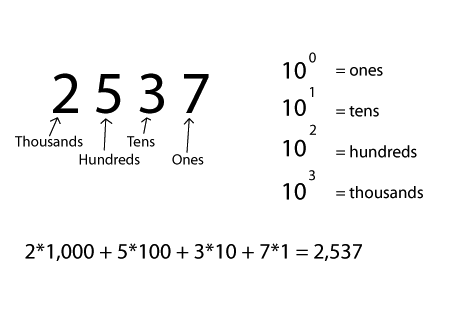
Base 10 Number System

a

Fractions

A fraction is a part of a whole.

· the bottom number (the denominator) says how many parts the whole is divided into

· the
top number (the numerator) says how many you have.

Converting decimals to fractions

To convert a decimal to a fraction you have to mutilply the decimal times a factor of 10. You can the carry out the procedure to find the decimal.

Divisible Numbers

In order to know what a number is divisible by you have to know if its prime or composite. A prime number is one that has no oother factors other than 1 and itself. A composite numbers can have alot of factors and there are different strategies for finding that out.

Adding and Subtracting Negative

There are different ways to add negative and postive numbers. In class we used red chips to represent odd numbers and yellow chips to represent positive numbers.

Foil Method

r

the Foil method, is an acronym for remebering the procedure in which we are supposed to multiply numbers in parenthesis.

NWIRR

r

The real number system categorizes different types of integers into different categories.

Greatest Common Factor and Least Common Multiple

r

Using the real number system graphic we can find out what numbers belong in which category. This graphic gives examples of the different numbers, such as square roots, negative and positive integers, repeating decimals, etc.

Vertical Lines Function Test

r

A vertical line function test is used to figure out if a line is a function or not. The way to find this out is to draw a vertical line on a graph, if the line touches 2 or more points on the cooridated line then it is not a function.

Number Sequence and Patterns

r

A sequence is like a rule that repeats itself over again. Some numbers have sequences, and there are different types of patterns that numbers can have.