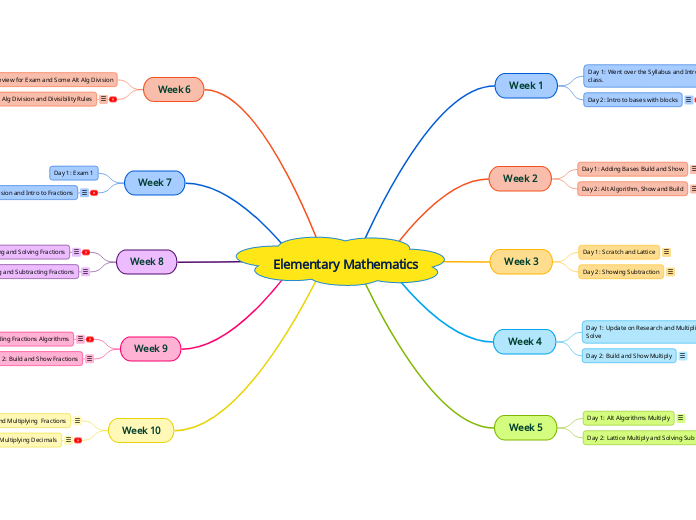
Day 1: Went over the Syllabus and Introduced Ourselves to the class.
Day 2: Intro to bases with blocks
With the Introduction of bases and base 10 blocks, you use the blocks (Singles being the units, Longs being the 10s and Flats that make up hundreds. Helps students with recognizing numbers and adding to ten, twenty or any number with different bases other than 10.
aDay 1: Adding Bases Build and Show
In this section, we focused on learning how to change or transfer bases into different bases or numbers using the units, longs and flats. For Example A Base of 8: Flats: 8 x 8 = 64Long: 1(8) = 8Unit: 1 = 1 Lets say that you have a problem 1a) Convert 64eight Use 6 Longs and 4 Units Since we are using base 8 the value is not 10 it is 8 6 Longs (6x8(The base is 8)) + 4 Units which equals 52
aDay 2: Alt Algorithm, Show and Build
There are many different approaches to this: Traditional or Alternative Algorithms To Create an Algorithm it needs to be efficient, has to be expandable and must be based in mathematical concepts Addition Algorithms: Expanded Form: Ex. 35+28 > 30+5+20+8 = 63Left to Right: Very similar to the common expanded form but instead you are adding to each place value. Scratch: You add the numbers from right to left vertically. You start from the top number on the ones side and add till you reach the given base. Once the given base is "filled" you circle the number you left off on, write the remainder and keep adding to that given remainder. when the ones are done, you take your circles and apply them to the tens spot (2 circles = 2) then repeat from the ones. Friendly Numbers: Using numbers that are multiplies of 10 or just by breaking the problem down by using numbers with 0 Trading Off: Taking numbers from one value and adding it to the other so it can create a value that ends with a zero. Lattice: Creating a rectangular shape below the problem and making squares for each place. You add the numbers vertically at first and then you add the remainder diagonally.
Day 1: Scratch and Lattice
On this day we did a scratch and lattice review, At first we started going over using scratch with numbers with regular bases like ten or bases that have been put lower then 10 (9,8,7,6........) More on this section we started to use scratch with number that had 3 or 4 digits and numbers with 5 values (24+60+30+22+11)Towards the end of the assignment, we used scratch, trade off and friendly numbers to complete various problems that involved addition.
Day 2: Showing Subtraction
For day 2 of week 3, we focused on learning how to subtract using alt algorithms and showing how to solve and use these alternate algorithms. We did standard subtraction with the base ten blocks EX. 1) 35-123longs and 5units - 1long and 2units = 2longs and 3units 2(10)+3(1)=23 We also used two other forms Expanded Form: 189-145 (100+80+9)-(100+40+5)=44 Equal Addends: adding the same amount to the top # and bottom # to make one of the numbers with a zero (20) and then subtract.
Day 1: Update on Research and Multiplication Build, Show, Solve
In class, we talked about why it is important to teach the fundamentals of multiplication at a young age. We go over the models of multiplication: Groups Arrays Area We need to encourage teaching students the rounds tables (like the 1's through the 9's)The difference between certain multiplication like tables and chairs like there is a difference between 10 tables and 30 chairs or 30 chairs and 10 tablesThe finger trick works but it also develops some certain grey areas for student as they learn more about multiples and doing the math quickly in their head.
Day 2: Build and Show Multiply
We learned about multiplying and how at the early stages of math when multiplying you use groups of that number Ex. 5(4) would be 5 groups of 5 (5+5+5+5+5) We actually used the base ten blocks to form a diagram to help the kids multiply numbers.Ex. 15(16)you apply the longs and units for the top number and the long and units for the bottom number and multiply the values for each box. Once they are multiplies you simply add from left to right. Instead of using the blocks you can also draw out the diagram Area Model: Using a box for each value and multiplying the numbers adjacent to them.
Day 1: Alt Algorithms Multiply
Expanded Form: expand for place values and then multiply up then across Similar to the way that you would use expanded form for addition but instead of adding you are multiplying Left to Right: multiply starting with the left side similar to expanded up and across then add Lattice: draw the lattice box with diagonal cuts and write one # on the top and the second number on the right then multiply across working right to left. Once you do get your multiplication values inside of the boxes, you add accordingly to get your final value.
Day 2: Lattice Multiply and Solving Sub Alt Ag
Day 1: Agenda Review for Exam and Some Alt Alg Division
Day 2: Alt Alg Division and Divisibility Rules
n they keep subtracting and repeating In this section, we talked about using three kinds of algorithms (Traditional, Repeated Subtraction and Upwards Division)In Traditional Division, also known as long division, is something that they had initially thought to us in grade school but we had found that there were two issues with long division. Students usually lose track or do not know how to set up long division or they just forgot or never learnedIn Repeated Subtraction you start by applying factors to the students lesson plan to ensure they can ease into this algorithm. What they do is they set it up like long division but they use factors instead and then they keep subtracting and repeating. In Upwards Division, we usually write the equation like we say it (numerator divided by nominator). you subtract the bottom from the first number of the top. Figure out how many times the denominator can go into the numerator write in answer spot. Then multiply it to subtract from the first digit then divide again for the next digit. Remainder is the numerator and the denominator stays the same.
aDay 1: Exam 1
Day 2: Wrap Up Division and Intro to Fractions
After wrapping up some division after the exam, we started to work into fractions: With fractions we used materials like pie's , squares, circles etc. We learned that with these props and using them for teaching, it is important to add coloration or slight differences in your pieces so the students can see differently from the other. Pie charts are okay to use, not recommended for student to write or draw out because as pies get bigger or smaller, it makes it harder to manipulate or show accurately. There are three types of Fractions Length Model is when you compare length and size For Example, Whale one is 3/4 larger than Whale two Garage One is 1/2 Bigger than garage two The Orange Pencil is 3/4 Smaller than the Green Pencil In the Set Model, you mainly give focus towards the color and shapes of the items. 1/2 of The Fish is Yellow 1/5 is Red 2/3 pieces are Orange In the Area Model, you compare the areas of items or fractions Brown is 1/5 of Black Green is 1/2 of Yellow
aDay 1: Watched Videos On Comparing and Solving Fractions
Fractions Numerator tells us the amount of shapes Denominator tells us smaller the #, the bigger the shape. How many pieces the shape is cut into. Anchor Fractions like 1/2 are great to be a base to help out which is greater/less than.5/11 and 7/15 both are almost half; 5 is 6 away from 11 and 7 is 8 away from 15. The 8 pieces missing are smaller than the 6 pieces missing; SO you have more left from 7/15 than 5/11. Figure out which is less away from 1/2 as the anchor fraction too.
aDay 2: Adding and Subtracting Fractions
When Adding or Subtracting a Whole Number with a fraction, you simply add the whole number to the fraction for example, 8 + 10 3/4 = 18 and 3/4 10 and 3/4 - 8 = 2 and 3/4 When you are taking away a fraction from a whole number, you have to add a whole fraction to the whole number for example, 10 - 15/34 -------> 10 and 34/34 - 15/34 = 9 and 19/24 Common Denominators can be added immediately Subtracting mixed number by mixed number: you subtract whole numbers first then multiply to get same denominator, then subtract.Adding mixed numbers with mixed numbers: you add whole numbers together then work on finding the same denominator; then add.
Day 1: Multiplying and Dividing Fractions Algorithms
Multiplying fraction by fraction: work with numerator to denominator to find factors for Funky 1 to simplify, then multiply across.For Example 24/35 x 21/40 -----------> Factors of 24 and 35 (3 and 8) ( 5 and 7) Factors for 21 and 40 (3 and 7)(8 and 5) Your Funks ones are 3/5 and 3/5 which is 3 x 3 and 5 x 5 = 9/25 Mixed number multiplied by mixed number: Do the backwards "C" to multiply denominator by whole number then add to numerator. Then funky 1.Dividing fraction by fraction: use KEEP, CHANGE, FLIP (multiply by the reciprocal), then funky 1.10/9 Divided by 16/21 After Keep Flip Change -----------------------------> 10/9 x 21/16
aDay 2: Build and Show Fractions
Build: Add: You have to convert or place on top of original fraction, pieces of all the same color(fraction) to be able to add the fractions together. Sub: You have to convert or place on top of original fraction, pieces of all the same color(fraction) to be able to take away the fractions. Multiply: Circle all of the groups and with fractions that you will need to add a second circle to show the fraction of the circled area. Show: Add: Use 3 boxes to solve Sub: Use 2 boxes to solve (circle the take away fraction) Multiply: Use 1 box to solve and draw both fractions on it. The double shaded area is the answer.
Day 1: Showing Adding, Subtracting and Multiplying Fractions
When adding or subtracting Fractions you make boxes and take away or add. For Example 1/2 + 1/3 First you make one big square and make one line down the middle in the color pink to indicate that the squares current fraction state is one half Secondly you Put three line through the box evenly and horizontality You then color one third of each side each half should be one third filled Lastly you add the shaded boxes from the two squares and you have your numerator, all squares added is the denominatorWhen Subtracting you follow the same steps, but instead of adding the shades you take away. (Circle What you take away) Multiplying: Ex. (1/5)(2/3)first make three rows of five (3x5) 1/5th of the squares should be shaded one color going horizontally 2/3rds of the squares should be shaded another. going vertically you then add the squares that have to colors in it and that is your numerator and your denominator is 15
Day 2: Showing Adding, Subtracting and Multiplying Decimals
Intro to Decimals is important, you need to insure that students do understand that fractions and decimals have similarities but even more importantly they need to be able to translate fractions into decimals and decimals into fractions. For instance 1/5 = 0.200.50 = 1/2 When Adding Decimals in the Tens and Hundreds you could essentially result back to using longs and flats Ex. If you have 10 Longs and We Knew that there were 10 Units per long we know that we would have 100 Units If I said that 7 Longs Were Yellow and 3 Longs Were Blue, I could say 7/10 Longs were Yellow and 3/10 Longs Were Blue. Or I could say 0.70 of the longs are yellow and 0.30 of the longs are green.
a