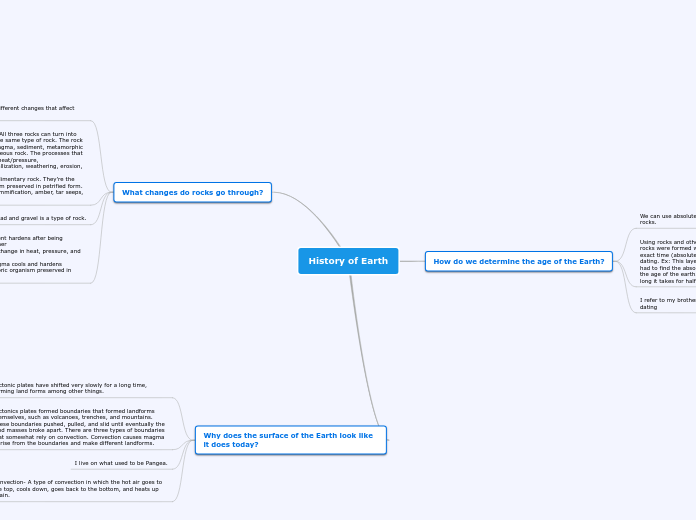
We can use absolute and relative dating and look at layers of rocks.
Using rocks and other minerals, we can see which layers of rocks were formed when. However, it’s usually hard to get the exact time (absolute dating), so we have to use relative dating. Ex: This layer of rock is older than the other one. We had to find the absolute dating of extremely old rocks to find the age of the earth. We did this by finding it’s half life, or how long it takes for half of a material to disintegrate.
I refer to my brother as my older brother which is relative dating
Rocks go through about three different changes that affect what they turn into.
There are three types of rocks. All three rocks can turn into the other rocks, or remain as the same type of rock. The rock cycle is endless and involves magma, sediment, metamorphic rock, sedimentary rock, and igneous rock. The processes that break these apart are melting, heat/pressure, compaction/cementation, crystallization, weathering, erosion, and deposition.
Fossils are mostly formed in sedimentary rock. They’re the remains of a prehistoric organism preserved in petrified form. They can be preserved with mummification, amber, tar seeps, and freezing.
I live on a gravel road and gravel is a type of rock.
Sedimentary rock- when sediment hardens after being cemented or compressed together
Metamorphic rock- forms from change in heat, pressure, and chemical process
Igneous rocks- forms when magma cools and hardens
Fossil- the remains of a prehistoric organism preserved in petrified form
Tectonic plates have shifted very slowly for a long time, forming land forms among other things.
Tectonics plates formed boundaries that formed landforms themselves, such as volcanoes, trenches, and mountains. These boundaries pushed, pulled, and slid until eventually the land masses broke apart. There are three types of boundaries that somewhat rely on convection. Convection causes magma to rise from the boundaries and make different landforms.
I live on what used to be Pangea.
Convection- A type of convection in which the hot air goes to the top, cools down, goes back to the bottom, and heats up again.