Skeletal System
The skeletal system supports and protects the body’s internal organs. The skeleton provides the framework and shape to our bodies. It also connects to our major muscles to allow movement.
It is made up of:
Bones
Joints
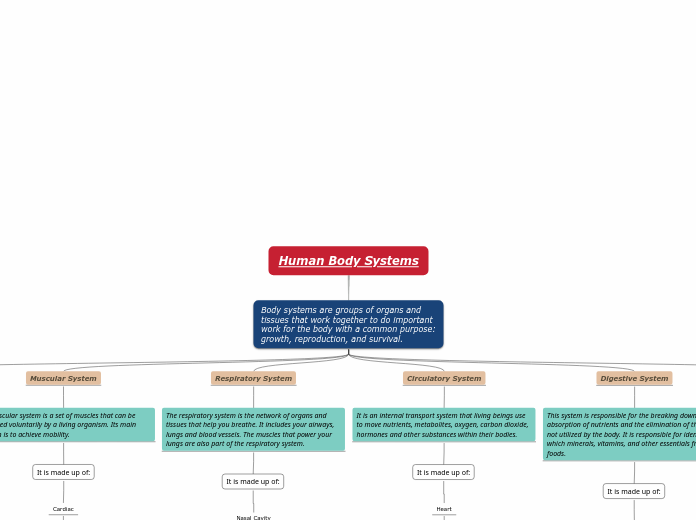
Muscular System
The muscular system is a set of muscles that can be controlled voluntarily by a living organism. Its main function is to achieve mobility.
It is made up of:
Cardiac
Smooth
Skeletal Muscles
Respiratory System
The respiratory system is the network of organs and tissues that help you breathe. It includes your airways, lungs and blood vessels. The muscles that power your lungs are also part of the respiratory system.
It is made up of:
Nasal Cavity
Pharynx, Larynx
Trachea
Bronchus
Lung
Circulatory System
It is an internal transport system that living beings use to move nutrients, metabolites, oxygen, carbon dioxide, hormones and other substances within their bodies.
It is made up of:
Heart
Blood
Vessels
Digestive System
This system is responsible for the breaking down and absorption of nutrients and the elimination of the waste not utilized by the body. It is responsible for identifying which minerals, vitamins, and other essentials from the foods.
It is made up of:
Oral Cavity
Esophagus
Liver
Stomach
Small Intestine
Large Intestine
Rectum, Anus
Nervous System
The nervous system is the part of the body that coordinates its behavior and transmits signals between different body areas.
It is made up of:
Brain
Spinal Cord
Nerves