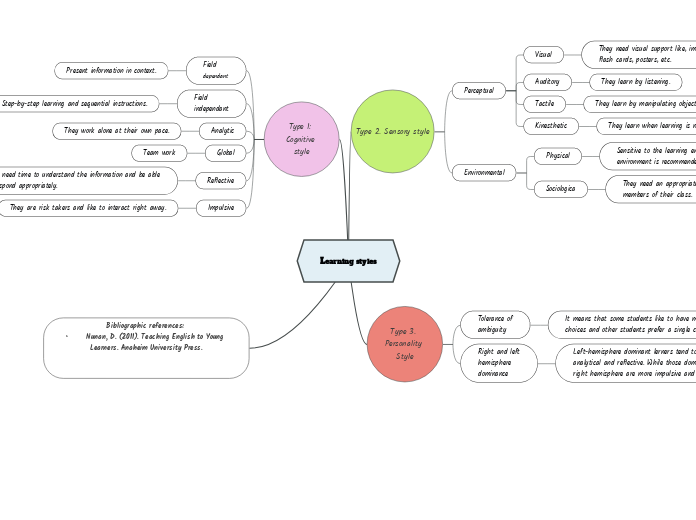
Perceptual
Visual
They need visual support like, images
flash cards, posters, etc.
Auditory
They learn by listening.
Tactile
They learn by manipulating objects.
Kinesthetic
They learn when learning is movement based.
Environmental
Physical
Sensitive to the learning environment, a suitable environment is recommended.
Sociologica
They need an appropriate environment to interact with members of their class.
Tolerance of
ambiguity
It means that some students like to have multiple answer choices and other students prefer a single correct answer.
Right and left
hemisphere
dominance
Left-hemisphere dominant lerners tend to be more analytical and reflective. While those dominated by the right hemisphere are more impulsive and interactive.
Field
dependant
Present information in context.
Field
independant
Step-by-step learning and sequential instructions.
Analytic
They work alone at their own pace.
Global
Team work
Reflective
They need time to understand the information and be able to respond appropriately.
Impulsive
They are risk takers and like to interact right away.