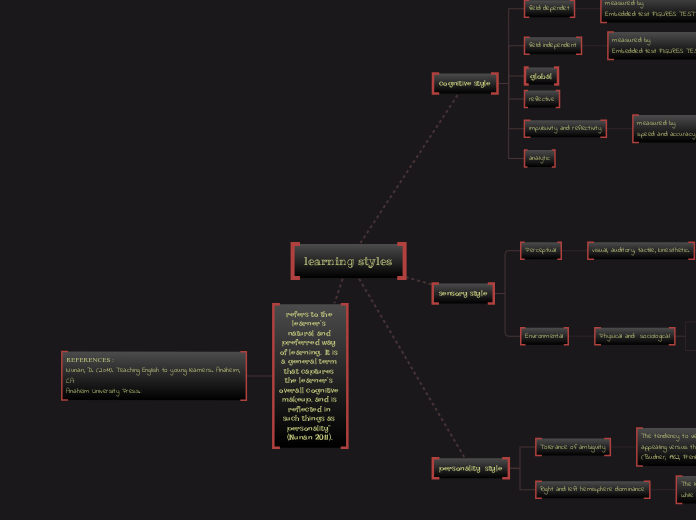
learning styles
cognitive style
field dependet
measured by Group Embedded test FIGURES TEST (GEFT)
field independent
measured by Group Embedded test FIGURES TEST (GEFT)
global
reflective
impulsivity and reflectivity
measured by speed and accuracy
analytic
sensory style
Perceptual
visual, auditory, tactile, kinesthetic.
visual
look,picture,see,imagine
auditory
sound,hear,tell,resonate
reflective
think,process,make sense, work
kinesthetic
feel,touch,connect,match
Environmental
Physical and sociological
physical
sensitive to learning environment
sociological
sensitive to relationships within the learning environment
personality style
Tolerance of ambiguity
The tendency to view ambiguous and uncertain situations as appealing versus threatening is known as ambiguity tolerance (Budner, 1962, Frenkel-Brunswik, 1949)
REFERENCE: Budner J. (1962). Tolerance of ambiguity as a personality variable. Journal of Personality, 30, 29-40.
Right and left hemisphere dominance
The left side is generally responsible for logic and language, while the right is responsible for creativity and intuition.
refers to the learner’s natural and preferred way of learning. It is a general term that captures the learner’s overall cognitive makeup, and is reflected in such things as personality” (Nunan 2011).
REFERENCES : Nunan, D. (2011). Teaching English to young learners. Anaheim, CA:
Anaheim University Press.: