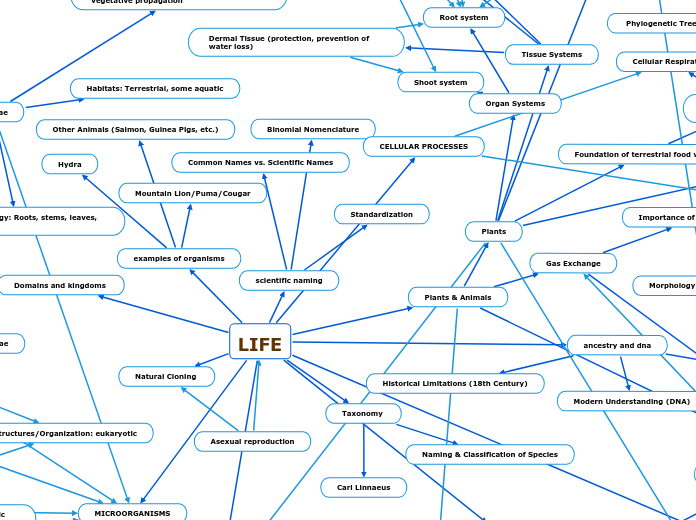
LIFE
Domains and kingdoms
Kingdoms
Protista
Feeding Strategies: heterotrophic
Structures/Organization: eukaryotic
Habitats: Freshwater, marine environments
General Morphology: Highly diverse (algae, protozoa)
Fungi
Reproductive Strategies: sexual
Habitats: Soil, decaying matter, symbiotic relationships
General Morphology: Mycelium, hyphae
Plantae
Feeding Strategies: Autotrophic (photosynthesis)
Reproductive Strategies: Seeds, spores, vegetative propagation
Structures/Organization: Multicellular, eukaryotic
Habitats: Terrestrial, some aquatic
General Morphology: Roots, stems, leaves, flowers
Animalia
Habitats: Terrestrial, aquatic, aerial
General Morphology: Diverse body plans, often with specialized organs and systems
Archae
Eubacteria
Reproductive Strategies: Binary fission, sporulation
Structures/Organization: Unicellular, prokaryotic
Habitats: Ubiquitous (soil, water, human body)
General Morphology: Cocci, bacilli, spirilla
MICROORGANISMS
examples of organisms
Hydra
Mountain Lion/Puma/Cougar
Other Animals (Salmon, Guinea Pigs, etc.)
scientific naming
Common Names vs. Scientific Names
Binomial Nomenclature
Standardization
ancestry and dna
Historical Limitations (18th Century)
Modern Understanding (DNA)
Impact on Classification
Environment
CO2 Balance
Value of trees in CO2 absorption
Taxonomy
Carl Linnaeus
Naming & Classification of Species
Natural Cloning
Biofluid Dynamics
Flow of liquids and gases in organisms
Facilitates critical processes like photosynthesis and aerobic cellular respiration
Transport in Animals
Heart Function
Pumps blood carrying gases and nutrients
Transport in Plants
Movement of water in plants, e.g., from roots to tips of tall trees like redwoods
CELLULAR PROCESSES
Plants & Animals
Gas Exchange
Importance of balance in gases
Morphology of tissues facilitating exchange
Demonstrates how form equals function
elevattion of CO2
Potential for faster plant growth, but with drawbacks
Animal Transport
Tissues Involved
Epithelial Tissue (endothelium)
Muscle Tissue (smooth muscle)
Connective Tissue
Nervous Tissue
Circulatory System
Specialized tissues and structures to circulate blood, gases, nutrients
Intimately involved in gas exchange and transport through diffusion
Artery and Vein Anatomy
Artery: thicker connective tissue, thicker smooth muscle layer
Vein: presence of a valve, thinner connective tissue, thinner smooth muscle layer
Arteriole, Venule, and Capillary Network
Plants
Plant Basics
Types of Plants
Phylogenetic Trees
Ulva: Photosynthetic ocean organisms (Algae)
Non-vascular land plants (Mosses/Bryophytes)
Seedless vascular plants (Ferns/Pteridophytes)
Monocots vs. Dicots
Characteristics and differences
Organ Systems
Shoot system
Root system
Vascular Systems
Xylem
Made up of dead cells
Vessel elements and tracheids
Phloem
Made up of living cells
Sieve tube elements and companion cells
Tissue Systems
Dermal Tissue (protection, prevention of water loss)
Ground Tissue (photosynthesis, food storage, support)
Vascular Tissue (transport of water, minerals, food)
Foundation of terrestrial food webs
Environmental impact
Cellular Respiration
Evaluating articles for bias using CRAAP
Asexual reproduction
Photosynthesis
CO2, water, and sunlight as raw materials
Environment and CO2 Balance
Production of glucose and O2
Vital for sustenance of Plants & Animals
Role of green plants in maintaining Earth's balance